AP Nethanna Bharosa is a flagship welfare scheme launched by the Government of Andhra Pradesh under the leadership of Chief Minister Nara Chandrababu Naidu to provide comprehensive financial support and social security to handloom weavers and their families across the state.
The scheme was officially announced on August 7, 2025, during the 11th National Handloom Day celebrations held at Mangalagiri in Guntur district. The name “Nethanna Bharosa” translates to “Assurance for Weavers,” reflecting the government’s commitment to standing by this traditional artisan community that has faced decades of economic hardship due to rising input costs, competition from power looms, and shrinking market demand for handloom products.
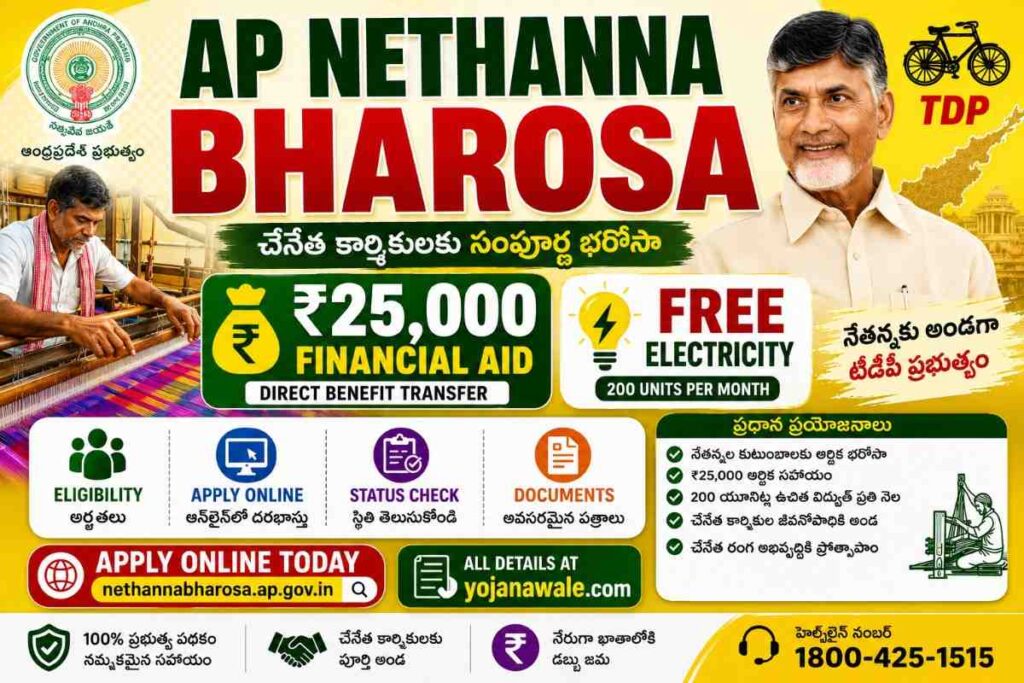
Under this scheme, every eligible handloom weaver family receives a direct financial assistance of Rs. 25,000 per year, paid in two instalments through Direct Benefit Transfer. This amount is specifically designed as working capital support to help weavers purchase raw materials like yarn and dyes, maintain their looms, and sustain their livelihood without falling into debt traps.
The scheme covers approximately 1.43 lakh handloom weaver families across Andhra Pradesh, including those in renowned weaving clusters such as Mangalagiri, Venkatagiri, Dharmavaram, Pithapuram, Uppada, and Chirala. The total annual budget allocation for this scheme stands at Rs. 245 crore, demonstrating the state’s serious financial commitment to reviving the handloom sector and preserving Andhra Pradesh’s rich textile heritage for future generations.
Quick Overview Table of AP Nethanna Bharosa Scheme
| Particulars | Details |
|---|---|
| Scheme Name | AP Nethanna Bharosa (నేతన్న భరోసా) |
| Launched By | Government of Andhra Pradesh, CM Nara Chandrababu Naidu |
| Launch Date | August 7, 2025 (11th National Handloom Day) |
| Annual Financial Aid | Rs. 25,000 per handloom weaver family |
| Payment Mode | Two instalments via Direct Benefit Transfer (DBT) |
| Total Beneficiary Families | 1.43 lakh handloom families |
| Annual Budget Allocation | Rs. 245 crore |
| Free Electricity | 200 units/month for handlooms; 500 units/month for power looms |
| GST Reimbursement | 5% on all handloom products |
| Thrift Fund | Rs. 5 crore for weaver welfare |
| Weaver Pension | Rs. 4,000 per month (enhanced under NTR Bharosa) |
| Nodal Department | Department of Handlooms & Textiles, Andhra Pradesh |
| Official Portal | handlooms.ap.gov.in |
| Previous Scheme | YSR Nethanna Nestham (Rs. 24,000/year) |
| Helpline | 08645-232466, 08645-232477 |
Main Objectives Behind Launching Nethanna Bharosa
The Andhra Pradesh government introduced Nethanna Bharosa with a multi-pronged vision that addresses both immediate economic relief and long-term sectoral revival for the handloom community.
- Provide Working Capital Support: Handloom weaving is a cash-intensive activity where weavers must purchase yarn, dyes, and other raw materials upfront before selling their finished products. The Rs. 25,000 annual aid acts as crucial working capital, preventing weavers from borrowing from moneylenders at high interest rates.
- Double Weaver Income: The scheme aims to double the income of handloom weavers by combining direct financial aid with supplementary benefits like free electricity, GST reimbursement, and yarn subsidies. This integrated approach ensures that weavers retain more of their earnings.
- Preserve Traditional Handloom Heritage: Andhra Pradesh is home to world-famous handloom varieties like Mangalagiri cotton, Venkatagiri silk, Dharmavaram pattu, and Uppada jamdani. The scheme seeks to keep these traditions alive by ensuring that the artisan families who create them can sustain their craft.
- Counter Power Loom Competition: Power looms produce cheaper textiles at mass scale, putting immense pressure on handloom weavers. By reducing input costs and providing financial stability, Nethanna Bharosa helps handloom products remain competitive.
- Improve Living Standards: Many weaver families live below the poverty line. The scheme, combined with the enhanced Rs. 4,000 monthly pension under NTR Bharosa, provides a safety net that improves nutrition, healthcare access, and children’s education.
- Promote Cluster-Based Development: The government is investing in specialized handloom clusters at Dharmavaram (Rs. 38.31 crore), Pithapuram (Rs. 12 crore), and Mangalagiri (Rs. 22.35 crore) to create economies of scale and better market access.
Who Can Apply: Eligibility Criteria in Detail
Understanding the eligibility criteria is essential for weavers to determine whether they qualify for Nethanna Bharosa benefits. The scheme has been designed to be inclusive yet targeted.
- Registered Handloom Weaver: The applicant must be a registered handloom weaver with the Andhra Pradesh Department of Handlooms & Textiles. Only those who practice traditional handloom weaving on manual looms are eligible. Power-loom operators are explicitly excluded from this scheme.
- Handloom Cooperative Society Membership: The weaver must be a member of a registered handloom cooperative society or possess a valid Weaver’s Identity Card issued by the department. This card serves as the primary proof of being an authentic handloom artisan.
- Permanent Resident of Andhra Pradesh: The applicant must be a permanent resident of Andhra Pradesh. Weavers from other states are not eligible even if they practice handloom weaving.
- Aadhaar-Linked Bank Account: The weaver must have an active bank account that is seeded with their Aadhaar number. This is mandatory because the Rs. 25,000 annual assistance is transferred directly through DBT. Without Aadhaar seeding, the payment will fail.
- Active Handloom Loom Ownership: The applicant must own and operate an active handloom. Inactive or abandoned looms do not qualify. The loom should be registered with the Handloom Association or cooperative society.
- Not a Power-Loom Operator: This is a strict exclusion. Anyone operating power looms or working in power-loom industrial units is not eligible, regardless of their economic status.
- BPL Category Preference: While not an absolute requirement, priority is given to weavers from Below Poverty Line families holding white ration cards, as they are the most vulnerable segment.
- Age No Bar: Unlike pension schemes, Nethanna Bharosa has no upper or lower age limit. Any registered handloom weaver, young or old, can apply.
PM-DAKSH Yojana: Skill Training, Registration & Job Placement 2026-27
Complete List of Documents Required for Application
Having the correct documents ready before applying saves time and prevents rejection. Here is the comprehensive checklist.
| Document Name | Purpose |
|---|---|
| Aadhaar Card | Identity verification and DBT linkage |
| Weaver’s Identity Card / Handloom Cooperative Membership Card | Proof of being a registered handloom weaver |
| Bank Passbook / Cancelled Cheque | For DBT transfer of Rs. 25,000 |
| Domicile Certificate / Residence Proof | Confirms permanent residency in Andhra Pradesh |
| Handloom Registration Certificate | Proof of loom ownership and active weaving |
| Passport Size Photographs | For application records |
| Mobile Number (Aadhaar-linked) | For OTP verification and SMS alerts |
| White Ration Card / BPL Card (if applicable) | For priority consideration |
Additional Notes on Documents:
- The Weaver’s Identity Card is the most critical document. If your card has expired, renew it at your nearest Handloom Cooperative Society office before applying.
- The name on your Aadhaar card must exactly match the name on your bank account and weaver registration records. Any mismatch will cause DBT payment failure.
- If you are a new handloom weaver and have not yet registered with the department, you must complete the registration process first. This involves submitting your loom details and getting a Weaver’s ID card.
- Tenant weavers who do not own looms but weave on shared looms can apply with a joint declaration from the loom owner and the cooperative society.
Step-by-Step Application Process
Weavers can apply for Nethanna Bharosa through both online and offline channels. Here is the detailed process for each method.
- Online Application Through Official Portal:
- Visit the official portal at handlooms.ap.gov.in.
- Navigate to the “Nethanna Bharosa” section on the homepage.
- Click on “Apply Online” or “New Registration” if you are applying for the first time.
- Enter your Weaver’s ID card number and Aadhaar number for verification.
- The system will auto-fetch your basic details if you are already registered with the department.
- Fill in additional details such as bank account information, mobile number, and loom details.
- Upload scanned copies of Aadhaar card, Weaver’s ID card, bank passbook, and photograph.
- Verify all details and submit the application.
- Note down the application reference number for future tracking.
- Offline Application Through Handloom Cooperative Society:
- Visit your nearest registered Handloom Cooperative Society office.
- Request the Nethanna Bharosa application form from the society secretary.
- Fill in all required details manually.
- Attach photocopies of all documents.
- Submit the form to the society secretary.
- The society will forward your application to the Department of Handlooms & Textiles for verification.
- Collect the acknowledgment receipt with your application number.
- Through Grama/Ward Sachivalayam:
- Some districts allow applications through the village or ward secretariat offices.
- Visit your local Sachivalayam with all documents.
- The welfare assistant will help you fill the form and upload documents digitally.
- This method is especially helpful for weavers in rural areas with limited internet access.
- Verification and Approval Process:
- After submission, the department verifies your weaver registration, Aadhaar details, and bank account linkage.
- Field verification may be conducted to confirm active loom operation.
- Approved beneficiaries are added to the official beneficiary list.
- The Rs. 25,000 amount is transferred in two instalments — typically before the Kharif and Rabi weaving seasons.
Financial Benefits Breakdown and Payment Schedule
The Rs. 25,000 annual assistance is structured to align with the weaving cycle, ensuring that weavers receive funds when they need them most for purchasing raw materials.
| Benefit Component | Amount | Payment Schedule |
|---|---|---|
| Annual Financial Assistance | Rs. 25,000 | Two instalments via DBT |
| First Instalment | Rs. 12,500 | Before Kharif weaving season (June-July) |
| Second Instalment | Rs. 12,500 | Before Rabi weaving season (October-November) |
| Free Electricity (Handlooms) | 200 units/month | Monthly waiver on electricity bill |
| Free Electricity (Power Looms) | 500 units/month | Monthly waiver on electricity bill |
| GST Reimbursement | 5% on products | Quarterly or annual reimbursement |
| Thrift Fund Contribution | Rs. 5 crore corpus | Managed by cooperative societies |
| Weaver Pension (NTR Bharosa) | Rs. 4,000/month | Monthly DBT to eligible weavers above 50 |
How the Money Helps Weavers:
- A typical handloom weaver spends Rs. 8,000 to Rs. 15,000 per season on yarn alone. The Rs. 25,000 annual aid covers nearly two seasons of raw material costs.
- Free electricity saves approximately Rs. 8,640 per year for handloom families and up to Rs. 21,600 for power-loom units, significantly reducing operational costs.
- The 5% GST reimbursement means that if a weaver sells products worth Rs. 1 lakh in a year, they get Rs. 5,000 back, improving their profit margin.
- The combined annual benefit (cash aid + electricity savings + GST refund) can exceed Rs. 40,000 for an active weaver family, making a substantial difference in their household income.
Free Electricity Scheme for Weavers: Details and Implementation
One of the most impactful components of the Nethanna Bharosa package is the free electricity scheme, which was rolled out from April 1, 2026, fulfilling a key pre-election promise of the NDA coalition government.
- Handloom Weavers: Eligible handloom weaver families receive up to 200 units of free electricity per month. This covers the basic lighting, fan, and small motor needs of a typical weaver household. The annual saving per family is estimated at Rs. 8,640.
- Power-Loom Operators: Power-loom units, which consume significantly more electricity due to motorized operations, are eligible for up to 500 units of free electricity per month. This translates to annual savings of approximately Rs. 21,600 per unit.
- Total Beneficiaries: The scheme covers approximately 1,04,488 weaver families, including nearly 93,000 handloom households and 11,488 power-loom units across Andhra Pradesh.
- Annual Cost to Exchequer: The free electricity initiative is expected to cost the state government around Rs. 150 crore annually.
- Implementation Mechanism: The electricity department identifies registered weaver households and applies the waiver directly to their monthly bills. Weavers do not need to apply separately if they are already registered with the Handlooms Department and have linked their electricity connection to their weaver ID.
- Impact on Weaver Livelihoods: Electricity is essential not just for lighting but also for pre-loom processes like dyeing, warping, and sizing. By removing this cost burden, the government enables weavers to reinvest savings into better raw materials and loom upgrades.
GST Reimbursement and Yarn Subsidy Benefits
Beyond direct cash transfers and free power, Nethanna Bharosa includes several indirect financial benefits that improve the overall economics of handloom weaving.
- 5% GST Reimbursement: Handloom products sold by registered weavers attract 5% GST. Under Nethanna Bharosa, the government reimburses this 5% GST amount back to the weavers. This effectively makes handloom products zero-GST for the weaver, improving their competitiveness against power-loom and mill-made textiles.
- Yarn Subsidy: The government provides up to 15% subsidy on yarn purchases through APCO (Andhra Pradesh Handloom Weavers’ Cooperative Society). This reduces the cost of the single largest input in handloom production.
- Modern Equipment Subsidy: Weavers can avail up to 90% subsidy on purchasing modern equipment like Jacquard lifting machines, double Jacquard systems, and other loom attachments that improve productivity and design complexity.
- Thrift Fund: A dedicated thrift fund of Rs. 5 crore has been allocated for weaver welfare. This fund provides emergency loans, marriage assistance, education support for weavers’ children, and funeral expenses.
- Cluster Development Investment: The government has sanctioned Rs. 10.44 crore for small handloom clusters and major investments for mega clusters at Dharmavaram (Rs. 38.31 crore), Pithapuram (Rs. 12 crore), and Mangalagiri (Rs. 22.35 crore). These clusters provide shared infrastructure, design centers, and common facility workshops.
- Marketing Support: The government organizes exhibitions and has tied up with e-commerce platforms like Amazon and Flipkart to enable direct sales from weavers to consumers, eliminating middlemen and ensuring better prices.
Weaver Pension Enhancement Under NTR Bharosa
While Nethanna Bharosa focuses on working capital, the government has simultaneously enhanced the weaver pension scheme under the broader NTR Bharosa umbrella, creating a comprehensive social security net.
- Monthly Pension Amount: The weaver pension has been increased to Rs. 4,000 per month under NTR Bharosa. This is a significant enhancement from previous amounts and provides a dignified living for elderly weavers who can no longer work actively.
- Eligibility for Pension: Weavers aged 50 years and above who belong to Below Poverty Line families and hold white ration cards are eligible. They must be registered with the Handlooms Department.
- Total Pension Budget: The NTR Bharosa pension scheme has been allocated Rs. 27,719 crore in the 2026-27 state budget, covering elderly, widows, disabled, and weavers across Andhra Pradesh.
- Exclusion Criteria: The following categories are excluded from the pension scheme:
- Government employees and pensioners
- Income taxpayers
- Landowners with more than 2.5 acres of wet land or 5 acres of dry land
- Owners of cars
- Freedom fighter pension holders
- Application Process: Weaver pension applications are processed through the Village/Ward Secretariat system. The MPDO sanctions pensions in rural areas, while the Municipal Commissioner sanctions them in urban areas.
- Combined Impact: A weaver family receiving both Nethanna Bharosa (Rs. 25,000/year) and NTR Bharosa pension (Rs. 48,000/year) gets a total annual support of Rs. 73,000, which is a life-changing amount for families living on the margins.
Key Features That Make Nethanna Bharosa Unique
Nethanna Bharosa stands out among weaver welfare schemes in India due to its holistic and integrated approach.
- Highest Direct Cash Transfer: At Rs. 25,000 per year, this is one of the highest direct financial assistance amounts for handloom weavers by any state government in India. The previous YSR Nethanna Nestham provided Rs. 24,000, and the current scheme has increased it by Rs. 1,000.
- Multi-Component Benefit Package: Unlike schemes that offer only cash or only subsidies, Nethanna Bharosa combines cash aid, free electricity, GST reimbursement, yarn subsidy, equipment subsidy, and pension support into one comprehensive package.
- DBT-Only Disbursement: The entire Rs. 25,000 is transferred directly to the weaver’s bank account, eliminating middlemen, corruption, and delays. There is no physical cash handling.
- Season-Aligned Payments: The two-instalment system aligns with the Kharif and Rabi weaving cycles, ensuring that weavers have money when they need to buy raw materials.
- Digital Integration: The scheme is managed through the handlooms.ap.gov.in portal with real-time tracking, SMS alerts, and digital verification, making it one of the most transparent welfare schemes in the state.
- Cluster-Based Approach: By investing in specialized clusters, the government is not just giving fish but teaching fishing — building infrastructure that creates sustainable livelihoods.
- E-Commerce Linkages: The tie-up with Amazon and Flipkart is a forward-looking feature that connects traditional artisans directly with modern consumers across India and the world.
Common Mistakes to Avoid While Applying
Many weavers face delays or rejections due to simple errors. Avoiding these mistakes ensures faster approval and timely payment.
- Not Having a Valid Weaver’s ID Card: This is the most common reason for rejection. Ensure your Weaver’s Identity Card is current and not expired. Renew it at your cooperative society if needed.
- Aadhaar-Bank Account Mismatch: If the name on your Aadhaar card does not exactly match your bank account name, the DBT payment will bounce back. Visit your bank to correct any discrepancies.
- Applying as a Power-Loom Operator: Power-loom operators are explicitly excluded. Do not attempt to apply under this scheme if you operate motorized looms. There is a separate free electricity scheme for power looms, but not the Rs. 25,000 cash aid.
- Inactive Loom Registration: If your loom has been inactive for a long time, the field verification team may reject your application. Ensure your loom is operational at the time of verification.
- Missing the Registration Window: The government announces specific enrollment periods. Missing these windows means waiting for the next cycle. Stay in touch with your cooperative society for deadlines.
- Not Linking Mobile Number: Your mobile number must be linked to Aadhaar and updated in the department records. Without this, you will not receive OTPs or payment confirmation SMS.
- Using Unofficial Agents: Never pay money to middlemen or agents who promise to “fast-track” your application. The application process is completely free. Apply only through official channels.
- Ignoring Annual Renewal: Some benefits require annual renewal or re-verification. Keep track of renewal dates to avoid benefit suspension.
Comparison with Previous YSR Nethanna Nestham Scheme
Understanding how Nethanna Bharosa differs from the previous government’s scheme helps weavers appreciate the enhancements.
| Feature | Nethanna Bharosa (Current) | YSR Nethanna Nestham (Previous) |
|---|---|---|
| Annual Cash Aid | Rs. 25,000 | Rs. 24,000 |
| Free Electricity | 200 units/month (handlooms), 500 units (power looms) | Not provided |
| GST Reimbursement | 5% on handloom products | Not provided |
| Weaver Pension | Rs. 4,000/month under NTR Bharosa | Rs. 2,250/month under YSR Pension Kanuka |
| Equipment Subsidy | Up to 90% | Limited subsidy |
| Yarn Subsidy | 15% through APCO | Limited availability |
| Thrift Fund | Rs. 5 crore corpus | Smaller fund |
| E-Commerce Tie-ups | Amazon, Flipkart | Not available |
| Cluster Investment | Rs. 38.31 crore (Dharmavaram), Rs. 22.35 crore (Mangalagiri) | Limited investment |
| Budget Allocation | Rs. 245 crore | Lower allocation |
Key Improvements:
- The Rs. 1,000 increase in annual aid, while modest, is accompanied by massive new benefits like free electricity and GST reimbursement that were absent before.
- The pension amount has nearly doubled from Rs. 2,250 to Rs. 4,000 per month.
- The e-commerce and cluster development components represent a shift from welfare to empowerment, helping weavers become self-reliant entrepreneurs.
Impact and Success Stories of the Scheme
Since its launch in August 2025 and implementation from 2026, Nethanna Bharosa has already begun transforming the lives of weaver families across Andhra Pradesh.
- Direct Financial Reach: With 1.43 lakh families covered and Rs. 245 crore allocated annually, the scheme is putting approximately Rs. 357.5 crore directly into weaver households every year when combined with free electricity savings and GST reimbursements.
- Electricity Relief: From April 1, 2026, over 1,04,488 weaver families started receiving free electricity, saving a combined Rs. 150 crore annually in power bills. This is one of the largest electricity subsidy programs for artisans in India.
- Revival of Dying Clusters: Clusters like Dharmavaram, which were facing closure due to weaver migration, are seeing renewed interest. The Rs. 38.31 crore mega cluster investment is creating shared dyeing facilities, design studios, and common work sheds.
- Digital Recognition: The APCO (Andhra Pradesh Handloom Weavers’ Cooperative Society) received a national SKOCH award for digital reforms, recognizing the state’s efforts in modernizing handloom governance.
- Youth Engagement: By making handloom weaving economically viable, the scheme is attracting younger generations back to the family craft. Several weaver families report that their children, who had moved to cities for menial jobs, are returning to take up weaving.
- Women Empowerment: A significant percentage of handloom weavers in Andhra Pradesh are women. The direct cash transfer to their bank accounts enhances their financial independence and decision-making power within households.
- Health Protection: The government is also introducing a universal health policy specifically for handloom weavers, adding another layer of social security beyond financial aid.
Important Links, PDF Notifications, and Official Resources
| Resource | Link / Contact |
|---|---|
| Official AP Handlooms Portal | handlooms.ap.gov.in |
| Nethanna Bharosa Online Application | handlooms.ap.gov.in → Nethanna Bharosa Section |
| APCO Handloom Weavers Cooperative Society | Errabalem, Mangalagiri, Amaravathi, AP |
| Department of Handlooms & Textiles Helpline | 08645-232466, 08645-232477 |
| Department Email | handlooms_textiles@yahoo.com |
| YSR Nethanna Nestham (Previous Scheme) Portal | gsws.ap.gov.in |
| NTR Bharosa Pension Scheme | Available through Village/Ward Secretariat |
| AP Budget 2026-27 Highlights | prsindia.org/budgets/states/andhra-pradesh-budget-analysis-2026-27 |
| Free Electricity for Weavers Notification | deccanchronicle.com |
| National Handloom Day Announcement | youtube.com/ETVAndhraPradesh |
How to Use These Resources:
- Visit handlooms.ap.gov.in for the official application form, beneficiary lists, and scheme guidelines. This is the only authorized portal — never pay anyone to apply on your behalf.
- Call the department helpline numbers 08645-232466 or 08645-232477 for queries about registration, document requirements, or payment status.
- For pension-related queries under NTR Bharosa, visit your nearest Village or Ward Secretariat office with your Weaver’s ID and Aadhaar card.
- Download official notifications and circulars from the AP Handlooms portal to stay updated on enrollment deadlines, instalment release dates, and scheme modifications.
- Follow the official ETV Andhra Pradesh YouTube channel for video updates on scheme launches and CM announcements regarding weaver welfare.
Frequently Asked Questions
Q1. How much money does a handloom weaver family get under Nethanna Bharosa?
Each eligible handloom weaver family receives Rs. 25,000 per year, paid in two instalments of Rs. 12,500 each through Direct Benefit Transfer to their Aadhaar-linked bank account.
Q2. When was the Nethanna Bharosa scheme launched?
The scheme was announced by Chief Minister Nara Chandrababu Naidu on August 7, 2025, during the 11th National Handloom Day celebrations at Mangalagiri, Guntur district.
Q3. Are power-loom operators eligible for the Rs. 25,000 cash aid?
No, power-loom operators are explicitly excluded from the Rs. 25,000 Nethanna Bharosa cash assistance. However, they are eligible for up to 500 units of free electricity per month under a separate component of the weaver welfare package.
Q4. How can I apply for Nethanna Bharosa online?
Visit the official portal at handlooms.ap.gov.in, navigate to the Nethanna Bharosa section, enter your Weaver’s ID and Aadhaar details, fill in your bank information, upload required documents, and submit. You can also apply offline at your nearest Handloom Cooperative Society.
Q5. What documents are mandatory for the application?
You need your Aadhaar card, Weaver’s Identity Card or cooperative membership card, bank passbook, domicile certificate, handloom registration certificate, passport photographs, and an Aadhaar-linked mobile number.
Q6. How does the free electricity scheme work for weavers?
Registered weaver households get up to 200 units (handlooms) or 500 units (power looms) of free electricity per month. The waiver is applied directly to your electricity bill by the power department. No separate application is needed if you are registered with the Handlooms Department.
Q7. What is the GST reimbursement benefit?
The government reimburses 5% GST paid on handloom products sold by registered weavers. This effectively makes handloom products zero-GST for the weaver, improving profit margins.
Q8. Can a weaver receive both Nethanna Bharosa and NTR Bharosa pension?
Yes, a weaver can receive both benefits simultaneously. Nethanna Bharosa provides Rs. 25,000/year as working capital, while NTR Bharosa provides Rs. 4,000/month as pension for weavers aged 50 and above, totaling over Rs. 73,000 in annual support.
Q9. What is the budget allocation for Nethanna Bharosa in 2026-27?
The Andhra Pradesh government has allocated Rs. 245 crore in the 2026-27 state budget for the Nethanna Bharosa scheme, covering 1.43 lakh handloom weaver families.
Q10. How can I check my payment status after applying?
You can track your application and payment status by visiting handlooms.ap.gov.in and using your Aadhaar number or Weaver’s ID. You will also receive SMS alerts on your registered mobile number when each instalment is credited.