PM-DAKSH Yojana stands for Pradhan Mantri Dakshta Aur Kushalta Sampann Hitgrahi Yojana. It is a Central Sector Scheme launched during the year 2020-21 by the Ministry of Social Justice and Empowerment, Government of India. The core purpose of this scheme is to provide high-quality skill training to marginalized communities so that they can find stable employment or start their own businesses. The scheme operates under a 100% grant-in-aid model, which means the entire cost of training is borne by the government and trainees do not have to pay any fee. This initiative plays a vital role in bridging the skill gap among disadvantaged sections and promoting inclusive economic growth across the country.
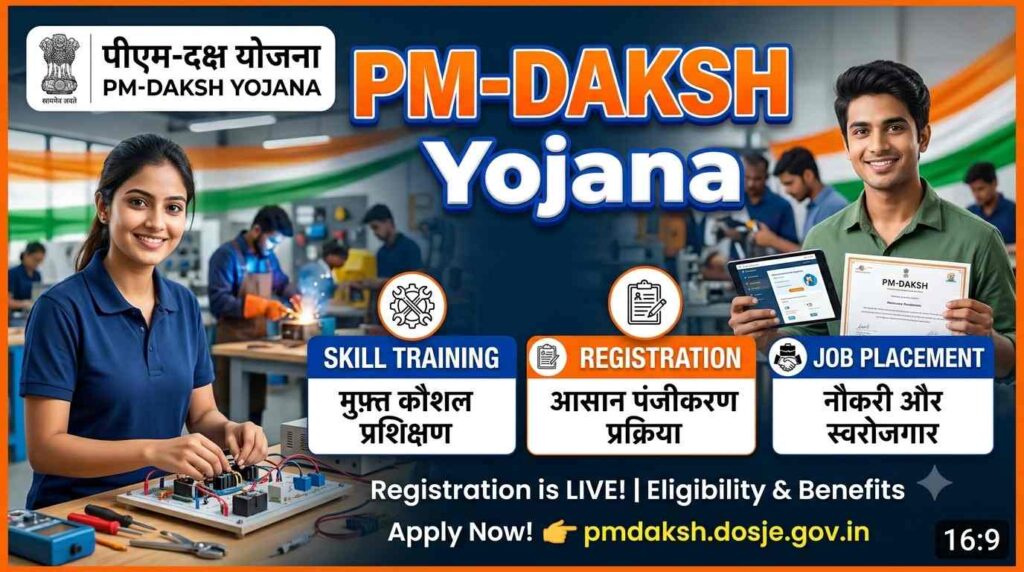
The scheme targets communities that have historically faced barriers in accessing education and employment opportunities. By offering free training, stipends during the training period, and placement support after course completion, PM-DAKSH ensures that beneficiaries are not only skilled but also financially supported throughout their learning journey. The courses are designed according to the National Skill Qualification Framework (NSQF), which guarantees that the training meets national standards and is recognized by employers across industries. The government has also made it mandatory for training institutes to ensure employment-linked outcomes for at least 70% of trained candidates, making this one of the most outcome-focused skill development programs in India.
Overview of PM-DAKSH Yojana
Below is a quick summary table that covers all the essential details about the scheme at a glance:
| Feature | Details |
|---|---|
| Full Name | Pradhan Mantri Dakshta Aur Kushalta Sampann Hitgrahi Yojana |
| Launch Year | 2020-21 |
| Ministry | Ministry of Social Justice and Empowerment, Government of India |
| Scheme Type | Central Sector Scheme |
| Total Budget | ₹450.25 Crore |
| Target Beneficiaries | 2.71 Lakh individuals over five years |
| Training Cost | 100% Free for Trainees |
| Age Limit | 18 to 45 Years |
| Income Criteria | No limit for SC, DNT, Safai Karamcharis; Below ₹3 Lakh for OBC/EWS |
| Stipend Provided | Yes, ranging from ₹500 to ₹1,500 per month |
| Training Duration | 1 Month to 1 Year depending on course type |
| Certification | NSQF Compliant Certificate |
| Placement Support | Mandatory 70% Placement Target for Institutes |
| Official Portal | pmdaksh.dosje.gov.in |
| App Available | PM-DAKSH Mobile App (Android) |
| Key Corporations | NSFDC, NBCFDC, NSKFDC |
This overview gives you a clear picture of what the scheme offers. It is designed as a comprehensive ecosystem where a candidate can register online, choose a suitable training program, receive free education with a monthly stipend, get certified, and finally receive placement or self-employment support. The scheme is especially beneficial for those who belong to Scheduled Castes, Other Backward Classes, Economically Weaker Sections, De-notified Tribes, and Safai Karamcharis including waste pickers. The government has integrated the portal with PFMS (Public Financial Management System) to ensure transparent stipend disbursement through Direct Benefit Transfer (DBT), which eliminates middlemen and ensures the money reaches the trainee directly.
Who Can Apply for PM-DAKSH Yojana
Eligibility is one of the most important parts of any government scheme. For PM-DAKSH Yojana, the government has clearly defined who can benefit from this program. Understanding these criteria will help you check whether you or someone in your family can apply.
- Scheduled Castes (SCs): Any person belonging to the SC category with a valid caste certificate issued by the competent state government authority can apply. There is no income limit for SC candidates.
- Other Backward Classes (OBCs): OBC candidates can apply only if their annual family income is below ₹3 Lakh. They must submit a valid OBC certificate and an income certificate from the appropriate state authority.
- Economically Weaker Sections (EWS): EWS candidates must also have an annual family income below ₹3 Lakh. A valid EWS certificate is required.
- De-notified, Nomadic and Semi-Nomadic Tribes (DNTs): DNT candidates can apply without any income limit. They need to provide relevant community proof.
- Safai Karamcharis including Waste Pickers: Sanitation workers and their dependents are eligible without any income limit. They are covered under NSKFDC.
- Age Requirement: All applicants must be between 18 and 45 years of age as on the date of application.
- Nationality: Only Indian citizens can apply for this scheme.
- Persons with Disabilities (Divyangjan): Recent expansions of the scheme now include skill training programs specifically designed for persons with disabilities at Composite Regional Centres.
It is important to note that income certificates for OBC and EWS candidates must be issued by proper government authorities. Self-certified income declarations are acceptable only if they are duly endorsed by a Gazetted Officer. Endorsements by public representatives like Gram Pradhan, Sarpanch, Councilor, or Notaries are not acceptable. Valid BPL cards or Antyodaya Anna Yojana (AAY) cards can also serve as proof of income for candidates falling within ₹1 Lakh annual family income.
Types of Skill Training Programs Available
PM-DAKSH Yojana offers four distinct categories of training programs. Each category is designed to meet different needs — whether you want to upgrade your existing skills, learn something new for a job, or start your own business.
- Up-skilling and Re-skilling (Recognition of Prior Learning – RPL):
- This program is meant for people who are already working in a trade but want to improve their skills.
- Target beneficiaries include rural artisans, domestic workers, sanitation workers, potters, weavers, and carpenters.
- The training includes upgrading their existing vocation along with financial literacy and digital literacy modules.
- Duration is spaced over up to one month.
- Trainees receive ₹2,500 as compensation for wage loss during the training period.
- Short Term Training Programs:
- These are job-oriented courses aligned with NSQF and National Occupational Standards (NOS).
- Examples include self-employed tailor training, furniture making, food processing, beauty and wellness, and retail operations.
- Duration normally ranges from 2 to 5 months.
- Focus is on immediate wage or self-employment opportunities.
- Stipend of ₹1,500 per month for SC and Safai Karamcharis; ₹1,000 per month for OBC, EWS, and DNT candidates in non-residential programs.
- Long Term Training Programs:
- These provide in-depth specialization in technical and vocational fields.
- Areas include production technology, plastic processing, apparel technology, healthcare sector skills, and more.
- Duration is 6 months to 1 year as per the norms of NCVT, AICTE, or MSME.
- Stipend structure is the same as short-term training.
- These courses give candidates a stronger standing in the job market due to longer and more rigorous training.
- Entrepreneurship Development Programmes (EDP):
- Designed for SC and OBC youth who have an entrepreneurial mindset.
- Preference is given to those who have already undergone skill training under PMKVY or similar schemes.
- Curriculum includes business opportunity guidance, market survey techniques, working capital management, and business plan preparation.
- Conducted by RSETIs, NIESBUD, IIE, and similar recognized institutions.
- Duration is normally 10 to 15 days.
Each training type is carefully structured to ensure that beneficiaries can either improve their current livelihood or transition into better-paying employment or self-employment opportunities.
Step-by-Step Online Registration Process
Applying for PM-DAKSH Yojana is now completely online through the official portal and mobile app. Here is a detailed step-by-step guide to help you register without any confusion:
- Step 1: Visit the Official Portal
- Open your browser and go to pmdaksh.dosje.gov.in.
- Alternatively, download the PM-DAKSH mobile app from the Google Play Store.
- Step 2: New Candidate Registration
- Click on the “Candidate Registration” button.
- Enter your basic details such as name, date of birth, mobile number, and email ID.
- Create a secure password for your account.
- Verify your mobile number through the OTP sent to your phone.
- Step 3: Complete Your Profile
- Log in to your account using your registered mobile number and password.
- Fill in your personal information including address, category (SC, OBC, EWS, DNT, or Safai Karamchari), and educational qualifications.
- Upload scanned copies of your category certificate, income certificate (if applicable), age proof, and photograph.
- Step 4: Take the Psychometric Test
- The portal includes an online psychometric test to understand your aptitude and interests.
- This test helps in recommending the most suitable training course for you.
- The test can be taken directly on the portal or app.
- Step 5: Browse and Select Training Program
- After the test, browse the list of available training programs.
- Filter by location, course type, duration, and sector.
- Select the program that matches your career goals and click “Apply.”
- Step 6: Submit Application and Track Status
- Review all details before final submission.
- Submit the application and note down your application number.
- You can track the status of your application through the portal dashboard.
- Step 7: Attend Training with AI-Based Attendance
- Once selected, attend the training at the designated center.
- Attendance is recorded through AI-based facial scanning to ensure transparency and prevent proxy attendance.
The entire process is designed to be user-friendly, and the portal is integrated with PFMS for direct stipend transfer to your bank account through DBT.
Documents Required for Application
Having the correct documents ready before you start the application will save you time and prevent rejection. Here is a complete checklist of documents you need:
| Document | Required For | Important Notes |
|---|---|---|
| Caste Certificate | SC, OBC, DNT applicants | Must be issued by State Government competent authority |
| Income Certificate | OBC and EWS applicants | Annual income must be below ₹3 Lakh; Self-certified with Gazetted Officer endorsement is acceptable |
| Age Proof (Aadhaar, Voter ID, Birth Certificate) | All applicants | Age must be between 18-45 years |
| Aadhaar Card | All applicants | Linked with bank account for DBT stipend transfer |
| Bank Passbook / Cancelled Cheque | All applicants | For Direct Benefit Transfer of stipend |
| Passport Size Photograph | All applicants | Recent photograph in JPEG format |
| Educational Qualification Certificates | All applicants | As per course requirements |
| BPL Card / AAY Card | OBC/EWS (optional) | Acceptable as income proof for income below ₹1 Lakh |
| Disability Certificate (if applicable) | Divyangjan applicants | Issued by competent medical authority |
| Mobile Number & Email ID | All applicants | For OTP verification and updates |
Make sure all documents are clear, legible, and in the prescribed file format (usually PDF or JPEG). Keep both original and photocopies ready for verification at the training center if required. Incorrect or incomplete documentation is one of the main reasons for application rejection, so double-check everything before submitting.
Monthly Stipend and Financial Support Details
One of the biggest advantages of PM-DAKSH Yojana is the financial support provided to trainees during the training period. This ensures that candidates can focus on learning without worrying about their daily expenses.
- Stipend for Short Term and Long Term Training (Non-Residential):
- SC Candidates: ₹1,500 per month
- OBC, EWS, and DNT Candidates: ₹1,000 per month
- Safai Karamcharis including Waste Pickers and their Dependents: ₹1,500 per month
- Stipend for Residential Training Programs:
- Trainees are provided with boarding and lodging facilities as per Common Cost Norms (CCN).
- No separate stipend is paid except for Safai Karamcharis, Waste Pickers, and their dependents who receive ₹500 per month.
- Stipend for Up-skilling and Re-skilling (RPL):
- Since trainees under RPL are already employed, they receive a one-time compensation of ₹2,500 for wage loss during the training period.
- Safai Mitras and Waste Pickers under RPL receive ₹500 as stipend for the duration of training.
- Additional Financial Support:
- After successful completion of training, eligible candidates can also apply for loans and financial assistance through NSFDC, NBCFDC, and NSKFDC for starting self-employment ventures.
- These corporations provide project preparation support, training, and financial assistance for entrepreneurship.
The stipend is directly transferred to the trainee’s bank account through DBT, ensuring complete transparency. The integration with PFMS allows beneficiaries to track their stipend payments online.
Training Institutes and Implementation Partners
The success of PM-DAKSH Yojana depends largely on the quality of training institutes and implementation partners. The government has partnered with several organizations to ensure effective delivery of the scheme.
- National Scheduled Castes Finance and Development Corporation (NSFDC):
- Responsible for implementing training programs for SC candidates.
- Also provides loan facilities for self-employment after training completion.
- National Backward Classes Finance and Development Corporation (NBCFDC):
- Implements training programs for OBC, EBC, and DNT candidates.
- Extends financial assistance and loan support for entrepreneurship ventures.
- National Safai Karamcharis Finance and Development Corporation (NSKFDC):
- Handles training and financial support specifically for Safai Karamcharis and Waste Pickers.
- Ensures that sanitation workers receive priority in skill development and employment.
- Empanelled Training Institutes:
- Training is conducted through institutes that are empanelled under the scheme.
- These institutes must offer NSQF-compliant courses and have the necessary infrastructure.
- Institutes are selected based on market demand, viable batch size, geographical coverage, and sector-specific requirements.
- Entrepreneurship Partners:
- RSETIs (Rural Self Employment Training Institutes)
- NIESBUD (National Institute for Entrepreneurship and Small Business Development)
- IIE (Indian Institute of Entrepreneurship)
Training institutes are required to maintain collaboration with relevant industries to facilitate placement and self-employment opportunities. If an institute fails to achieve the mandatory 70% placement target, the third installment of funds (30% of training cost) is forfeited, ensuring accountability.
Job Placement and Self-Employment Support
PM-DAKSH Yojana is not just about training — it is about ensuring that trained candidates actually get jobs or become self-employed. The government has put strong mechanisms in place to guarantee outcomes.
- Mandatory Placement Target:
- Training institutes must ensure wage employment or self-employment for at least 70% of candidates who complete short-term training courses.
- This is a strict condition, and failure to meet it results in financial penalties for the institute.
- Industry Collaboration:
- Institutes are mandated to partner with industries and employers to create placement pipelines.
- This includes organizing job fairs, campus interviews, and industry visits.
- Post-Training Certification:
- After successful completion of training and assessment, candidates receive an NSQF-compliant certificate.
- This certificate is nationally recognized and improves employability.
- Self-Employment Support:
- For candidates interested in starting their own business, Entrepreneurship Development Programmes (EDP) are available.
- NSFDC, NBCFDC, and NSKFDC provide loans and financial assistance for viable business projects.
- Support includes project preparation, working capital guidance, and market linkage assistance.
- Evaluation and Impact:
- An independent third-party evaluation has shown that over 90% of beneficiaries reported that the training aligned with their career goals and local labor market needs.
- The study also highlighted improved confidence, self-esteem, and social recognition among trainees, especially women.
This outcome-focused approach makes PM-DAKSH one of the most effective skill development schemes for marginalized communities in India.
Key Features and Benefits of the Scheme
PM-DAKSH Yojana comes with several unique features that make it stand out from other skill development programs. Here are the key benefits explained in detail:
- 100% Free Training:
- The entire cost of training is borne by the government. Trainees do not have to pay any registration fee, course fee, or examination fee.
- Monthly Stipend:
- Financial support during training ensures that candidates from economically weak backgrounds can afford to attend courses without sacrificing their livelihood.
- NSQF-Aligned Courses:
- All courses follow the National Skill Qualification Framework, ensuring national recognition and industry relevance.
- AI-Based Attendance System:
- The portal uses Artificial Intelligence-based facial scanning for attendance, which prevents fraud and ensures transparency.
- Direct Benefit Transfer (DBT):
- Stipends and other financial benefits are transferred directly to the trainee’s bank account, eliminating intermediaries.
- Online Portal and Mobile App:
- The PM-DAKSH portal and Android app allow candidates to register, apply, take psychometric tests, and track their application status from anywhere.
- Integration with PMKVY:
- The scheme has been integrated with Pradhan Mantri Kaushal Vikas Yojana (PMKVY) of the Ministry of Skill Development and Entrepreneurship for better coordination.
- Focus on Women Empowerment:
- Special emphasis is given to women candidates, enabling them to enter self-employment without neglecting domestic responsibilities.
- Support for Divyangjan:
- Recent expansions include dedicated training programs for persons with disabilities at Composite Regional Centres.
- Loan and Financial Assistance:
- Beyond training, eligible candidates can access loans from NSFDC, NBCFDC, and NSKFDC for entrepreneurship.
These features collectively create a robust ecosystem that supports candidates from registration to employment or self-employment.
Latest Updates and Recent Developments
Staying updated with the latest changes in PM-DAKSH Yojana is important for applicants and stakeholders. Here are the most recent developments:
- Merger with PMKVY:
- PM-DAKSH has been merged with the Pradhan Mantri Kaushal Vikas Yojana of the Ministry of Skill Development and Entrepreneurship. This integration helps in better resource utilization and avoids duplication of efforts.
- Placement Performance Data:
- Recent data presented in the Lok Sabha revealed that less than half of the students trained under PM-DAKSH between 2021 and 2024 were placed. The government has since tightened the mandatory 70% placement norm to improve outcomes.
- Beneficiary Numbers:
- In the year 2023-2024, the scheme benefited 1,87,305 individuals across various target groups.
- Skill Training for Divyangjan:
- The Union Minister of State for Social Justice and Empowerment inaugurated a skill training program for Persons with Disabilities (Divyangjan) at the Composite Regional Centre in Shillong, expanding the scheme’s reach.
- Third-Party Evaluation:
- An independent evaluation study indicated strong relevance and learning effectiveness, with over 90% of beneficiaries reporting alignment of training with their career goals.
- PM-DAKSH Portal Enhancements:
- The portal continues to be improved with better user interface, faster processing, and enhanced tracking features for both candidates and training institutes.
- Budget Allocation:
- The scheme operates with a total budget of ₹450.25 Crore aimed at training 2.71 Lakh individuals over a five-year period.
These updates show that the government is continuously working to improve the scheme’s effectiveness and reach.
Comparison with Other Skill Development Schemes
Understanding how PM-DAKSH differs from other government skill programs can help you choose the right scheme. Here is a comparative overview:
| Parameter | PM-DAKSH Yojana | PMKVY | DDU-GKY |
|---|---|---|---|
| Target Group | SC, OBC, EWS, DNT, Safai Karamcharis | All Indian youth (primarily 18-35 years) | Rural poor youth (BPL families) |
| Ministry | Social Justice and Empowerment | Skill Development and Entrepreneurship | Rural Development |
| Training Cost | 100% Free | 100% Free | 100% Free |
| Stipend | ₹500 – ₹1,500 per month | ₹1,000 per month | ₹1,000 – ₹1,500 per month |
| Placement Target | 70% Mandatory | Employment-linked | 75% Mandatory |
| Course Duration | 1 Month to 1 Year | Short Term (usually 3-6 months) | 3 to 12 Months |
| Entrepreneurship Support | Yes, through EDP and loans | Limited | Limited |
| Special Focus | Marginalized communities | General youth skilling | Rural poverty alleviation |
| Certification | NSQF Compliant | NSQF Compliant | NSQF Compliant |
PM-DAKSH is uniquely positioned because it specifically targets marginalized communities that other schemes may not reach as effectively. The combination of free training, stipends, mandatory placement, and post-training financial support makes it a comprehensive solution for socio-economic upliftment.
Common Mistakes to Avoid While Applying
Many applicants face rejection or delays due to simple errors. Here are the most common mistakes and how to avoid them:
- Uploading Blurry or Incorrect Documents:
- Always scan your documents clearly. Blurry images are often rejected by the system. Use a good quality scanner or mobile scanning app.
- Providing Wrong Income Certificate:
- OBC and EWS candidates must ensure their income certificate is issued by the correct authority and shows annual family income below ₹3 Lakh. Self-certified declarations must be endorsed by a Gazetted Officer only.
- Entering Mismatched Bank Details:
- Your Aadhaar must be linked to your bank account for DBT. Double-check your account number and IFSC code before submitting.
- Ignoring the Psychometric Test:
- The psychometric test is mandatory and helps in course recommendation. Do not skip it or answer randomly.
- Selecting the Wrong Category:
- Choose your category carefully. If you select SC but upload an OBC certificate, your application will be rejected.
- Applying After Age Limit:
- The age limit is strictly 18-45 years. Do not apply if you are outside this range.
- Not Tracking Application Status:
- After submission, regularly check your application status on the portal. If additional documents are requested, upload them promptly.
- Choosing a Course Without Research:
- Select a course that has good job prospects in your area. Do not choose randomly without understanding the placement opportunities.
By avoiding these mistakes, you can significantly improve your chances of successful registration and selection.
Success Stories and Impact on Communities
The real measure of any scheme lies in its impact on people’s lives. PM-DAKSH Yojana has created meaningful change across various communities:
- Women Empowerment:
- Many women from SC and OBC communities have completed training in beauty and wellness, tailoring, and food processing. They have started their own small businesses from home, earning a steady income while managing household responsibilities.
- Artisan Upliftment:
- Rural artisans such as potters and weavers have benefited from the Up-skilling and RPL programs. By learning modern techniques and digital literacy, they have been able to sell their products online and reach wider markets.
- Safai Karamchari Rehabilitation:
- Sanitation workers and waste pickers who underwent training have transitioned into better-paying roles in waste management companies or started their own waste collection and segregation businesses.
- Youth Employment:
- Young candidates who completed long-term courses in healthcare, apparel technology, and production technology have secured jobs in private companies with stable salaries.
- Entrepreneurship Growth:
- Several trained youth have received loans from NSFDC and NBCFDC to start small manufacturing units, retail shops, and service centers.
- Social Recognition:
- The independent evaluation study highlighted that beneficiaries experienced improved confidence, self-esteem, and social recognition within their communities.
These stories demonstrate that PM-DAKSH is not just a training program — it is a pathway to dignity, financial independence, and social inclusion.
Frequently Asked Questions (FAQs)
Here are answers to the most commonly asked questions about PM-DAKSH Yojana:
- What is the full form of PM-DAKSH?
- PM-DAKSH stands for Pradhan Mantri Dakshta Aur Kushalta Sampann Hitgrahi Yojana.
- Who can apply for this scheme?
- Indian citizens aged 18-45 years belonging to SC, OBC (income below ₹3 Lakh), EWS (income below ₹3 Lakh), DNT, or Safai Karamchari categories can apply.
- Is there any application fee?
- No, the entire training is 100% free. There is no application fee, course fee, or examination fee.
- How much stipend will I receive?
- SC and Safai Karamcharis receive ₹1,500 per month for non-residential training. OBC, EWS, and DNT candidates receive ₹1,000 per month.
- Can I apply if I am already employed?
- Yes, if you are employed in a low-skill job, you can apply for Up-skilling and Re-skilling (RPL) programs to improve your skills and income.
- What documents are needed for online registration?
- You need your Aadhaar card, caste certificate, income certificate (for OBC/EWS), age proof, bank details, photograph, and educational certificates.
- How do I track my application status?
- Log in to the official portal at pmdaksh.dosje.gov.in using your registered mobile number and password to track your application.
- Is there a mobile app for PM-DAKSH?
- Yes, the PM-DAKSH app is available on the Google Play Store for Android devices.
- What happens after I complete the training?
- You will receive an NSQF-compliant certificate. Training institutes are mandated to help at least 70% of candidates find wage or self-employment. You can also apply for loans through NSFDC, NBCFDC, or NSKFDC.
- Can persons with disabilities apply?
- Yes, recent expansions of the scheme now include dedicated training programs for Divyangjan at Composite Regional Centres.
Important Links and Official Resources
Below is a curated list of all important links, portals, and official resources related to PM-DAKSH Yojana. Bookmark these for quick access:
| Resource | Link / Details |
|---|---|
| Official PM-DAKSH Portal | https://pmdaksh.dosje.gov.in/ |
| Ministry of Social Justice and Empowerment | https://socialjustice.gov.in/ |
| PM-DAKSH Scheme Page (MSJE) | https://socialjustice.gov.in/schemes/100 |
| UMANG App Portal | https://web.umang.gov.in/landing/department/pm-daksh.html |
| MyScheme Government Portal | https://www.myscheme.gov.in/schemes/pm-daksh |
| NSFDC Official Website | https://nsfdc.nic.in/ |
| NBCFDC Official Website | https://nbcfdc.gov.in/ |
| NSKFDC Official Website | https://nskfdc.nic.in/ |
| PM-DAKSH Mobile App | Available on Google Play Store (Search “PM-DAKSH”) |
| PMKVY Official Portal | https://www.pmkvyofficial.org/ |
| NIESBUD Entrepreneurship Portal | https://niesbud.nic.in/ |
| RSETI Information | Available through respective banks and NABARD |
| Helpline / Contact | 14th Floor, SCOPE Minar, Core 1 & 2, North Tower, Laxmi Nagar, Delhi – 110092 |
| Working Hours | Monday to Saturday, 09:00 AM to 06:00 PM |
Official Notifications and PDFs:
- PM-DAKSH Scheme Guidelines (Ministry of Social Justice and Empowerment)
- Common Cost Norms (CCN) issued by Ministry of Skill Development and Entrepreneurship
- National Skill Qualification Framework (NSQF) Course Catalog
- PM-DAKSH Integration Circular with PMKVY
All these documents can be accessed through the official PM-DAKSH portal or the Ministry’s website. Always download notifications and forms only from official government websites to avoid misinformation.