
Kisan Credit Card Scheme is a revolutionary credit delivery mechanism launched by the Government of India in 1998 to provide timely and affordable institutional credit to farmers for their agricultural and allied needs. Over the years, this scheme has evolved into one of the most powerful financial tools for India’s farming community.
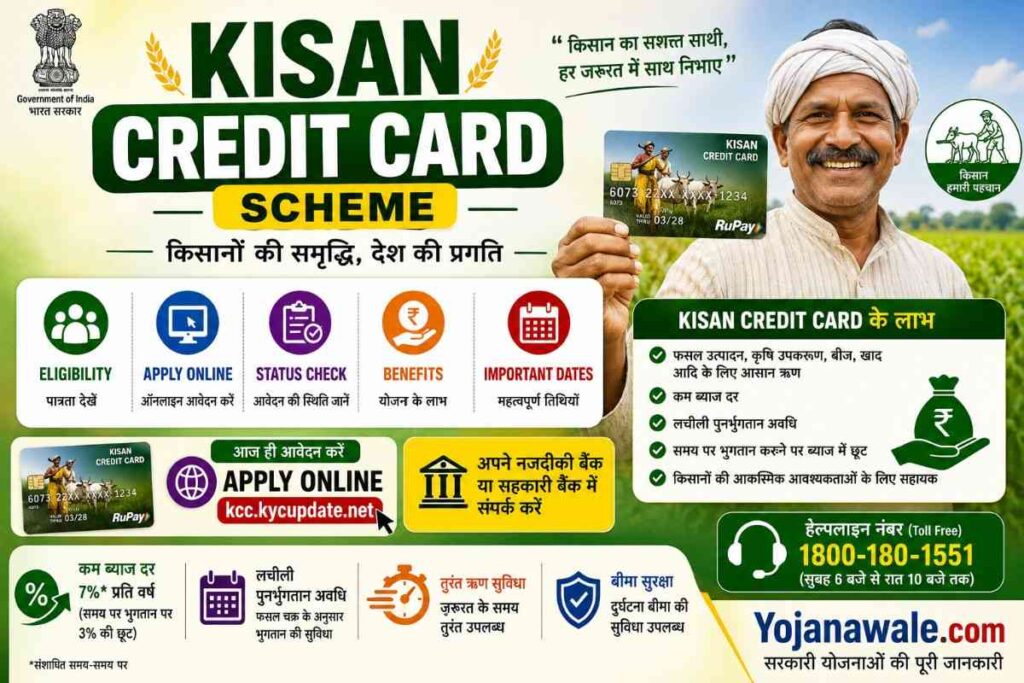
As of 2026, more than 7.72 crore KCC accounts are active nationwide, with outstanding loans of approximately Rs. 10.2 lakh crore. The scheme operates on a revolving credit facility model, functioning like an overdraft account where farmers can withdraw funds as needed for crop cultivation, post-harvest expenses, marketing costs, and even household consumption requirements.
Unlike traditional loans that require fresh paperwork every season, the KCC offers a five-year validity period with annual reviews, eliminating the bureaucratic burden of reapplying before every sowing season. The modern KCC comes as a RuPay-enabled Smart Card with an EMV chip, allowing farmers to withdraw cash from any ATM, make digital payments at input dealers with zero merchant discount rate, and even use UPI for transactions at mandis. The scheme has been digitally transformed through the Kisan Rin Portal and Jan Samarth Portal, enabling end-to-end digital applications, real-time tracking of interest subventions, and seamless integration with the PM-KISAN database for pre-filled applications.
Quick Overview Table of Kisan Credit Card Scheme
| Particulars | Details |
|---|---|
| Scheme Name | Kisan Credit Card (KCC) Scheme |
| Launched By | Government of India (Ministry of Agriculture & Farmers’ Welfare) |
| Launch Year | 1998 (Revised in 2020) |
| Active KCC Accounts | 7.72 crore+ (as of 2026) |
| Total Outstanding Loans | Rs. 10.2 lakh crore |
| KCC Loan Limit (MISS) | Up to Rs. 5 lakh (Budget 2025-26) |
| Collateral-Free Limit | Up to Rs. 2 lakh (effective from January 1, 2025) |
| Base Interest Rate | 7% per annum |
| Effective Interest Rate (with PRI) | 4% per annum |
| Interest Subvention | 1.5% to banks |
| Prompt Repayment Incentive | Additional 3% for timely repayment |
| Card Validity | 5 years with annual review |
| Annual Limit Increment | 10% increase each year |
| Official Portal | pmkisan.gov.in, Kisan Rin Portal |
| National Helpline | 1800-180-1551 |
Main Objectives Behind Launching KCC
The Government of India introduced the Kisan Credit Card Scheme with several well-defined objectives that address the long-standing credit challenges faced by Indian farmers.
- Eliminate Dependence on Moneylenders: Before KCC, millions of farmers were forced to borrow from village moneylenders at exorbitant interest rates ranging from 24% to 60%. KCC provides formal institutional credit at just 4%, breaking the cycle of rural indebtedness and exploitation.
- Ensure Timely Credit Availability: Agriculture is highly time-sensitive. Farmers need money at specific stages — for seeds before sowing, for fertilizers during growth, and for harvesting equipment. KCC provides a revolving credit facility that farmers can access 24/7 through ATMs, Micro-ATMs, and POS machines.
- Provide Comprehensive Coverage: The scheme covers not just crop cultivation but also post-harvest expenses, marketing costs, working capital for farm asset maintenance, and household consumption needs. This holistic approach ensures farmers do not need multiple loans.
- Expand to Allied Activities: In 2019, KCC was extended to cover animal husbandry, dairy, poultry, fisheries, and beekeeping. This recognizes that many farmers depend on allied activities for their livelihood and need working capital for feed, veterinary medicines, and equipment.
- Promote Financial Inclusion: With approximately 76% of agricultural credit accounts held by small and marginal farmers, KCC plays a critical role in bringing the most vulnerable farming segments into the formal banking system.
- Digital Integration: The scheme aims to create a unified financial identity for every farmer through Aadhaar-linked accounts, RuPay cards, and digital portals, reducing paperwork and ensuring transparency.
Who Can Apply: Eligibility Criteria in Detail
KCC is designed to be highly inclusive, covering almost every category of farmer and agricultural worker in India. Understanding the eligibility criteria ensures a smooth application process.
- All Categories of Farmers: The scheme is open to all farmers, including small and marginal farmers, large landholders, sharecroppers, tenant farmers, and even Self-Help Groups and Joint Liability Groups engaged in farming.
- Landowners and Cultivators: Farmers who own agricultural land and cultivate crops are the primary beneficiaries. They must possess valid land records such as Records of Rights, Khatauni, or Pattadar Passbook.
- Tenant Farmers and Sharecroppers: Farmers who cultivate land on lease or sharecropping basis are explicitly eligible. They must submit a declaration or affidavit of the crops being grown, or a Joint Liability Group guarantee. This is a significant inclusion that recognizes the reality of Indian agriculture where many farmers do not own land.
- Farmers in Allied Activities: Those engaged exclusively in animal husbandry, dairy, poultry, fisheries, and beekeeping can apply for a standalone KCC limit of up to Rs. 2 lakh with the same 4% interest benefit.
- PM-KISAN Beneficiaries: Farmers already registered under the PM-KISAN scheme are essentially “pre-approved” for KCC. Their basic details are pre-filled from the PM-KISAN database, making the application process extremely simple.
- Aadhaar-Linked Bank Account: The applicant must have an Aadhaar-linked bank account. Aadhaar seeding and e-KYC are mandatory for availing interest subvention benefits under the Modified Interest Subvention Scheme.
- No Income Ceiling: Unlike many welfare schemes, KCC does not have an income ceiling. Any farmer, regardless of income level, can apply. However, the loan limit is determined by landholding size and cropping pattern.
- Valid Mobile Number: The farmer’s mobile number must be linked to Aadhaar for e-KYC and to receive OTPs, status updates, and claim notifications.
Complete List of Documents Required for Application
The documentation process has been simplified to a single-page form, especially for PM-KISAN beneficiaries. However, having all documents ready ensures faster approval.
| Document Name | Purpose |
|---|---|
| Aadhaar Card | Identity verification and e-KYC (mandatory) |
| Land Records (7/12 Extract / Khatauni / Pattadar Passbook) | Proof of land ownership or cultivation rights |
| Bank Passbook / Cancelled Cheque | For loan disbursement and DBT |
| PM-KISAN Registration Details | Pre-fills application form automatically |
| Two Passport Size Photographs | For application records |
| Land Lease Agreement (for tenant farmers) | Proof of tenancy or sharecropping |
| Mobile Number (Aadhaar-linked) | For OTP verification and SMS alerts |
| Self-Declaration of Cropping Pattern | Declares intended crops for limit calculation |
Additional Notes on Documents:
- Land records must be current and certified by the revenue department or patwari of the respective state.
- For tenant farmers, a simple declaration on plain paper or an affidavit stating the crops being cultivated is often sufficient, especially when applying through cooperative banks or PACS.
- The name on land records must exactly match the name on the Aadhaar card. Any mismatch will cause system flags and delays in the Kisan Rin Portal.
- PM-KISAN beneficiaries enjoy a major advantage — their name, address, and Aadhaar details are auto-populated, and they only need to declare their cropping pattern.
- For farmers applying through Common Service Centers, the CSC operator will guide them through document scanning and uploading.
Step-by-Step Application Process
Farmers can apply for KCC through multiple channels. Here is the complete guide for each method.
- Through Banks (Direct Application):
- Visit your nearest bank branch — Commercial Bank, Regional Rural Bank, or Cooperative Bank.
- Request the simplified one-page KCC application form.
- If you are a PM-KISAN beneficiary, your details will be pre-filled. Just verify and add your cropping pattern.
- Attach photocopies of Aadhaar, land records, bank passbook, and photographs.
- Submit the form to the bank officer. The bank will conduct verification and sanction the limit.
- Collect your RuPay-enabled KCC Smart Card once approved.
- Through Common Service Centers (CSC):
- Locate your nearest CSC (there are over 4 lakh CSCs across India).
- The CSC operator will help fill the digital application form and upload documents.
- Biometric authentication via Aadhaar will be done at the CSC.
- The application is digitally transmitted to the concerned bank branch.
- Collect the acknowledgment receipt with your application reference number.
- Through Kisan Rin Portal (Online):
- Visit the Kisan Rin Portal (launched in September 2023).
- Register using your Aadhaar number and mobile number.
- Fill the online application with crop details, land area, and bank information.
- Upload scanned documents.
- Track your application status in real-time on the portal.
- Through PM-KISAN Portal:
- If you are already a PM-KISAN beneficiary, log in to pmkisan.gov.in.
- Look for the KCC application link, which uses your existing verified data.
- Complete the one-page form with minimal additional input.
- Submit and track status online.
- Through Bank Mitras and Business Correspondents:
- In remote villages, Bank Mitras visit door-to-door with Micro-ATMs.
- They help farmers fill forms, collect documents, and submit applications digitally.
- This is especially useful for elderly farmers and those without internet access.
Loan Limit Structure and Annual Increment System
The KCC loan limit is not a fixed number — it is scientifically calculated based on multiple factors and grows automatically each year.
| Component | Calculation Method |
|---|---|
| Basic Crop Loan | Scale of Finance per acre × Area cultivated |
| Household/Consumption Needs | + 10% of basic crop loan |
| Farm Asset Maintenance | + 20% of basic crop loan |
| Crop Insurance & PAIS | Added as per actual premium |
| Year 1 Total Limit | Sum of all above components |
| Annual Increment (Years 2-5) | + 10% of previous year’s limit each year |
| Year 5 Maximum Permissible Limit | Year 5 short-term limit + estimated term loan |
Example Calculation:
- A farmer has 2 acres and grows wheat with a Scale of Finance of Rs. 30,000 per acre.
- Basic crop loan = 2 × 30,000 = Rs. 60,000
- Household needs = 10% of 60,000 = Rs. 6,000
- Farm maintenance = 20% of 60,000 = Rs. 12,000
- Year 1 limit = Rs. 78,000
- Year 2 limit = Rs. 85,800 (10% increment)
- Year 3 limit = Rs. 94,380
- Year 4 limit = Rs. 1,03,818
- Year 5 limit = Rs. 1,14,200 (approximate)
Key Points:
- The Scale of Finance is decided by the District Level Technical Committee for each crop in each district.
- If a farmer changes their cropping pattern to high-value crops, the limit can be revised upward.
- For allied activities only, the standalone limit is up to Rs. 2 lakh at 4% interest.
- The overall subvention limit under MISS is Rs. 3 lakh for combined crop and allied activities, though the Budget 2025-26 announced an increase to Rs. 5 lakh.
Interest Rate Structure and How to Get 4% Rate
Understanding the interest rate structure is crucial because timely repayment can save farmers thousands of rupees.
| Component | Rate |
|---|---|
| Base Lending Rate to Farmers | 7% per annum |
| Government Interest Subvention to Banks | 1.5% per annum |
| Prompt Repayment Incentive (PRI) | Additional 3% per annum |
| Effective Rate for Timely Repayment | 4% per annum |
| Rate if Repayment is Delayed | 7% or higher (PRI lost) |
How the 4% Rate Works:
- The government provides a 1.5% interest subvention to lending institutions, allowing banks to lend at 7% instead of their normal lending rate.
- If a farmer repays the loan on or before the due date (maximum one year from disbursement), they receive an additional 3% Prompt Repayment Incentive.
- This brings the effective interest rate down to just 4% — one of the lowest agricultural credit rates globally.
- If the farmer misses the due date by even one day, the 3% PRI is lost, and they must pay the full 7% or higher rate.
- The 4% benefit applies to short-term loans up to Rs. 3 lakh (proposed increase to Rs. 5 lakh in Budget 2025-26).
- For loans exclusively for animal husbandry or fisheries, the interest benefit applies up to Rs. 2 lakh.
Pro Tip for Farmers:
- Set a reminder for the 12-month mark from your loan disbursement date.
- Consider a “roll-over” strategy — repay the loan and immediately re-borrow, which counts as prompt repayment and maintains your 4% eligibility.
- Always ensure your Aadhaar is linked to your bank account, as this is mandatory for receiving subvention benefits.
Key Features That Make KCC Unique
KCC stands out among agricultural credit schemes worldwide due to its farmer-centric design and continuous evolution.
- RuPay-Enabled Smart Card: The modern KCC is not just a loan document — it is a full-fledged debit card with an EMV chip. Farmers can withdraw cash from any ATM, swipe at input dealers with zero MDR, and make UPI payments at mandis using apps like BHIM or Google Pay.
- Collateral-Free Loans Up to Rs. 2 Lakh: Effective from January 1, 2025, farmers can avail loans up to Rs. 2 lakh without any collateral or guarantee. This is a significant increase from the previous Rs. 1.6 lakh limit and greatly benefits tenant and marginal farmers.
- Revolving Credit Facility: Unlike term loans where you receive a lump sum, KCC works like an overdraft. You withdraw only what you need, when you need it, and pay interest only on the amount utilized.
- 5-Year Validity with Annual Review: The card is valid for five years, with an automatic 10% annual increase in the credit limit to account for inflation and rising input costs. No fresh paperwork is needed each year.
- Integrated Insurance Coverage: KCC borrowers are typically covered under Pradhan Mantri Fasal Bima Yojana for crop risks and a Personal Accident Insurance Scheme for the cardholder, providing a safety net.
- Interest Waiver During Natural Calamities: If a farmer is affected by natural disasters, interest is not charged for up to one year, extendable to five years in cases of severe calamities, as decided by a High Level Committee.
- Doorstep Banking via Business Correspondents: In remote areas, Bank Mitras use Micro-ATMs to provide cash and services at the farmer’s doorstep through biometric verification.
- Digital Integration: The Kisan Rin Portal and Jan Samarth Portal enable end-to-end digital processing, real-time status tracking, and transparent claim settlement.
How KCC Supports Allied Activities Like Dairy, Poultry, and Fisheries
KCC has expanded far beyond traditional crop cultivation to support the entire agricultural value chain.
- Dairy Farming: KCC funds can be used to purchase cattle feed, veterinary medicines, electricity for sheds, and minor equipment. Dairy farmers who are part of cooperatives like Amul can often apply directly through their society secretary during seasonal saturation drives.
- Poultry: The scheme covers the cost of day-old chicks, poultry feed, vaccines, and shed maintenance. This helps small poultry farmers scale up their operations without seeking high-interest informal loans.
- Fisheries: Inland fishers can use KCC for fingerlings, fish feed, and pond maintenance. Marine fishers can avail funds for boat fuel, net repairs, and ice for preservation. The credit limit for fisheries and allied activities has been increased to Rs. 5 lakh in Budget 2025-26.
- Animal Husbandry: Funds can be used for purchasing livestock, fodder, breeding services, and veterinary care. The exceptionally high acceptance rate of 55.08 lakh out of 55.9 lakh applications in animal husbandry shows strong demand and effective implementation.
- Beekeeping: Working capital for bee boxes, honey extraction equipment, and transportation is covered under KCC for allied activities.
- Standalone vs. Combined Limits:
- Farmers engaged only in allied activities can get a standalone KCC limit of up to Rs. 2 lakh at 4% interest.
- Farmers doing both crop cultivation and allied activities have a combined subvention limit of Rs. 3 lakh (proposed Rs. 5 lakh), with the crop loan component taking priority.
Role of Kisan Rin Portal in Digital Transformation
The Kisan Rin Portal, launched in September 2023, has revolutionized how KCC is implemented and monitored across India.
- Unified Digital Platform: KRP integrates farmer profiles, loan disbursement data, interest subvention claims, and scheme performance metrics on a single platform. This eliminates data silos and reduces manual errors.
- For Farmers: The portal simplifies access to low-cost institutional credit, expands coverage to allied activities, and enables faster loan processing through seamless digital integration with banks and cooperative institutions. Farmers can check their loan status and interest subventions in real-time.
- For Banks and Lending Agencies: KRP facilitates automated submission and processing of Interest Subvention and Prompt Repayment Incentive claims. It reduces delays through end-to-end digitization and enhances transparency and accountability in claim verification and settlement.
- Integration with PM-KISAN: Since PM-KISAN already holds Aadhaar-linked and land-verified data for millions of farmers, banks use this “Golden Record” to identify eligible borrowers instantly. This linkage has enabled the simplified one-page application form.
- Validation of Multiple Accounts: The portal ensures that a farmer receives MISS benefits through multiple KCC accounts only up to the overall limit of Rs. 3 lakh per farmer across all accounts. It prevents duplicate claims and ensures fair distribution.
- Real-Time Monitoring: Government officials can track scheme performance, identify gaps in coverage, and take corrective action through the portal’s dashboard and analytics.
Common Mistakes to Avoid While Applying or Using KCC
Many farmers face delays, rejections, or loss of benefits due to simple errors. Avoiding these mistakes ensures a smooth experience.
- Aadhaar-Bank Account Mismatch: If the name on your Aadhaar card does not exactly match the name on your land records or bank account, the Kisan Rin Portal will flag the discrepancy. Always verify and correct name mismatches before applying.
- Not Linking Mobile Number to Aadhaar: Your mobile number must be linked to Aadhaar for e-KYC. Without this, the digital application process cannot proceed, and you will not receive OTPs or status updates.
- Missing the Annual Review: KCC requires an annual review for limit enhancement. If you miss the review, your limit will not increase by the 10% annual increment, and you may lose benefits.
- Delayed Repayment Losing PRI: Missing the repayment due date by even one day means losing the 3% Prompt Repayment Incentive. Your interest rate jumps from 4% to 7% or higher. Set reminders well in advance.
- Not Updating Cropping Pattern: If you change your crops but do not inform the bank, your limit may not reflect the new Scale of Finance. Always update the bank when switching to high-value crops.
- Ignoring Card Activation: The RuPay KCC Smart Card must be activated by performing at least one transaction every six months. Inactive cards may be blocked by the bank.
- Applying Through Informal Agents: Always apply through authorized channels — banks, CSCs, or official portals. Avoid middlemen who charge illegal fees.
- Not Checking Subvention Credit: Banks sometimes fail to pass on the interest subvention. Check your loan account statement regularly to ensure the 1.5% subvention and 3% PRI have been correctly applied.
Comparison with Traditional Agricultural Loans
Understanding how KCC differs from traditional agricultural loans helps farmers appreciate its unique advantages.
| Feature | Kisan Credit Card | Traditional Agricultural Loan |
|---|---|---|
| Application Process | One-page simplified form, often pre-filled | Lengthy paperwork, fresh application each time |
| Validity Period | 5 years with annual review | Single season or one year |
| Interest Rate | 4% with prompt repayment (7% base) | 9% to 13% or higher |
| Collateral Requirement | Up to Rs. 2 lakh without collateral | Often requires land mortgage or guarantor |
| Revolving Credit | Yes, withdraw as needed | Lump sum disbursement |
| Digital Access | RuPay card, ATM, UPI, Micro-ATM | Mostly branch-based |
| Insurance Coverage | Integrated PMFBY and PAIS | Separate application required |
| Allied Activities | Explicitly covered | Often not covered |
| Interest on Utilized Amount Only | Yes | Interest on full sanctioned amount |
| Doorstep Service | Available via Bank Mitras | Rarely available |
Why KCC is Superior:
- KCC saves farmers from the trap of moneylenders charging 24% to 60% interest.
- The revolving nature means you pay interest only on what you use, not the full limit.
- Digital access through RuPay cards and UPI brings banking to the farmer’s field.
- Integrated insurance provides protection that informal lenders cannot offer.
Impact and Achievements of KCC Since Launch
KCC has transformed agricultural finance in India and delivered measurable benefits to millions of farming families.
- Massive Scale: Over 7.72 crore KCC accounts are active nationwide as of 2026. The KCC platform has onboarded 457 banks and received more than 1,998.7 lakh applications across commercial, regional, rural, and cooperative banks.
- Huge Credit Flow: Institutional credit disbursement through KCC increased from Rs. 4.26 lakh crore in 2014 to Rs. 10.05 lakh crore by December 2024. Overall agricultural credit flow rose from Rs. 7.3 lakh crore in FY 2013-14 to Rs. 25.49 lakh crore in FY 2023-24.
- Inclusion of Small Farmers: Approximately 76% of agricultural credit accounts are held by small and marginal farmers, showing that KCC has successfully reached the most vulnerable segments.
- Allied Sector Growth: In animal husbandry, 55.08 lakh out of 55.9 lakh applications were accepted, with 39.22 lakh sanctioned. In fisheries, 6.83 lakh applications were received, with 6.77 lakh accepted and 4.82 lakh sanctioned.
- Digital Transformation: The launch of Kisan Rin Portal in August 2023 has enhanced transparency, reduced claim processing time, and enabled real-time monitoring of interest subventions.
- KCC Saturation Drive: Under the Atmanirbhar Bharat Abhiyan, a nationwide saturation drive is ensuring coverage of all eligible farmers, including those in animal husbandry, dairy, and fisheries, through district-level weekly camps.
- Global Benchmark: KCC is now recognized as one of the most efficient and farmer-friendly agricultural credit systems in the world, with its 4% effective interest rate being among the lowest globally.
Important Links, PDF Notifications, and Official Resources
| Resource | Link / Contact |
|---|---|
| PM-KISAN Official Portal | pmkisan.gov.in |
| Kisan Rin Portal (KRP) | kisanrin.nic.in |
| Jan Samarth Portal | jansamarth.in |
| Ministry of Agriculture & Farmers’ Welfare | agricoop.gov.in |
| NABARD Official Website | nabard.org |
| RBI KCC Circulars & Guidelines | rbi.org.in |
| PIB Official Notification (MISS Continuation FY 2025-26) | pib.gov.in/PressReleasePage.aspx?PRID=2238004 |
| Lok Sabha Unstarred Question No. 1365 (KCC Limit Increase) | sansad.in/getFile/loksabhaquestions/annex/185/AU1365_spXbvr.pdf |
| National Helpline | 1800-180-1551 |
| Grievance Portal | pgportal.gov.in |
How to Use These Resources:
- Visit the PM-KISAN portal to check your beneficiary status and access the simplified KCC application form.
- Use the Kisan Rin Portal for real-time tracking of your loan application, interest subvention claims, and repayment status.
- Download official KCC guidelines and circulars from the Ministry of Agriculture and RBI websites for detailed policy information.
- For grievances related to KCC, first contact your bank branch manager. If unresolved, file a complaint at pgportal.gov.in under the Department of Financial Services.
- The Jan Samarth Portal provides a unified interface for multiple government loan schemes, including KCC, with end-to-end digital processing.
Frequently Asked Questions
Q1. What is the maximum loan limit under KCC in 2026?
The loan limit under the Modified Interest Subvention Scheme has been enhanced to Rs. 5 lakh in Union Budget 2025-26. The collateral-free limit has been increased to Rs. 2 lakh per borrower, effective from January 1, 2025.
Q2. How can a farmer get the 4% interest rate on KCC loans?
Farmers who repay their short-term loans on or before the due date receive an additional 3% Prompt Repayment Incentive on top of the 1.5% government subvention. This reduces the effective interest rate from 7% to 4% for loans up to Rs. 3 lakh.
Q3. Can tenant farmers and sharecroppers apply for KCC?
Yes, tenant farmers and sharecroppers are explicitly eligible. They can submit a simple declaration or affidavit of the crops being cultivated, or a Joint Liability Group guarantee, instead of land ownership documents.
Q4. What documents are needed for the one-page KCC application?
PM-KISAN beneficiaries need minimal documents — mainly Aadhaar, land records, bank passbook, and two passport photos. Their basic details are pre-filled from the PM-KISAN database. Non-PM-KISAN farmers need the same documents plus complete personal details.
Q5. How is the KCC credit limit calculated?
The limit is calculated as: (Scale of Finance per acre × Area cultivated) + 10% for household needs + 20% for farm maintenance + insurance premiums. The limit increases by 10% annually from Year 2 to Year 5.
Q6. Can KCC be used for non-agricultural purposes?
KCC is primarily for agricultural and allied activities. However, up to 10% of the limit can be used for household and consumption needs of the farmer’s family. It cannot be used for speculative or non-agricultural business purposes.
Q7. What happens if a farmer cannot repay due to crop failure?
If affected by natural calamities, farmers can request loan restructuring. Interest subvention is available for the first year on restructured loans, extendable to three years for severe calamities (up to five years as decided by High Level Committee). Interest is not charged for up to one year in such cases.
Q8. How can I check my KCC application status?
Visit the Kisan Rin Portal or your bank’s website. Enter your Aadhaar number or application reference number. You can also visit your bank branch or call the national helpline at 1800-180-1551.
Q9. Is Aadhaar mandatory for KCC?
Yes, Aadhaar seeding and authentication are mandatory for availing interest subvention benefits under MISS. All banks must ensure e-KYC is completed for every farmer applicant.
Q10. What is the difference between KCC for crop loans and allied activities?
For crop loans, the subvention limit is up to Rs. 3 lakh (proposed Rs. 5 lakh) at 4% interest. For allied activities only, the standalone limit is up to Rs. 2 lakh at 4% interest. If a farmer does both, the combined subvention limit is Rs. 3 lakh with crop loan taking priority.