
Sukanya Samriddhi Yojana (SSY) is a government-backed small savings scheme launched by the Government of India in January 2015 under the “Beti Bachao, Beti Padhao” campaign. The primary goal of this scheme is to encourage parents and legal guardians to build a secure financial corpus for their daughter’s future needs, including higher education and marriage expenses.
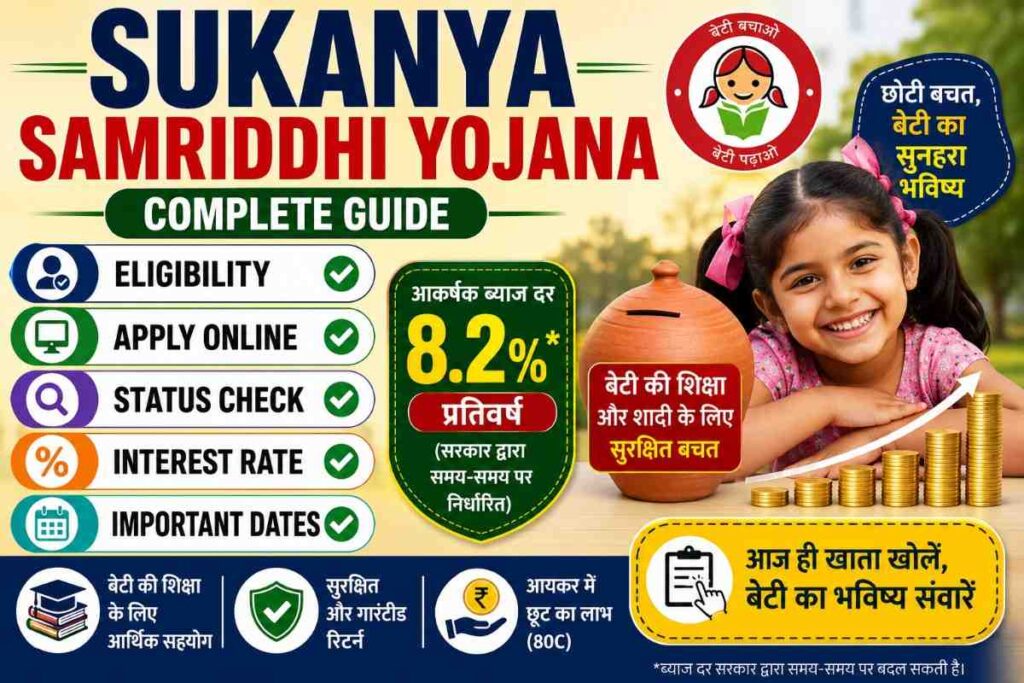
This scheme is exclusively designed for the girl child and offers one of the highest interest rates among all government small savings schemes in India. The account can be opened at any authorized post office or participating bank across the country. What makes SSY particularly attractive is its Exempt-Exempt-Exempt (EEE) tax status, which means deposits, interest earned, and maturity amount are all completely tax-free under the Income Tax Act.
The scheme operates on a long-term investment model where parents deposit money for 15 years, but the account continues to earn interest for a total of 21 years from the date of opening. This extended compounding period allows the corpus to grow significantly, making it an excellent wealth-building tool for a girl child’s future.
Quick Overview of Sukanya Samriddhi Yojana
Here is a complete snapshot of the scheme for quick reference:
| Feature | Details |
|---|---|
| Scheme Name | Sukanya Samriddhi Yojana (SSY) |
| Launched By | Government of India (PM Narendra Modi) |
| Launch Year | January 2015 |
| Campaign | Beti Bachao, Beti Padhao |
| Current Interest Rate (2025-26) | 8.2% per annum (compounded annually) |
| Minimum Annual Deposit | ₹250 |
| Maximum Annual Deposit | ₹1,50,000 |
| Deposit Period | 15 years from account opening |
| Maturity Period | 21 years from account opening |
| Account Holder | Girl child (operated by parent/guardian until age 18) |
| Maximum Accounts per Family | 2 accounts (3 in case of twins/triplets) |
| Tax Status | EEE (Exempt-Exempt-Exempt) |
| Tax Deduction | Up to ₹1.5 lakh under Section 80C |
| Partial Withdrawal | Up to 50% after girl turns 18 (for education) |
| Premature Closure | Allowed for marriage after age 18, death, or medical emergency |
| Where to Open | Post Offices & Authorized Banks (SBI, HDFC, ICICI, etc.) |
| Online Payment | Available via IPPB Mobile App |
| Risk Level | Zero Risk (Sovereign Guarantee) |
Who Can Apply for Sukanya Samriddhi Yojana
Understanding the eligibility criteria is the first step before applying for this scheme. The rules are straightforward but must be followed carefully to avoid rejection.
For the Girl Child (Account Holder):
- The girl must be an Indian citizen and resident
- Her age must be below 10 years at the time of account opening
- A one-year grace period may be available in certain cases
- She must remain a resident Indian until maturity or closure
For the Parent or Guardian:
- Only biological parents or legal guardians can open the account
- The guardian must be a resident Indian citizen
- NRIs are not eligible to open an SSY account
- Only one parent or guardian needs to apply (both are not required)
Family-wise Account Limits:
- A maximum of two SSY accounts can be opened per family
- In case of twins or triplets, a third account is permitted with valid medical proof
- Only one account per girl child is allowed
Special Cases:
- Adopted daughters are eligible with a valid adoption certificate
- If the girl child becomes an NRI later, the account must be closed
- If the girl child passes away, the balance is paid to the guardian
Documents Required for Account Opening
Having the correct documents ready before visiting the bank or post office will save you time and prevent application rejection. Here is the complete list:
| Document | Purpose | Notes |
|---|---|---|
| Birth Certificate of Girl Child | Proof of age and identity | Mandatory; obtain from municipal corporation |
| Identity Proof of Parent/Guardian | KYC verification | Aadhaar, PAN, Passport, Voter ID, or Driving License |
| Address Proof of Parent/Guardian | Residence verification | Aadhaar, Passport, utility bill, bank statement, or ration card |
| Passport-size Photographs | Record maintenance | Recent photos of both girl child and guardian (2-4 copies) |
| Form SSA-1 | Official application form | Available at bank/post office or downloadable online |
| Initial Deposit Slip | Proof of first payment | Minimum ₹250 required at opening |
| Medical Certificate | For twins/triplets cases | Required only when opening a third account |
| Adoption Certificate | For adopted children | Required only if girl child is adopted |
| Guardianship Certificate | For non-parent guardians | Required if grandparents or legal guardians apply |
Pro Tips for Document Submission:
- Carry both original and self-attested photocopies
- Use Aadhaar as both identity and address proof to reduce paperwork
- Ensure the girl child’s name and date of birth match across all documents
- Update your Aadhaar address if you have recently moved
- Check with your specific bank branch for any additional requirements
Step-by-Step Application Process
Opening a Sukanya Samriddhi Yojana account is a simple process if you follow these steps carefully:
Step 1: Locate Your Nearest Branch
- Find an authorized post office or bank branch near you
- Major banks offering SSY include SBI, HDFC Bank, ICICI Bank, Axis Bank, and Punjab National Bank
- You can also use the India Post website to locate the nearest post office
Step 2: Collect or Download the Application Form
- Visit the branch and ask for Form SSA-1
- Alternatively, download the form from the India Post website or your bank’s portal
- Fill in all details carefully including girl child’s name, date of birth, guardian details, and deposit amount
Step 3: Arrange Your Documents
- Gather all documents listed in the previous section
- Make self-attested photocopies
- Keep original documents ready for verification
Step 4: Submit the Form with Documents
- Visit the branch with the filled form and documents
- Submit everything to the concerned officer
- Pay the initial deposit (minimum ₹250, maximum ₹1.5 lakh)
Step 5: Verification and Account Opening
- The bank or post office will verify your documents
- This process usually takes a few working days
- Once approved, your SSY account will be activated
Step 6: Receive Your Passbook
- You will be issued an SSY passbook containing:
- Account number and opening date
- Girl child’s details
- Guardian’s details
- Record of all deposits and interest
Step 7: Start Regular Deposits
- You can deposit via cash, cheque, demand draft, or online transfer
- Set up reminders to ensure minimum annual deposits
Current Interest Rate and How It Works
The Sukanya Samriddhi Yojana offers a highly competitive interest rate that is revised quarterly by the Ministry of Finance. For the financial year 2025-26, the rate stands at 8.2% per annum, compounded annually.
Interest Rate Trend (Recent Years):
| Financial Year / Quarter | Interest Rate |
|---|---|
| Apr 2020 – Mar 2023 | 7.6% |
| Apr 2023 – Dec 2023 | 8.0% |
| Jan 2024 – Mar 2026 | 8.2% |
| Apr 2026 – Jun 2026 | 8.2% |
How Interest is Calculated:
- Interest is compounded annually (once per year)
- It is credited to the account at the end of each financial year
- The formula used is: A = P (1 + r/100)^n
- A = Maturity amount
- P = Principal invested
- r = Rate of interest
- n = Number of years
Key Points About Interest:
- No interest is paid if the girl becomes an NRI
- No interest is earned on deposits exceeding ₹1.5 lakh per year
- Interest continues to accrue even after the 15-year deposit period ends (years 16-21)
- The government guarantees the interest rate, making it completely risk-free
Deposit Rules and Penalties
Understanding the deposit rules is essential to keep your account active and avoid penalties.
Minimum and Maximum Deposits:
| Parameter | Rule |
|---|---|
| Minimum Annual Deposit | ₹250 per financial year |
| Maximum Annual Deposit | ₹1,50,000 per financial year |
| Deposit Frequency | Anytime during the year (lump sum or installments) |
| Deposit Multiples | In multiples of ₹50 |
| Deposit Period | 15 years from account opening |
What Happens If You Miss a Deposit:
- If you fail to deposit the minimum ₹250 in a financial year, the account becomes inactive or default
- To reactivate, you must pay:
- The minimum deposit of ₹250
- A penalty of ₹50 per year of default
- The account can be reactivated even after multiple years of default
What Happens If You Deposit More:
- Any amount above ₹1.5 lakh in a year does not earn interest
- The excess amount can be withdrawn by the account holder
- It is advisable to stay within the prescribed limit to maximize benefits
Payment Methods:
- Cash at bank/post office counter
- Cheque or demand draft
- Online transfer via NEFT/RTGS
- Through IPPB (India Post Payments Bank) mobile app
Tax Benefits Under Sukanya Samriddhi Yojana
One of the biggest advantages of SSY is its exceptional tax treatment. It enjoys EEE (Exempt-Exempt-Exempt) status, which is the most favorable tax structure available in India.
Three Levels of Tax Exemption:
| Stage | Tax Benefit | Details |
|---|---|---|
| Investment (Deposit) | Tax Deduction under Section 80C | Up to ₹1.5 lakh per year deductible from taxable income |
| Interest Earned | Tax-Free under Section 10 | Annual interest is completely exempt from income tax |
| Maturity Amount | Tax-Free Withdrawal | Final corpus (principal + interest) is fully exempt |
Tax Savings Example:
| Annual Income | Without SSY | With SSY (₹1.5L invested) |
|---|---|---|
| Taxable Income | ₹10,00,000 | ₹8,50,000 |
| Tax Payable (Old Regime) | ₹1,06,600 | ₹82,000 |
| Tax Saved | — | ₹24,600 |
Additional Tax Notes:
- The ₹1.5 lakh limit is shared with other Section 80C investments (PPF, ELSS, LIC, etc.)
- Both parents cannot claim separate deductions for the same SSY account
- Tax benefits apply only under the old tax regime
- No TDS is deducted on interest or maturity amount
Maturity and Withdrawal Rules
The SSY account has specific rules regarding when and how you can access the accumulated funds.
Maturity Conditions:
- The account matures after 21 years from the date of opening
- Alternatively, it can be closed if the girl gets married after turning 18
- No interest is paid after the 21-year period
Partial Withdrawal for Higher Education:
- Allowed after the girl turns 18 years old or completes 10th standard
- Maximum withdrawal: 50% of the balance at the end of the previous financial year
- Required documents:
- Proof of admission to college/university
- Fee structure or receipt
- Identity and address proof of the girl
Complete Withdrawal on Maturity:
- The girl child must submit:
- Withdrawal application form
- Identity proof (Aadhaar, PAN, etc.)
- Address proof
- Citizenship proof
- SSY passbook
- The entire balance (principal + interest) is paid to the girl child
- The amount is completely tax-free
Premature Closure Allowed For:
- Marriage of the girl child after age 18 (with age proof)
- Death of the account holder (balance paid to guardian with death certificate)
- Life-threatening illness of the girl child
- Death of the guardian causing undue hardship
- Girl child becoming an NRI
- Note: Closure before 5 years attracts reduced interest (post office savings rate)
How to Make Online Deposits
The government has made it convenient to deposit money into your SSY account without visiting the branch every time. Here is how to do it online:
Using the IPPB (India Post Payments Bank) Mobile App:
- Step 1: Download the IPPB mobile app from Google Play Store or Apple App Store
- Step 2: Complete the registration process with your mobile number and KYC
- Step 3: Link your existing bank account to transfer funds to IPPB
- Step 4: Add your SSY account details (account number and DOP customer ID)
- Step 5: Navigate to the “DOP Products” section and select SSY
- Step 6: Enter the deposit amount and confirm the transaction
- Step 7: Set up standing instructions for automatic monthly deposits (optional)
Using Net Banking (for Bank SSY Accounts):
- Log in to your bank’s internet banking portal
- Add your SSY account as a beneficiary
- Transfer funds via NEFT/IMPS
- Some banks allow direct SSY deposits through their mobile apps
Benefits of Online Deposits:
- No need to visit the branch physically
- Set up auto-debit for disciplined savings
- Track all transactions digitally
- Receive instant confirmation via SMS and email
Mukhyamantri Ayushman Arogya Yojana 2026: Eligibility, Apply Online, Status Check
Account Transfer and Passbook Details
Transferring Your SSY Account:
You can transfer your Sukanya Samriddhi Yojana account from one post office to another, or from a post office to a bank, and vice versa.
When Transfer is Free:
- Change in residence of the guardian
- Change in residence of the girl child
- Transfer within the same city or across India
When Transfer Fee Applies:
- ₹100 fee for transfers due to personal preference (not residence change)
Steps to Transfer:
- Visit the current branch (post office or bank)
- Submit a transfer application with:
- SSY passbook
- Identity proof
- Address proof
- KYC documents
- The branch will process and forward your account
- Visit the new branch after a few days to collect the new passbook
About the SSY Passbook:
- Issued after account opening
- Contains all transaction records
- Shows deposits, withdrawals, and interest credited
- Must be presented for every deposit and withdrawal
- Keep it safe and updated regularly
Sukanya Samriddhi Yojana Calculator and Maturity Examples
Using an SSY calculator helps you plan your investments better. Here are some practical examples based on the current 8.2% interest rate:
Example 1: Maximum Investment (₹1.5 lakh/year)
| Detail | Amount |
|---|---|
| Annual Investment | ₹1,50,000 |
| Investment Period | 15 years |
| Total Investment | ₹22,50,000 |
| Interest Earned | ₹50,48,219 |
| Maturity Amount (21 years) | ₹72,98,219 |
Example 2: Moderate Investment (₹50,000/year)
| Detail | Amount |
|---|---|
| Annual Investment | ₹50,000 |
| Investment Period | 15 years |
| Total Investment | ₹7,50,000 |
| Interest Earned | ₹16,82,740 |
| Maturity Amount (21 years) | ₹24,32,740 |
Example 3: Small Investment (₹5,000/year)
| Detail | Amount |
|---|---|
| Annual Investment | ₹5,000 |
| Investment Period | 15 years |
| Total Investment | ₹75,000 |
| Interest Earned | ₹1,68,274 |
| Maturity Amount (21 years) | ₹2,43,274 |
Monthly Investment Breakdown:
| Monthly Deposit | Annual Deposit | Total Investment (15 yrs) | Maturity Amount (21 yrs) |
|---|---|---|---|
| ₹1,000 | ₹12,000 | ₹1,80,000 | ₹5,85,366 |
| ₹5,000 | ₹60,000 | ₹9,00,000 | ₹29,26,831 |
| ₹10,000 | ₹1,20,000 | ₹18,00,000 | ₹58,53,663 |
| ₹12,500 | ₹1,50,000 | ₹22,50,000 | ₹72,98,219 |
Comparison with Other Savings Schemes
Here is how SSY compares with other popular savings options for your daughter’s future:
| Feature | SSY | PPF | Fixed Deposit | Recurring Deposit |
|---|---|---|---|---|
| Interest Rate | 8.2% | 7.1% | 6.5% – 7.5% | 6.0% – 7.0% |
| Tax Status | EEE | EEE | Taxable | Taxable |
| Lock-in Period | 21 years | 15 years | 1 – 10 years | As per tenure |
| Risk Level | Zero | Zero | Low | Low |
| Minimum Deposit | ₹250/year | ₹500/year | ₹1,000 | ₹100/month |
| Maximum Deposit | ₹1.5L/year | ₹1.5L/year | No limit | No limit |
| Premature Withdrawal | Limited | After 5 years | Allowed with penalty | Allowed with penalty |
| Loan Facility | No | After 3 years | No | No |
| Target | Girl child only | Anyone | Anyone | Anyone |
Why Choose SSY Over Others:
- Highest interest rate among government schemes
- Triple tax exemption (EEE status)
- Specifically designed for girl child’s future
- Long-term wealth creation through compounding
- Sovereign guarantee (zero risk)
Common Mistakes to Avoid
Many applicants make errors that delay account opening or reduce benefits. Here are mistakes to watch out for:
- Wrong Age Entry: Always verify the girl child’s age with the birth certificate before applying. Accounts opened for girls above 10 years are invalid.
- Incomplete Documentation: Missing even one document can lead to rejection. Use the checklist provided above.
- Exceeding Deposit Limit: Depositing more than ₹1.5 lakh wastes money as excess earns no interest.
- Missing Minimum Deposit: Forgetting to deposit ₹250 in a year makes the account inactive and attracts penalties.
- Wrong Guardian Details: Ensure the guardian’s name matches exactly across all documents and the application form.
- Not Updating Passbook: Regularly update your passbook to track deposits and interest.
- Ignoring Online Options: Use the IPPB app for convenient deposits instead of visiting branches every time.
- Closing Early Without Reason: Premature closure before 5 years reduces interest significantly.
- Not Planning Tax Benefits: Coordinate SSY investments with other Section 80C instruments to maximize deductions.
- Forgetting Nomination: Always add a nominee to avoid complications in case of unforeseen events.
Important Links and Official Resources
Here are the official links and resources you need to apply for and manage your Sukanya Samriddhi Yojana account:
| Resource | Link / Details |
|---|---|
| India Post Official Website | www.indiapost.gov.in |
| Ministry of Finance (Small Savings) | www.finmin.nic.in |
| Beti Bachao Beti Padhao Portal | wcd.nic.in/bbbp-scheme |
| IPPB Mobile App (Online Deposits) | Available on Google Play Store & Apple App Store |
| Form SSA-1 Download | Available at post offices and authorized banks |
| List of Authorized Banks | SBI, HDFC Bank, ICICI Bank, Axis Bank, PNB, BOB, Canara Bank, Union Bank, and more |
| SSY Interest Rate Updates | Published quarterly on the Ministry of Finance website |
| Post Office Locator | Available on the India Post website |
| Toll-Free Helpline (India Post) | 1800 266 6868 |
| Customer Care (IPPB) | 155299 (from IPPB number) or 1800 890 7434 |
Official PDF Notifications and Circulars:
- Gazette Notification for Sukanya Samriddhi Yojana Rules, 2016
- Ministry of Finance Circular on Interest Rates (Quarterly)
- KYC Guidelines for Small Savings Schemes
- SSY Account Transfer Guidelines
- Premature Closure and Withdrawal Rules Circular
Note: Always refer to official government websites for the most accurate and updated information. Interest rates, rules, and procedures are subject to change based on government notifications.
Frequently Asked Questions (FAQs)
Q1: Can I open an SSY account for my daughter who is 10 years and 6 months old?
No. The girl child must be below 10 years at the time of account opening. However, a one-year grace period may apply in some cases. It is best to check with your nearest post office or bank.
Q2: Can both parents open separate SSY accounts for the same daughter?
No. Only one account can be opened per girl child. Both parents cannot open separate accounts for the same daughter.
Q3: What happens if I miss depositing for one year?
Your account becomes inactive. To reactivate it, you need to pay the minimum deposit of ₹250 plus a penalty of ₹50 for each year of default.
Q4: Can I withdraw money before the girl turns 18?
No. Partial withdrawal is allowed only after the girl turns 18 or completes 10th standard, and only up to 50% of the balance for higher education purposes.
Q5: Is the interest rate fixed for 21 years?
No. The interest rate is revised quarterly by the government. However, once credited to your account, the interest for that year is locked in.
Q6: Can NRIs open an SSY account?
No. NRIs are not eligible to open SSY accounts. If the girl child becomes an NRI later, the account must be closed.
Q7: What documents are needed for partial withdrawal for education?
You need to submit proof of admission to a recognized educational institution, fee receipts, the girl’s identity proof, and the SSY passbook.
Q8: Can I transfer my SSY account from a post office to a bank?
Yes. You can transfer your account between post offices and banks. The transfer is free if done due to a change in residence; otherwise, a ₹100 fee applies.
Q9: Is there any loan facility available against SSY?
No. Unlike PPF, Sukanya Samriddhi Yojana does not offer any loan facility against the account balance.
Q10: What happens to the account if the guardian passes away?
The account remains active. The other parent or a legal guardian can take over as the operator. The accumulated corpus continues to earn interest until maturity.