The Thalliki Vandanam Scheme is a major welfare program started by the Government of Andhra Pradesh to help mothers and guardians of school-going children. Under this scheme, every eligible mother receives ₹15,000 per year for each child studying from Class 1 to Class 12. This amount is sent directly to the mother’s bank account through Direct Benefit Transfer (DBT). The main idea behind this scheme is to reduce the money problems that stop poor families from sending their children to school. It was launched on 12 June 2025 by Chief Minister N. Chandrababu Naidu as part of the “Super Six” promises made during the elections.

In this article, you will learn everything about the Thalliki Vandanam Scheme 2026 – who can apply, what documents are needed, how to check your payment status, important dates, and answers to all common questions. Whether you are a mother waiting for the money or a student whose family needs help, this guide will give you all the details in simple words.
PM-KISAN Farmer Honour Scheme 2026 | ₹6,000 Eligibility, Status & 22nd Instalment
Overview of Thalliki Vandanam Scheme
| Particulars | Details |
|---|---|
| Scheme Name | Thalliki Vandanam Scheme |
| Launched By | Government of Andhra Pradesh |
| Launch Date | 12 June 2025 |
| Benefit Amount | ₹15,000 per child per year |
| Amount Credited to Mother | ₹13,000 (after ₹2,000 deduction) |
| Classes Covered | Class 1 to Class 12 (including Intermediate) |
| Total Beneficiaries | 67.27 lakh students |
| Total Mothers Covered | 42.69 lakh mothers |
| Budget 2026-27 | ₹9,668 crore |
| Payment Mode | Direct Benefit Transfer (DBT) |
| Implementing Department | School Education & GSWS Department |
| Minimum Attendance Required | 75% |
| Official Website | gsws-nbm.ap.gov.in |
How to Check Talli Vandanam Scheme Payment Status
Today, we have an important update regarding the Talli Vandanam scheme. The government has now updated the payment statuses for this scheme. You can check your payment status through the WhatGovernance platform as well as through the official government website: the Beneficiary Management Portal of the Government of Andhra Prade
Step 1: Access the Portal
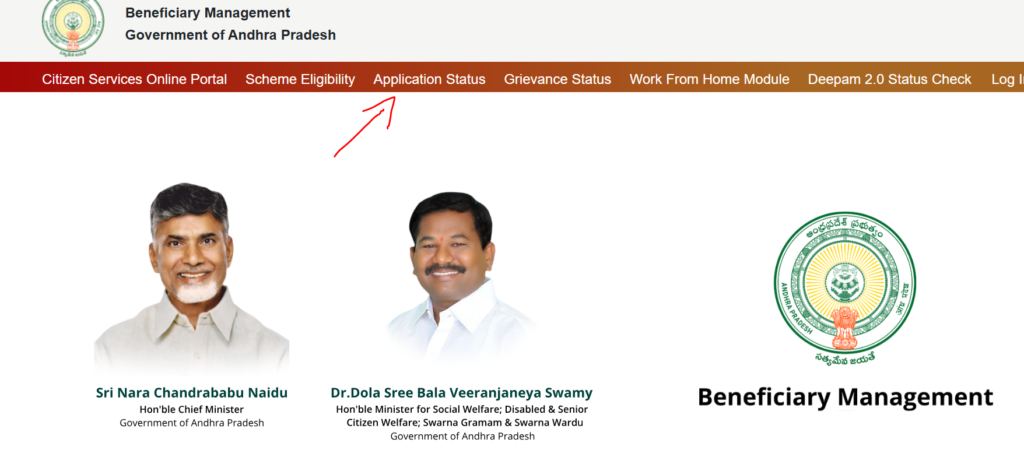
Click on the link for the payment status, and it will take you to the Beneficiary Management Government of Andhra Pradesh website. – CLICK HERE
Step 2: Enter Login Credentials
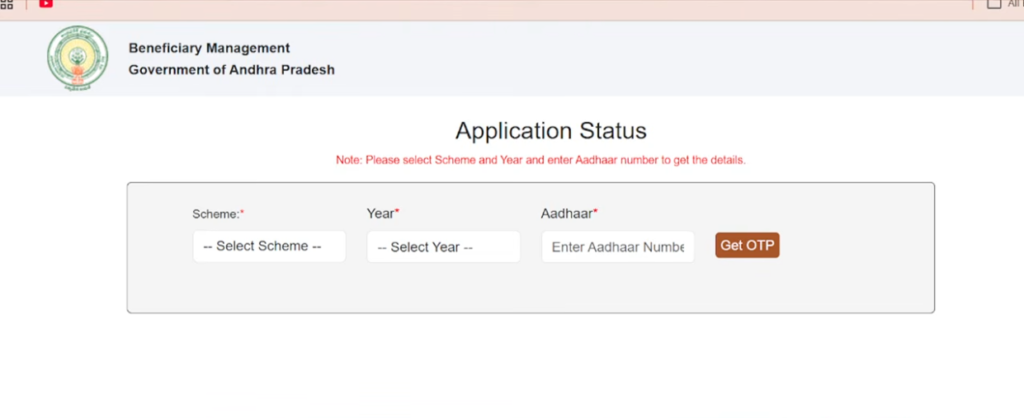
Once on the site, you will need to:
- Select the Scheme: Choose “Talliki Vandanam” from the dropdown menu.
- Select the Year: Choose “2026-27.”
- Choose Search Method: Select the option “Search by Mother/Father/Guardian.”
- Enter Aadhaar Number: Enter the Mother’s Aadhaar number (as per her application).
- Generate OTP: Click on “Get OTP.”
- You will see a CAPTCHA code. Enter it carefully.
- An OTP will be sent to the mobile number registered with the mother’s Aadhaar. Enter the OTP to verify.
Step 3: View the Status
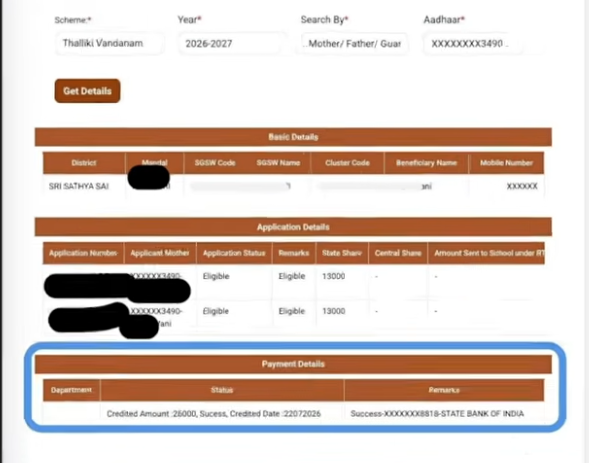
Once you log in, you will see the application details. The screen will show:
- Basic Details
- Application Details
- Payment Details
In the Payment Details section, you can see the updated status.
Example: As you can see in my example, the payment date is 22/07/2026. The amount for two children (₹13,000 each, totaling ₹26,000) was successfully credited to a State Bank of India (SBI) account. This confirms the payment status has been updated.
How to Check Payment Status via WhatGovernance
If the BM Portal is down, you can also check your payment status via the WhatGovernance platform. Here is the process:
- Start a Conversation: Send a “Hi” message to the WhatGovernance contact.
- Select the Service: You will get a reply with options. Choose the “Select a Service” option.
- Choose the Scheme: Select “Talliki Vandanam” from the list of services.
- Check Status: Choose the option for “2026-27 Status” and click on “Confirm.”
- Enter Aadhaar: You will be asked to enter the mother’s Aadhaar number. The system will then send an OTP to her registered mobile number.
- View Details: After entering the OTP, your application status and payment details will be displayed. While I cannot show a live demo due to technical and security issues, I assure you the process is straightforward.
Addressing Errors and Issues
1. Grievance Applications Temporarily Suspended
The government has temporarily stopped accepting new grievance applications. I will provide an update as soon as they resume. Please stay tuned.
2. “Not in TV List” / “Data Not Set” Errors
Many of you have reported seeing errors like “Not in TV List” or “Data Not Set” when checking your payment details. This issue arises because the data from the Education Department has not yet been properly transferred to the Secretariat Department. If you see these errors, you will need to raise a grievance once the system is active again.
The government has identified approximately 38 types of problems, and you can file a grievance for any of them.
General Information & Updates
1. 1st Class & Inter 1st Year Students:
You may have noticed that some students, including those in 1st Class and Intermediate 1st Year, have already received their payments. The government had initially stated that funds for 1st Class students would be released in August. However, they were released earlier on the 22nd. If you fall into this category and haven’t received your payment, you should file a grievance when the portal opens.
2. Payment Schedule & Banks:
- For the current phase, all payments will be credited by July 30th.
- If you haven’t received the money, it could be due to bank server issues. Don’t worry, the amount will be credited.
- Second Phase: After July 30th, the second phase will begin for other beneficiaries. Their payments will be processed by August 30th.
Eligibility Criteria of Thalliki Vandanam Scheme
To get the benefits of the Thalliki Vandanam Scheme, families must meet certain rules set by the government. Both the family conditions and the student’s conditions are checked before giving the money. Here are the complete eligibility criteria in simple points:
Family Income Rules:
- Rural families must have a monthly income below ₹10,000
- Urban families must have a monthly income below ₹12,000
Rice Card Requirement:
- At least one person in the family must have a rice ration card (white ration card)
Land Ownership Rules:
- The family should not own more than 3 acres of wet land (paddy fields)
- Or not more than 10 acres of dry land
- Or a combined total of less than 10 acres of both wet and dry land
Vehicle Rules:
- The family should not own a private four-wheeler car
- Taxis, autos, and tractors are allowed and do not count
Electricity Usage:
- The family’s monthly electricity bill should be less than 300 units on average
- This is calculated using the last 12 months’ bills
House Property Rules:
- The family should not own any municipal property of 1,000 square feet or more
Government Job Rules:
- No family member should be working in Central or State Government jobs or PSUs
- Sanitation workers are exempted from this rule
- Government employees getting less than ₹10,000 (rural) or ₹12,000 (urban) are also exempted
Income Tax Rules:
- No family member should be paying income tax
Student Rules:
- The child must be studying in Class 1 to Class 12
- The school must be a recognized Government, Aided, Private, or Residential school
- The student must have at least 75% attendance in the previous academic year
- Students in ITI, Polytechnic, or IIIT courses are NOT eligible
- Orphans and street children enrolled through voluntary organizations are eligible
Bank Account Rules:
- The mother’s bank account must be linked with Aadhaar through NPCI
- This is very important for receiving the DBT payment
Yuva Nidhi Scheme 2026 – ₹3,000 Monthly Allowance, Eligibility & Online Application
Benefits of Thalliki Vandanam Scheme
The Thalliki Vandanam Scheme offers many benefits to mothers, students, and schools in Andhra Pradesh. Here are the main benefits explained in detail:
Financial Support to Mothers
- Every eligible mother gets ₹15,000 per year for each child studying in school
- This money is sent directly to her bank account, so she can use it for school fees, books, uniforms, and other education needs
- There is no limit on the number of children – if a mother has 3 children in school, she gets ₹15,000 × 3 = ₹45,000 per year
School Development Fund
- ₹2,000 is deducted from each student’s ₹15,000 for school development
- This money is used for:
- Building maintenance and repairs
- Cleaning and hygiene work
- Toilet and sanitation facilities
- Other school infrastructure needs
Increased Coverage
- The scheme covers 67.27 lakh students, which is 24.66 lakh more than the old Amma Vodi scheme
- This means many more poor families are getting help now
Support for All Communities
- The scheme gives special attention to SC, ST, BC, Minority, and EWS students
- Out of 67.27 lakh beneficiaries:
- 29.82 lakh are from Backward Classes (BC)
- 11.76 lakh are from Scheduled Castes (SC)
- 4.26 lakh are from Scheduled Tribes (ST)
- 66,500 are from minority communities
- 8.44 lakh are from Economically Backward Classes (EBC)
Encourages School Attendance
- Because 75% attendance is required, students are motivated to go to school regularly
- This helps improve the literacy rate in Andhra Pradesh
Direct and Transparent Payment
- The DBT system makes sure there is no corruption or delay
- Mothers get the money directly without any agent or middleman
Application Procedure of Thalliki Vandanam Scheme
The Thalliki Vandanam Scheme does not have a separate online or offline application form that parents need to fill. The government collects data automatically from schools and verifies it. However, there are important steps that parents and schools must follow to make sure the student is included in the beneficiary list.
How the Government Collects Data (Online Process)
The application process is mainly done through data collection by the government:
- Step 1: The School Education Department and Board of Intermediate Education collect student data from all recognized schools
- Step 2: School heads enter student details into the UDISE portal and other official portals
- Step 3: The data includes:
- Student’s name, Aadhaar number, gender, caste, date of birth, class, school name, and attendance percentage
- Mother’s name, Aadhaar number, age, and relationship with the student
- Step 4: The GSWS Department checks and cleans the data by:
- Validating Aadhaar numbers
- Removing duplicate or wrong entries
- Mapping mother and child correctly
- Cross-checking with Household Survey and Civil Supplies data
- Step 5: After verification, the eligible list is prepared and displayed at Grama/Ward Sachivalayams
- Step 6: The money is then sent directly to the mother’s Aadhaar-linked bank account
AP OBMMS Self Employment Schemes 2026-27: Apply Online for Subsidy Loans | Eligibility, Process
What Parents Need to Do (Offline Process)
Since there is no direct application form, parents should:
- Make sure their child’s school has the correct Aadhaar number and details
- Ensure the mother’s bank account is linked with Aadhaar through NPCI
- Check the eligible list displayed at the local Sachivalayam
- If their name is missing or marked ineligible, raise a grievance at the Sachivalayam
Important Dates of Thalliki Vandanam Scheme
Here is the table of important dates for the Thalliki Vandanam Scheme 2026-27:
| Activity | Date |
|---|---|
| Scheme Launch Date | 12 June 2025 |
| Payment Start Date 2026 | 19 June 2026 |
| School Reopening Date | 12 June 2026 |
| Eligible List Display at Sachivalayams | June 2026 |
| Grievance Submission Last Date | 20 June 2026 |
| Grievance Verification Period | 21 June to 28 June 2026 |
| Final List Publication | 30 June 2026 |
| Academic Year Considered | 2025-26 and 2026-27 |
| Budget Allocation 2026-27 | ₹9,668 crore |
Documents Required to Apply for Thalliki Vandanam Scheme
To be included in the Thalliki Vandanam Scheme beneficiary list, the following documents and details are required. Parents should make sure all these are correct and updated:
- Student’s School Registration Details – Proof that the child is enrolled in a recognized school
- Passport Size Photograph – Of the student or mother as required by the school
- Aadhaar Card – Of both the student and the mother (or guardian)
- Birth Certificate – To verify the student’s age and class
- Caste Certificate – For SC/ST/BC/Minority students (if applicable)
- Parents ID Proof – Any government-issued identity proof
- Address Proof – Ration card or any other address document
- Income Proof – To show the family income is below the limit
- Rice Ration Card – White ration card is mandatory for eligibility
- Parents Bank Account Details – Bank passbook with Aadhaar seeding
- NPCI Linking Proof – Confirmation that Aadhaar is linked to the bank account for DBT
- Electricity Bill – Last 12 months’ bills to check consumption is below 300 units
- Land Documents – To prove land holding is within limits
- Attendance Certificate – From school showing 75% or more attendance
Chandranna Bima Yojana 2026: ₹5 Lakh Accident Insurance for AP Workers | Eligibility, Claim Process
Based on the search results, here are the key dates for the Thalliki Vandanam scheme for the 2026-27 academic year.
Thalliki Vandanam Scheme Important Dates (2026)
| Date | Event / Activity | Details |
|---|---|---|
| July 22, 2026 | First Phase Disbursement | The first round of payments is credited to verified eligible mothers/guardians . Beneficiary lists are published at local offices . |
| July 22 – Aug 3, 2026 | Grievance Submission Period | Time for eligible individuals who were left out to file complaints for rectification . |
| Aug 4 – 10, 2026 | Grievance Verification | Government officials verify the submitted grievances and prepare supplementary lists . |
| Aug 25, 2026 | Admission Cut-off Date | Deadline for considering fresh admissions into Class I and Junior Intermediate for the scheme . |
| Aug 30, 2026 | Final Supplementary Payment | Final list is published and additional payments (including for new admissions and resolved grievances) are credited . |
Application Fee and Scheme Fee
The Thalliki Vandanam Scheme is completely free for all eligible families. There is no application fee, registration fee, or any other charge to be included in the beneficiary list. Parents should be careful of fraudsters who ask for money in the name of this scheme.
Important Points:
- No fee is required to apply or check status
- No agent or middleman is authorized to collect money
- The ₹2,000 deduction is done automatically by the government from the ₹15,000 – parents do not need to pay this separately
- If anyone asks for money to add your name to the list, report it to the police or your local Sachivalayam
Latest Updates of Thalliki Vandanam Scheme
Here are the latest updates about the Thalliki Vandanam Scheme as of 2026:
- Budget 2026-27: The Andhra Pradesh government has allocated ₹9,668 crore for the Thalliki Vandanam Scheme in the 2026-27 budget. This is a big increase from the previous year.
- Payment Date Confirmed: CM Chandrababu Naidu has announced that payments for the 2026-27 academic year will start on 19 June 2026, when schools reopen after summer holidays.
- Increased Coverage: The scheme now covers 67.27 lakh students, which is 24.66 lakh more than the old Amma Vodi scheme. This includes students from all communities.
- All Children Covered: Unlike Amma Vodi which gave money for only one child per family, Thalliki Vandanam gives money for every child in the family, no matter how many.
- School Infrastructure Fund: The ₹2,000 deduction per student is being used to improve school buildings, toilets, and cleanliness across the state.
- Grievance System Improved: The online grievance system has been made stronger so that parents who are wrongly marked ineligible can get their issues solved quickly.
- NPCI Linking Mandatory: The government has made it clear that without Aadhaar-NPCI linking, payments cannot be credited. Parents are advised to complete this at their bank immediately.
Selection Process of Thalliki Vandanam Scheme
The selection of beneficiaries for the Thalliki Vandanam Scheme is done through a detailed verification process by the government. Here is how it works:
- Data Collection: Schools and junior colleges send student data to the School Education Department and Board of Intermediate Education
- Data Entry: School heads enter all details into the UDISE portal and official government portals
- Aadhaar Validation: The GSWS Department checks if the Aadhaar numbers of both student and mother are correct
- Duplicate Removal: Any duplicate entries or wrong information is removed
- Mother-Child Mapping: The system checks that the student is correctly linked to the mother or guardian
- Cross-Verification: The data is matched with:
- Household Survey data
- Civil Supplies Department data (for rice card verification)
- Electricity department data (for power consumption)
- Transport department data (for vehicle ownership)
- Revenue department data (for land ownership and income)
- 6-Step Validation: The system checks six main parameters:
- Land ownership
- Urban property
- Electricity consumption
- Four-wheeler ownership
- Income tax payment
- Government employment
- Final List: After all checks, the final eligible list is prepared and displayed at Sachivalayams
Common Mistakes While Applying
Since there is no direct application form, parents often make mistakes that lead to their names being marked ineligible. Here are common mistakes to avoid:
- Wrong Aadhaar Number: If the school enters the wrong Aadhaar number, the student will be rejected
- NPCI Not Linked: Many mothers forget to link their bank account with Aadhaar through NPCI – this is the biggest reason for payment failure
- Incorrect Bank Details: If the bank account number or IFSC code is wrong, the money cannot be transferred
- Low Attendance: Students with less than 75% attendance are automatically removed from the list
- Wrong Income Data: If the family’s income is shown above the limit, the application is rejected
- Missing Rice Card: Families without a valid rice card are not considered
- Not Checking the List: Many parents do not visit the Sachivalayam to check the displayed list and miss the chance to correct errors
- Late Grievance Submission: Waiting too long to raise a grievance means missing the deadline
Reasons for Application Rejection
Your child’s name may be marked ineligible for the Thalliki Vandanam Scheme due to these reasons:
- Family income is above the limit – More than ₹10,000/month (rural) or ₹12,000/month (urban)
- No rice card in the family
- Land ownership exceeds limits – More than 3 acres wet or 10 acres dry land
- Owns a four-wheeler (except taxi, auto, tractor)
- Electricity consumption is above 300 units per month on average
- Owns municipal property of 1,000 sq. ft or more
- Family member is a government employee (except sanitation workers and low-salary employees)
- Any family member pays income tax
- Student attendance is below 75%
- Student is in ITI, Polytechnic, or IIIT (not eligible)
- Aadhaar is not seeded with bank account through NPCI
- Student is not in the household database
- Duplicate application or wrong data entry
- Student studies in an unrecognized school
How to Register and Login to the GSWS-NBM Portal
The Thalliki Vandanam Scheme status is checked through the GSWS-NBM (Grama/Ward Sachivalayam – Navasakam Beneficiary Management) Portal. Here is how to use it:
How to Access the Portal
- Open your browser and go to gsws-nbm.ap.gov.in
- This is the official portal for checking scheme status and other services
For Citizens (Status Check)
- You do not need to register or create an account
- Simply click on “Application Status Check”
- Enter your Aadhaar number and follow the OTP process
- No username or password is needed for basic status checking
For Officials (Login)
- Government officials like DA, WEDPS, MPDO, MC use their official login credentials
- They can access dashboards to:
- View beneficiary lists
- Process grievances
- Update data
- Generate reports
Reset and Forget Password for the Portal
Since citizens do not need a password to check their Thalliki Vandanam status (they use Aadhaar + OTP), there is no separate password reset process for beneficiaries.
For officials who forget their password:
- Visit the GSWS-NBM portal login page
- Click on “Forgot Password” option
- Enter your registered email or mobile number
- An OTP or reset link will be sent
- Follow the instructions to create a new password
- If the problem continues, contact the GSWS Department or your department’s IT cell
For citizens facing OTP issues:
- Make sure your mobile number is linked to your Aadhaar
- If you are not receiving OTP, check with your mobile service provider
- You can also visit the nearest Sachivalayam for offline status checking
Chandranna Bima Yojana 2026: ₹5 Lakh Accident Insurance for AP Workers | Eligibility, Claim Process
Grievance Redressal Process
If your name is wrongly marked ineligible or you face any problem with the Thalliki Vandanam Scheme, you can raise a grievance. Here is how:
Online Grievance Process
- Visit the NBM Portal at gsws-nbm.ap.gov.in
- Login with your credentials (for officials) or visit the citizen section
- Click on “Create Grievance”
- Select the scheme name: “Thalliki Vandanam (FY 2025-26 or 2026-27)”
- Select the type of grievance: “6 Step Validation Parameters”
- The system will show which parameter made you ineligible (land, vehicle, electricity, etc.)
- Fill in the details and submit
Offline Grievance Process
- Visit your nearest Grama Sachivalayam or Ward Secretariat
- Ask the DA or WEDPS officer to register your complaint
- If the ineligibility is due to technical reasons, they will note it in the manual register
- For vehicle-related issues (RTA), the District Transport Officer will verify
- For income tax issues, the VRO → MRO → RDO → JC will verify
- For electricity, land, or other issues, raise a service request through the APSEVA portal at your Sachivalayam
Grievance Timeline
- Grievances are accepted from 12 June to 20 June 2026
- Verification is done from 21 June to 28 June 2026
- Final list is published on 30 June 2026
Renewal Process
The Thalliki Vandanam Scheme is renewed automatically every year for students who continue to meet the eligibility criteria. However, there are some important points:
- Automatic Renewal: If the student continues in the same school and meets all criteria, the renewal is automatic
- Attendance Check: Every year, the student’s attendance is checked again. If it falls below 75%, the benefit is stopped for the next year
- New Admissions: Students joining Class 1 and Class 11 (Intermediate first year) are added after the enrollment process is complete
- Data Update: If there are any changes in family income, land, or other details, the school must update the data in the portal
- Bank Account: Make sure the mother’s bank account remains active and Aadhaar-linked throughout the year
- No Separate Renewal Form: Parents do not need to fill any renewal form – the school and government handle it
Important Links and PDFs of the Scheme
Here are the important official links and documents for the Thalliki Vandanam Scheme:
| Resource | Link |
|---|---|
| Official Portal | gsws-nbm.ap.gov.in |
| Status Check Page | gsws-nbm.ap.gov.in/NBM/#!/ApplicationStatusCheckP |
| GSWS Dashboard | gsws-nbm.ap.gov.in/BM/ |
| APSEVA Portal | apseva.ap.gov.in |
| NPCI Aadhaar Linking | www.npci.org.in |
| GO MS No. 26 (Guidelines) | Available on AP School Education Department website |
| GO MS No. 27 (Launch Order) | Available on AP School Education Department website |
| Grievance SOP Document | Available at Sachivalayams and on GSWS portal |
Contact and Information of the Scheme
For any queries or help regarding the Thalliki Vandanam Scheme, you can use the following contact methods:
- Official Website: gsws-nbm.ap.gov.in – For status check and information
- Nearest Grama Sachivalayam: Visit your village secretariat for grievance registration and list checking
- Nearest Ward Secretariat: For urban area residents
- School Headmaster: For questions about student data and attendance
- District Collector Office: For serious complaints or orphan-related queries
- APSEVA Portal: For online service requests and grievances
- GSWS Department: For technical issues with the portal or data
- Helpline: Currently, no specific toll-free number is announced for Thalliki Vandanam. Please check the official website for updates or visit your nearest Sachivalayam.
Important Note: There is no official helpline number announced yet for this scheme. Be careful of fake numbers and fraud calls. Always verify information through the official portal or by visiting the Sachivalayam in person.
Frequently Asked Questions (FAQs)
Q1. What is the Thalliki Vandanam Scheme?
The Thalliki Vandanam Scheme is an Andhra Pradesh government welfare program that gives ₹15,000 per year per child to mothers of students studying from Class 1 to Class 12.
Q2. When will the Thalliki Vandanam payment be credited in 2026?
The payment for the 2026-27 academic year will start from 19 June 2026, when schools reopen after summer holidays.
Q3. How much money will I actually receive under Thalliki Vandanam?
You will receive ₹13,000 in your bank account. The government deducts ₹2,000 for school development work.
Q4. Can I get money for more than one child?
Yes. Unlike the old Amma Vodi scheme, Thalliki Vandanam gives money for every child in the family, no matter how many children you have.
Q5. What is the minimum attendance required?
The student must have at least 75% attendance in the previous academic year to be eligible.
Q6. Is there any application form to fill?
No. The government collects data automatically from schools. You just need to make sure your details are correct with the school.
Q7. Why is my name showing ineligible?
Your name may be ineligible due to reasons like high income, no rice card, land above limits, vehicle ownership, high electricity bill, government job, or low attendance.
Q8. What is NPCI linking and why is it important?
NPCI linking means your Aadhaar is connected to your bank account in the National Payments Corporation of India system. Without this, DBT payments cannot be credited.
Q9. How can I check my Thalliki Vandanam status?
Visit gsws-nbm.ap.gov.in, click on Application Status Check, enter your Aadhaar, and verify with OTP.
Q10. What should I do if my money is not credited?
First, check your status online. If you are eligible but money is not credited, visit your nearest Sachivalayam and raise a grievance before 20 June 2026.
Q11. Are ITI and Polytechnic students eligible?
No. Students in ITI, Polytechnic, and IIIT courses are not eligible for this scheme.
Q12. What is the difference between Thalliki Vandanam and Amma Vodi?
The main difference is that Thalliki Vandanam covers all children in a family, while Amma Vodi covered only one child per family. Also, Thalliki Vandanam covers 67.27 lakh students compared to Amma Vodi’s 42.61 lakh.
Q13. Do I need to pay any fee to apply?
No. The scheme is completely free. Do not pay any money to agents or middlemen.
Q14. Can orphans get this benefit?
Yes. Orphans and street children enrolled through voluntary organizations are eligible. The money is sent to the District Collector for verification and onward payment.
Q15. What documents do I need to keep ready?
Keep your Aadhaar card, rice card, bank passbook, caste certificate, income proof, electricity bills, and land documents ready.