The Himachal Pradesh Indira Gandhi Balika Suraksha Yojana is a flagship state government scheme launched by the Department of Health and Family Welfare to combat the declining child sex ratio and promote the welfare of the girl child in the state. The scheme was originally introduced in the year 2007 with the core objective of encouraging the small family norm while simultaneously improving the social status of daughters in Himachali households.
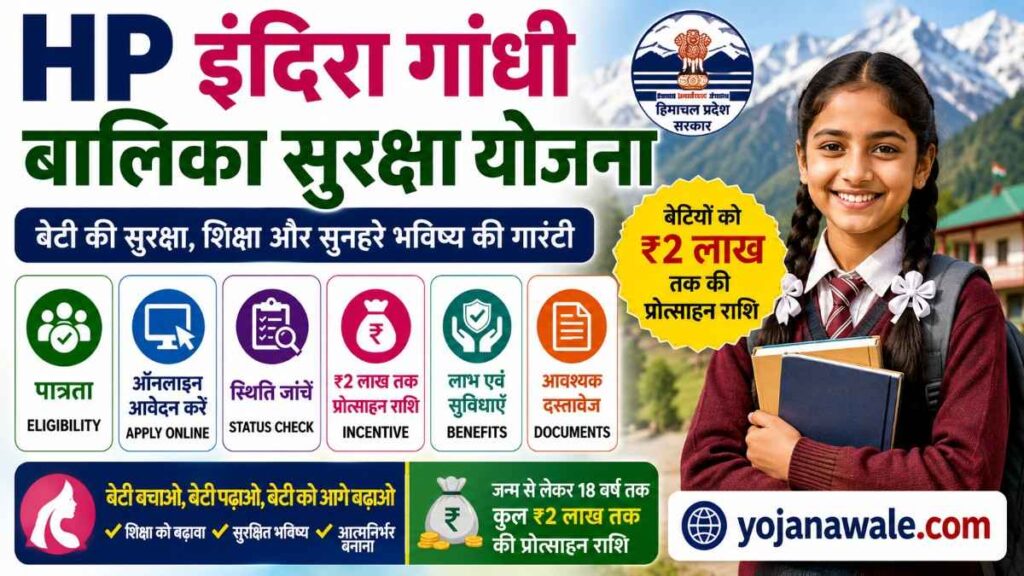
Under this initiative, the state government provides a substantial financial incentive to couples who voluntarily adopt permanent family planning methods after the birth of one or two girl children, with the condition that no male child exists in the family at the time of sterilization.
This scheme represents a unique approach to population stabilization by linking financial rewards directly to family planning decisions that favor daughters. Unlike many other girl child welfare schemes that focus solely on education or marriage, this program targets the root cause of gender imbalance by incentivizing parents to value their daughters and limit family size. The incentive amount is deposited in an interest-bearing account in the name of the girl child, which she can access upon reaching maturity, thereby ensuring long-term financial security for her future needs, education, or marriage expenses.
Thalliki Vandanam Scheme 2026: Eligibility, Apply Online, Status Check, Payment Date & Benefits
Quick Overview of HP Indira Gandhi Balika Suraksha Yojana
Here is a complete snapshot of the scheme for quick reference:
| Feature | Details |
|---|---|
| Scheme Name | Indira Gandhi Balika Suraksha Yojana (HP) |
| Launched By | Himachal Pradesh Government |
| Launch Year | 2007 |
| Implementing Department | Department of Health and Family Welfare |
| Revised Incentive (Single Girl Child) | ₹2,00,000 (revised from ₹35,000 in October 2023) |
| Revised Incentive (Two Girl Children) | ₹1,00,000 (revised from ₹25,000 in October 2023) |
| Original Incentive (Single Girl) | ₹25,000 (at launch, later ₹35,000) |
| Original Incentive (Two Girls) | ₹20,000 (at launch, later ₹25,000) |
| Beneficiary | Couples adopting family planning after one/two girl children |
| Condition | No male child at time of sterilization |
| Family Planning Method | Permanent sterilization (terminal method) |
| Deposit Type | Interest-bearing account in girl child’s name |
| Maturity Period | Payable to girl child at age of maturity |
| Maximum Beneficiaries per Family | Applicable for one or two girl children |
| Residence Requirement | Permanent resident of Himachal Pradesh |
| Application Initiation | Health Worker at Sub-Centre level |
| Verification Authority | Block Medical Officer (BMO) |
| Final Approval | District Family Planning Officer |
Objectives and Purpose of the Scheme
The Himachal Pradesh government designed this scheme with multiple interconnected goals that address both demographic and social challenges faced by the state. Understanding these objectives helps applicants appreciate the broader impact of their participation.
Primary Objectives:
- Improve the deteriorating sex ratio in Himachal Pradesh by reducing female foeticide and encouraging the birth of girl children
- Encourage the small family norm by rewarding couples who voluntarily limit their family size after having daughters
- Promote gender equality by financially valuing daughters equally with sons in family planning decisions
- Provide long-term financial security for girl children through interest-bearing deposits that mature when they need support
Secondary Objectives:
- Support the state’s efforts under the Pre-Conception and Pre-Natal Diagnostic Techniques (PC & PNDT) Act, 1994
- Reduce the social and economic burden on families with multiple children
- Create a positive mindset shift where daughters are seen as assets rather than liabilities
- Align with national goals of women empowerment and child welfare
Why This Scheme Matters:
Himachal Pradesh has historically maintained a relatively better sex ratio compared to many other Indian states, with the SRS data 2018-20 showing 950 females per 1,000 males. However, certain districts still face challenges, and this scheme acts as a preventive measure to ensure the ratio does not decline. By linking financial incentives to family planning decisions, the government creates a direct economic motivation for parents to cherish and invest in their daughters’ futures.
Thalliki Vandanam Scheme 2026: Eligibility, Apply Online, Status Check, Payment Date & Benefits
Who Can Apply for the Scheme
The eligibility criteria for the Indira Gandhi Balika Suraksha Yojana are specific and must be met precisely to qualify for the incentive. The scheme is not open to all families but targets a specific demographic that aligns with its population stabilization goals.
For the Couple (Parents):
- Both parents must be permanent residents of Himachal Pradesh
- The couple must have undergone permanent sterilization (terminal family planning method)
- The sterilization must have been performed by a registered medical officer at a government-approved facility
- The couple must have no male child at the time of accepting the sterilization method
- The couple’s names must be registered in the eligible couple register maintained by the Health Worker or Health Supervisor
For the Girl Child/Children:
- The family must have either one girl child or two girl children
- There should be no surviving male child in the family at the time of sterilization
- The girl children must be the biological children of the applying couple
Special Conditions:
- The sterilization certificate must be attested by the medical officer who performed the procedure
- An affidavit attested by an Executive Magistrate is required, stating the number and gender of children
- Only couples whose cases are verified at the Sub-Centre level and recommended by the Block Medical Officer are eligible
- The scheme is applicable across all 12 districts of Himachal Pradesh
Who Cannot Apply:
- Couples with a male child (even if they also have daughters)
- Couples who have not undergone permanent sterilization
- NRIs or non-residents of Himachal Pradesh
- Couples who have already availed the benefit for the maximum allowed cases
Revised Incentive Amount and Financial Benefits
In October 2023, the Himachal Pradesh government made a landmark announcement significantly enhancing the financial incentives under this scheme. Chief Minister Sukhvinder Singh Sukhu announced a major revision during a workshop on the PC & PNDT Act, 1994, held in Shimla.
Revised Incentive Structure (Effective October 2023):
| Category | Old Amount | Revised Amount | Increase |
|---|---|---|---|
| Single Girl Child | ₹35,000 | ₹2,00,000 | ₹1,65,000 (471% increase) |
| Two Girl Children | ₹25,000 | ₹1,00,000 | ₹75,000 (300% increase) |
Historical Incentive Evolution:
| Year | Single Girl Child | Two Girl Children |
|---|---|---|
| 2007 (Launch) | ₹25,000 | ₹20,000 |
| Pre-2023 | ₹35,000 | ₹25,000 |
| October 2023 Onwards | ₹2,00,000 | ₹1,00,000 |
How the Amount is Disbursed:
- The incentive amount is deposited in an interest-bearing account opened in the name of the girl child
- The account is maintained by the state government until the girl reaches maturity
- The accumulated amount (principal + interest) is paid to the girl child when she attains the age of maturity
- This ensures the funds grow over time and provide meaningful financial support for her education, vocational training, or marriage
Additional Benefits:
- The interest earned on the deposited amount adds to the final corpus
- The scheme is completely free of cost for eligible beneficiaries
- No processing fee or hidden charges are deducted from the incentive amount
Mukhyamantri Ayushman Arogya Yojana 2026: Eligibility, Apply Online, Status Check
Documents Required for Application
Preparing the correct documentation is crucial for a smooth application process. Based on the scheme’s operational framework and government guidelines, here is the complete document checklist:
| Document | Purpose | Issuing Authority |
|---|---|---|
| Sterilization Certificate | Proof of permanent family planning | Medical Officer who performed the procedure |
| Affidavit | Declaration of number and gender of children | Executive Magistrate |
| Birth Certificate of Girl Child | Proof of age and identity | Municipal Corporation / Registrar of Births |
| Residence Certificate (Himachali Bonafide) | Proof of permanent residency | Tehsildar / SDM Office |
| Identity Proof of Parents | KYC verification | Aadhaar Card / Voter ID / PAN Card |
| Eligible Couple Register Entry | Verification of registration | Health Worker / Health Supervisor |
| Bank Account Details | For deposit of incentive amount | Nationalized Bank / Post Office |
| Passport-size Photographs | Record maintenance | Self-attested recent photos |
| Medical Fitness Certificate | Confirming sterilization was safe | Performing Medical Institution |
| Family Ration Card / BPL Card | Economic status verification (if applicable) | Food & Civil Supplies Department |
Important Notes on Documentation:
- The sterilization certificate must specifically mention that the procedure was a terminal (permanent) method
- The affidavit must clearly state that the couple has only one or two female children and no male child
- All documents must be self-attested by the applicant
- Keep photocopies of all documents for your personal records
- The Health Worker at the Sub-Centre will verify original documents during the initial application stage
Step-by-Step Application Process
The application process for the Indira Gandhi Balika Suraksha Yojana follows a structured verification chain to ensure transparency and prevent fraudulent claims. Here is the complete step-by-step guide:
Step 1: Undergo Permanent Sterilization
- Visit a government hospital or approved medical facility
- Get the sterilization procedure done by a registered medical officer
- Obtain the sterilization certificate from the performing doctor
Step 2: Prepare the Affidavit
- Visit the office of an Executive Magistrate
- Submit an affidavit declaring:
- Number of children (one or two girls)
- Confirmation of no male child
- Details of the sterilization procedure
- Get the affidavit duly attested
Step 3: Contact Your Local Health Worker
- Approach the Health Worker or Health Supervisor at your nearest Sub-Centre
- Submit the sterilization certificate and affidavit
- Ensure your names are registered in the eligible couple register
- The Health Worker will initiate the application process
Step 4: Sub-Centre Verification
- The Health Worker verifies the genuineness of your case
- Checks the eligible couple register for your entry
- Prepares the case file with all supporting documents
Step 5: Block Medical Officer (BMO) Review
- The Health Worker submits the verified case to the concerned Block Medical Officer
- The BMO conducts a thorough review of all documents
- The BMO recommends the case to the District Family Planning Officer if satisfied
Step 6: District Level Approval
- The District Family Planning Officer gives final approval
- Once approved, the incentive amount is sanctioned for deposit
Step 7: Account Opening and Deposit
- An interest-bearing account is opened in the girl child’s name
- The sanctioned amount is deposited by the state government
- The account is maintained until the girl reaches maturity
Step 8: Maturity and Withdrawal
- Upon the girl child attaining maturity age, the accumulated amount (with interest) is released to her
- The girl can use this amount for education, vocational training, or other needs
Role of Health Workers and Government Officials
The successful implementation of this scheme depends heavily on the coordinated efforts of various government functionaries at different administrative levels. Understanding their roles helps applicants navigate the process effectively.
Health Worker / Health Supervisor (Sub-Centre Level):
- Maintains the eligible couple register in their jurisdiction
- Identifies potential beneficiaries during routine health surveys
- Initiates the application process by collecting documents from eligible couples
- Verifies the authenticity of sterilization certificates and affidavits
- Submits verified cases to the Block Medical Officer
Panchayat Secretary:
- Assists in local-level verification of the couple’s residence and family details
- Provides administrative support at the village level
- Helps in coordinating between the Health Worker and the Block Medical Officer
Block Medical Officer (BMO):
- Receives cases from Health Workers across all Sub-Centres in the block
- Conducts detailed scrutiny of application files
- Verifies that all eligibility conditions are met
- Recommends genuine cases to the District Family Planning Officer
- Rejects applications that do not meet the criteria with reasons
District Family Planning Officer:
- Exercises final authority over approval and sanction of incentive amounts
- Maintains district-level records of all beneficiaries
- Coordinates with the state treasury for fund release
- Monitors the overall implementation of the scheme in the district
State Government (Health and Family Welfare Department):
- Formulates and revises scheme guidelines
- Allocates budget for the scheme
- Issues notifications for incentive revisions
- Conducts statewide publicity campaigns through print and electronic media
- Monitors district-wise performance and beneficiary numbers
Rajasthan Mukhyamantri Work From Home Yojana 2026: Eligibility, Apply Online, Status
District-wise Implementation and Beneficiary Data
The Indira Gandhi Balika Suraksha Yojana is implemented across all 12 districts of Himachal Pradesh. While comprehensive district-wise beneficiary data for the revised scheme is still being compiled, historical data provides insight into the scheme’s reach.
Historical Beneficiary Overview:
| Financial Year | Number of Beneficiaries |
|---|---|
| 2007-08 | 152 |
| 2008-09 | 318 |
| 2009-10 | 233 |
| Total (First 3 Years) | ~700 girls |
Districts with Notable Performance:
- Chamba District – Recognized for maintaining a good sex ratio
- Shimla District – Awarded for effective implementation
- Mandi District – Commended for scheme outreach
Budget Allocation:
- The state government historically allocated approximately ₹33 lakh per annum for scheme implementation
- However, actual expenditure was only about one-third of the allocated budget, indicating scope for increased awareness and enrollment
- With the revised incentive amounts in 2023, the budget allocation is expected to increase significantly
Challenges in Implementation:
- Lack of adequate publicity in remote areas
- No robust monitoring mechanism in place
- Complex application procedure requiring multiple levels of verification
- Limited awareness among target beneficiaries about the revised incentive amounts
Comparison with Other HP Girl Child Schemes
Himachal Pradesh runs multiple welfare schemes for girls and women. Understanding how the Indira Gandhi Balika Suraksha Yojana differs from other programs helps families choose the right benefits.
| Feature | Indira Gandhi Balika Suraksha Yojana | Beti Hai Anmol Yojana (Now Indira Gandhi Sukh Suraksha Yojana) | Indira Gandhi Sukh Shiksha Yojana |
|---|---|---|---|
| Launch Year | 2007 | 2010 (Replaced in 2026) | 2023 |
| Department | Health and Family Welfare | Women and Child Development | Education Department |
| Target | Couples doing family planning after daughters | BPL families with newborn girls | Students for higher education |
| Incentive Type | Deposit in girl’s name | Deposit + Scholarships | Scholarship for professional courses |
| Amount | ₹2 lakh (1 girl) / ₹1 lakh (2 girls) | ₹25,000 deposit + insurance | Varies by course |
| Condition | Permanent sterilization, no male child | BPL status, girl born after April 2026 | Income below ₹1 lakh, HP resident |
| Maturity | At girl’s maturity age | After girl turns 18 (up to 27) | During course period |
| Insurance for Parents | Not included | ₹2 lakh each parent | Not applicable |
Other Related HP Schemes:
- Indira Gandhi Mahila Samman Nidhi Yojana – ₹1,500 monthly DBT to women aged 18-59
- Kalpana Chawla Chhatravriti Yojana – Scholarship for meritorious girls in science
- HP Girls Scooty Scheme – Free scooty for girls scoring high in Class 12
- Shubh Vivah Yojana – Marriage assistance (merged from Kanyadaan and Shagun Yojana)
Vidya Sambal Yojana 2026-27: Eligibility, Apply Online, Status Check, Salary & Latest Vacancies
Common Mistakes to Avoid During Application
Many eligible families miss out on benefits due to simple errors in the application process. Here are the most common mistakes and how to avoid them:
- Not Getting Permanent Sterilization: Only terminal methods qualify. Temporary methods like Copper-T, pills, or condoms do not make you eligible.
- Having a Male Child: Even if sterilized, couples with a surviving son cannot apply. The scheme is exclusively for families with only daughters.
- Missing the Eligible Couple Register: Ensure your names are registered with the Health Worker before applying. Unregistered couples face rejection.
- Incomplete Affidavit: The affidavit must clearly state the exact number and gender of children. Vague statements lead to delays.
- Wrong Medical Officer Certificate: The sterilization certificate must be from the medical officer who actually performed the procedure, not just any doctor.
- Delay in Application: Apply as soon as possible after sterilization. Delayed applications may face verification challenges.
- Not Keeping Copies: Always keep self-attested photocopies of every document submitted. This helps in case of file misplacement.
- Ignoring Follow-ups: After submitting to the Health Worker, regularly follow up with the BMO office to track your application status.
- Providing False Information: Any misrepresentation discovered during verification leads to permanent disqualification and possible legal action.
- Not Updating Contact Details: Ensure your mobile number and address are current so officials can reach you for verification.
Important Links and Official Resources
Here are the official links and resources you need to apply for and track your application under the HP Indira Gandhi Balika Suraksha Yojana:
| Resource | Link / Details |
|---|---|
| Himachal Pradesh Government Official Portal | himachalpr.gov.in |
| HP Health and Family Welfare Department | hphealth.nic.in |
| HIMSeva Portal (e-Governance) | himseva.hp.gov.in |
| HIMSeva Helpline | 1800-180-8076 |
| HIMSeva Helpdesk Email | helpdesk-hp@nic.in |
| PC & PNDT Act Information | Available at Health Department offices |
| District Family Welfare Bureau Contacts | Available at respective District Headquarters |
| Block Medical Officer (BMO) Offices | Located at every Block Development Office |
| Sub-Centre / PHC Locator | Contact your nearest Panchayat or Gram Sevak |
Official Notifications and PDFs:
- Revised Incentive Notification under Indira Gandhi Balika Suraksha Yojana (October 2023)
- HP Cabinet Decision on Indira Gandhi Sukh Shiksha Yojana Amendments (February 2026)
- HP Budget 2026-27 Announcement on Indira Gandhi Sukh Suraksha Yojana
- PC & PNDT Act, 1994 Guidelines (Relevant to scheme implementation)
- Family Planning Sterilization Guidelines by Ministry of Health & Family Welfare
How to Access These Documents:
- Visit the Himachal Pradesh Government website and navigate to the Press Releases section
- Check the Health and Family Welfare Department’s notice board
- Contact your local Block Medical Officer’s office for printed copies
- Visit the District Family Welfare Bureau for scheme brochures and application guidelines
District-wise Contact Information:
- For district-specific BMO and CDPO contact details, visit the HIMSeva portal or contact the State Helpline at 1800-180-8076
- Each district has a designated Family Welfare Officer who can provide guidance on the application process
Frequently Asked Questions (FAQs)
Q1: Can I apply if I have one daughter and one son?
No. The scheme strictly requires that there be no male child in the family at the time of sterilization. Families with even one son are not eligible, regardless of the number of daughters.
Q2: What type of family planning is accepted under this scheme?
Only permanent sterilization methods are accepted. This includes tubectomy for women and vasectomy for men. Temporary methods like IUDs, oral pills, or barrier methods do not qualify.
Q3: Is the ₹2 lakh amount given in cash or deposited in an account?
The amount is deposited in an interest-bearing account opened in the girl child’s name. It is not given as cash to the parents. The girl child receives the accumulated amount (with interest) at maturity.
Q4: Can NRIs or non-Himachali residents apply?
No. Both parents must be permanent residents of Himachal Pradesh. The scheme is exclusively for Himachali families.
Q5: What happens if the girl child passes away before maturity?
In the unfortunate event of the girl child’s death before the account matures, the deposited amount typically reverts to the state government as per scheme rules. Parents should check with the District Family Planning Officer for specific procedures.
Q6: Can I apply if I adopted my daughter?
The scheme is designed for biological children of the couple. Adopted children may not be eligible unless specifically covered under revised guidelines. It is best to confirm with the Health Department.
Q7: How long does the application process take?
The timeline varies by district and verification workload. Typically, after submitting documents to the Health Worker, it takes 2-3 months for the case to move through BMO review to District Officer approval and final deposit.
Q8: Is there any income limit or BPL requirement?
Unlike the Beti Hai Anmol Yojana, the Indira Gandhi Balika Suraksha Yojana does not have a BPL or income criteria. The only conditions are residency, sterilization, and having no male child.
Q9: Can I get the benefit for a third daughter?
No. The scheme provides benefits for one or two girl children only. A third daughter would not make the family eligible for additional incentives under this scheme.
Q10: Where can I get the application form?
There is no separate downloadable form. The application process is initiated by the Health Worker at your local Sub-Centre. Visit your nearest government health sub-centre or Primary Health Centre (PHC) to start the process.