Punjab Farishtey Yojana is a life-saving welfare scheme launched by the Government of Punjab to provide immediate, hassle-free, and cashless medical treatment to road accident victims during the critical “golden hour.” The scheme was officially launched in 2024 by the Governor of Punjab with the primary objective of reducing the mortality and morbidity rate caused by roadside accidents across the state.
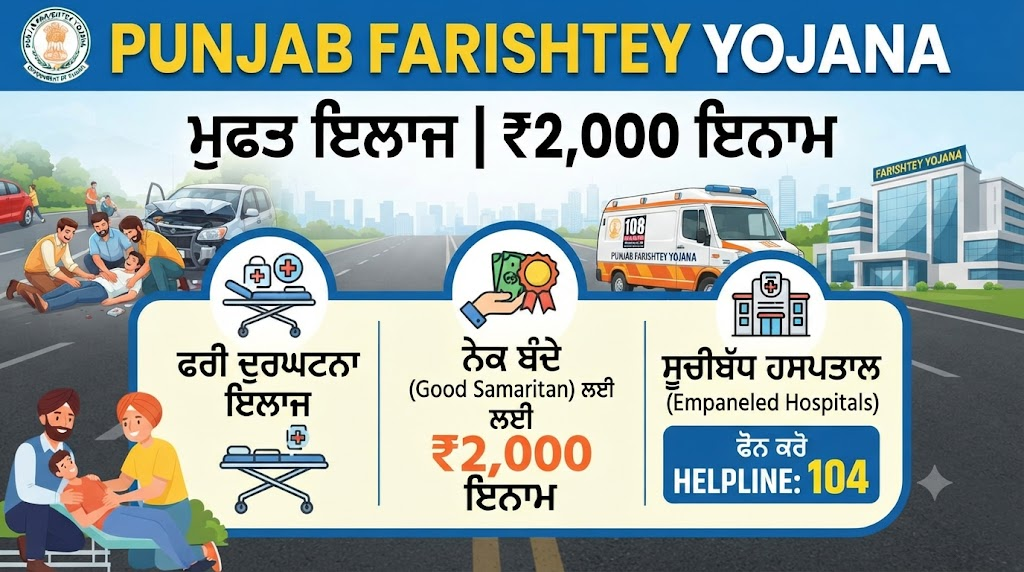
Under this scheme, any road accident victim who is brought to a government or empaneled private hospital receives completely free treatment from the moment of arrival until discharge, regardless of whether the victim has any other insurance coverage. The scheme also honors and rewards ordinary citizens who step forward to help accident victims by conferring them the title of “Farishta” and giving them a cash reward of ₹2,000 along with a commendation certificate.
Additionally, these Good Samaritans are provided complete legal immunity and protection from police harassment or prolonged inquiries, addressing the common fear that prevents bystanders from helping accident victims in India. The scheme is integrated with Punjab’s emergency response infrastructure, including the 108 ambulance service, 112 emergency helpline, and the Sadak Surakhiya Force (SSF), creating a seamless rescue-to-treatment chain that has already saved hundreds of lives since its inception.
Delhi Female Cab Drivers Scheme 2026: Apply for Women Driver Programs & Benefits
Quick Overview Table of Punjab Farishtey Yojana
| Particulars | Details |
|---|---|
| Scheme Name | Punjab Farishtey Yojana |
| Launched By | Governor of Punjab (Government of Punjab) |
| Launch Year | 2024 |
| Primary Objective | Free treatment for road accident victims; encourage bystanders to help |
| Good Samaritan Reward | ₹2,000 cash + commendation certificate |
| Legal Protection | Immunity from police inquiries and legal complications |
| Total Empaneled Hospitals | 494 hospitals (including 90 tertiary care hospitals) |
| Coverage Radius | 30 km stretch along national and state highways |
| Emergency Helplines | 108, 1033, 112 |
| Victims Treated (till Dec 2024) | 223+ accident victims |
| Annual Accidental Deaths in Punjab | Approximately 5,000 |
| Nodal Department | Lead Agency, Punjab Road Safety and Traffic Research Centre (PSRSC) |
| Road Safety Force | Sadak Surakhiya Force (SSF) — 144 vehicles |
| Accident Black Spots Identified | 798 (647 rectified, 106 remaining) |
| Budget Head | Road Safety Fund, Demand No. 29 |
Main Objectives Behind Launching Farishtey Yojana
The Punjab government introduced Farishtey Yojana with a multi-layered vision that addresses both the medical emergency response gap and the psychological barrier that prevents citizens from helping accident victims.
- Save Lives During the Golden Hour: Medical science confirms that the first hour after a traumatic injury — known as the “golden hour” — is critical for survival. The scheme ensures that accident victims receive immediate medical attention within this window by removing financial and bureaucratic barriers at hospitals.
- Encourage Bystander Intervention: In India, a major reason why accident victims bleed to death on roads is that bystanders fear police harassment, legal complications, and hospital admission procedures. By offering ₹2,000 and legal immunity, the scheme directly incentivizes citizens to become “Farishtas” and rush victims to hospitals.
- Provide Cashless Treatment: Victims often die because they cannot pay hospital deposits or because hospitals refuse treatment without upfront payment. Farishtey Yojana mandates that all empaneled hospitals provide completely free, cashless treatment from arrival to discharge.
- Reduce Road Accident Mortality: Punjab records approximately 5,000 accidental deaths every year. The scheme aims to significantly bring down this number by ensuring timely medical intervention and creating a robust emergency response ecosystem.
- Integrate with Emergency Services: The scheme is linked with 108 ambulances, 112 emergency response, and the Sadak Surakhiya Force (SSF) to create a coordinated rescue and treatment network across the state’s highways and critical roads.
- Extend Coverage Beyond Road Accidents: In a significant expansion announced in May 2025, the scheme was extended to cover victims of war and terrorist activities, ensuring comprehensive support for all trauma victims in the state.
HAPPY Card Scheme 2026: Free Bus Travel for Antyodaya Families, Eligibility & Apply Online
Who is a “Farishta” and What Benefits They Receive
Understanding the role and rewards of a “Farishta” is central to appreciating how this scheme transforms ordinary citizens into life-saving heroes.
- Definition of Farishta: Under the Farishtey Scheme, any person who brings a road accident victim to a government or empaneled private hospital is recognized as a “Farishta” — literally meaning “angel” or “savior.” There is no restriction on who can become a Farishta; any citizen, regardless of age, gender, or profession, qualifies.
- Cash Reward of ₹2,000: Every Farishta receives a cash reward of ₹2,000 as a token of appreciation from the Punjab government. This amount is given to acknowledge the time, effort, and moral courage shown by the citizen.
- Commendation Certificate: In addition to cash, the Farishta is awarded an official commendation certificate signed by government authorities. This certificate serves as a mark of honor and can be used for recognition in community and official forums.
- Legal Immunity and Protection: This is perhaps the most important benefit. The Farishta is provided complete immunity from:
- Police interrogation or prolonged questioning
- Legal proceedings related to the accident
- Being forced to stay at the hospital for paperwork
- Any liability arising from the accident
- Requirement to reveal personal identity details at the hospital
- No Upper Limit on Rewards: While the standard reward is ₹2,000 per incident, there is no stated annual cap on how many times a person can be recognized as a Farishta. A citizen who repeatedly helps accident victims can receive multiple rewards and certificates.
- Recognition at Official Events: The government organizes periodic felicitation ceremonies where outstanding Farishtas are publicly honored, creating positive social reinforcement for helping behavior.
Complete List of Documents Required for Farishta Reward Claim
While the scheme is designed to be hassle-free, Farishtas may need to provide minimal documentation to claim their reward. Here is the checklist.
| Document | Purpose |
|---|---|
| Aadhaar Card | Identity verification for reward disbursement |
| Mobile Number | For OTP verification and SMS confirmation |
| Bank Account Details | For DBT transfer of ₹2,000 reward |
| Basic Incident Details | Date, time, location of accident, hospital name |
| Witness or Hospital Verification | Confirmation from hospital staff or police station |
Important Notes:
- The scheme is designed to minimize paperwork. In many cases, the hospital or police station where the victim is admitted will automatically verify the Farishta’s details and forward the claim to the Lead Agency.
- The Farishta is NOT required to file a police report, give a statement, or sign any legal documents related to the accident. This is explicitly guaranteed under the scheme’s legal protection provisions.
- If the Farishta wishes to remain anonymous, they can do so and still receive the reward through a trusted intermediary or by providing only basic contact details.
- The ₹2,000 reward is typically processed within 15 to 30 days of the incident verification.
Uttarakhand ₹1 Tap Water Connection Scheme 2026: Benefits, Eligibility & Apply Online
Step-by-Step Process for Accident Victims and Farishtas
The scheme operates through a well-defined process that ensures both victims and helpers are treated with dignity and speed.
- Step 1 Accident Occurs: A road accident takes place on any road in Punjab, including national highways, state highways, and district roads.
- Step 2 Bystander Becomes Farishta: An ordinary citizen witnesses the accident and decides to help. They can either:
- Call the 108 ambulance helpline
- Call the 112 emergency helpline
- Call the 1033 highway helpline
- Directly transport the victim to the nearest empaneled hospital using their own vehicle
- Step 3 Hospital Admission: The victim is brought to any of the 494 empaneled hospitals. The hospital is legally bound to admit the victim immediately without asking for payment, deposit, or identity proof.
- Step 4 Free Treatment Begins: The hospital begins treatment immediately. All costs — including emergency care, surgery, ICU, medicines, diagnostics, and hospital stay — are covered under the scheme until the victim is discharged.
- Step 5 Farishta Verification: Hospital staff or the attending police officer notes the details of the person who brought the victim. This person’s name and contact are forwarded to the Lead Agency for Farishta recognition.
- Step 6 Reward Processing: The Lead Agency verifies the incident and processes the ₹2,000 reward along with the commendation certificate. The money is transferred to the Farishta’s bank account via DBT.
- Step 7 Discharge: The victim is discharged after full recovery. The hospital bills the Punjab government directly through the Road Safety Fund. The victim does not pay anything.
Empaneled Hospital Network and Coverage Map
The strength of Farishtey Yojana lies in its extensive network of empaneled hospitals strategically located to cover accident-prone zones.
| Hospital Category | Number | Coverage Details |
|---|---|---|
| Total Empaneled Hospitals | 494 | Across Punjab |
| Tertiary Care Hospitals | 90 | Major cities and district headquarters |
| Secondary Care Hospitals | 200+ | District and sub-district levels |
| Primary Care / Emergency Centers | 200+ | Rural and highway-adjacent areas |
| Coverage Radius | 30 km | Along all national and state highways |
How the Network Works:
- Hospitals are empaneled based on their proximity to accident black spots and their capacity to handle trauma cases.
- The 30 km coverage radius ensures that no accident victim is more than 30 minutes away from a treatment facility when transported by ambulance.
- Tertiary care hospitals handle complex surgeries, ICU care, and multi-specialty treatment.
- The 108 ambulance staff are trained to identify the nearest empaneled hospital based on the victim’s condition and transport them there directly.
- The Sadak Surakhiya Force (SSF) patrols 4,095 km of critical roads and coordinates with hospitals for quick referrals.
Finding the Nearest Empaneled Hospital:
- Call 108 or 112 the operator will guide you to the nearest empaneled hospital.
- Visit the Lead Agency office or check the official Punjab government road safety portal.
- Look for “Farishtey Yojana Empaneled” signage at hospital entrances.
Indira Gandhi Balika Suraksha Yojana HP 2026: Rs 2 Lakh for Single Girl Child, Eligibility & Apply
Integration with Emergency Services: 108, 112, and Sadak Surakhiya Force
Farishtey Yojana is not a standalone scheme — it is embedded within Punjab’s broader emergency response infrastructure.
- 108 Ambulance Service: The 108 helpline is the primary emergency medical response number. Ambulance staff are specially trained to:
- Provide first aid at the accident site
- Stabilize the victim during transport
- Identify and communicate with the nearest empaneled hospital
- Coordinate with the Farishtey Yojana system for cashless admission
- 112 Emergency Helpline: The unified emergency number 112 connects callers to police, fire, and medical services. For road accidents, 112 dispatches both police and ambulance support simultaneously.
- 1033 Highway Helpline: Dedicated to national and state highway emergencies, this helpline is particularly useful for accidents on remote highway stretches.
- Sadak Surakhiya Force (SSF): Launched on February 1, 2024, the SSF is a specialized highway patrol force with:
- 144 vehicles (116 Toyota Hilux pickup trucks and 28 Mahindra Scorpio SUVs)
- Coverage of 4,095 km of critical roads
- Patrol on national highways (2,628 km), state highways (761 km), and major district roads (395 km)
- Trained personnel who can provide first aid and coordinate hospital transport
- IT-Enabled Coordination: All helplines and the SSF use integrated IT systems to locate the nearest empaneled hospital, track ambulance movement, and ensure the victim reaches treatment within the golden hour.
Key Features That Make Farishtey Yojana Unique
Farishtey Yojana stands out among road safety initiatives in India due to its comprehensive and humane approach.
- Cashless Treatment from Arrival to Discharge: Unlike schemes that only cover emergency stabilization, Farishtey Yojana covers the entire treatment journey — from emergency room to surgery to ICU to final discharge — with zero cost to the victim.
- Legal Protection for Good Samaritans: This is the first scheme in Punjab that explicitly guarantees legal immunity to helpers, removing the single biggest barrier to bystander intervention in India.
- No Insurance Pre-Condition: Even if the victim has no insurance, no identity proof, or no money, they are still entitled to full treatment. The scheme is the ultimate safety net.
- Dual Benefit Structure: The scheme benefits both the victim (free treatment) and the helper (reward + protection), creating a positive cycle of community care.
- Extensive Hospital Network: With 494 empaneled hospitals including 90 tertiary care centers, the scheme has one of the largest hospital networks for accident care in any Indian state.
- Integration with Road Safety Fund: The scheme is financed through the dedicated Road Safety Fund, ensuring sustained budgetary support independent of general health budgets.
- Expansion to War and Terror Victims: The May 2025 extension to cover victims of war and terrorism makes this one of the most inclusive trauma care schemes in the country.
Indira Grah Jyoti Yojana 2026: 100 Units Electricity at Rs 100, Eligibility & Benefits
Common Mistakes to Avoid When Helping Accident Victims
Many well-meaning citizens hesitate or make errors during emergencies. Avoiding these mistakes can save lives.
- Hesitating Due to Fear of Police: The most common mistake is not helping because of fear of police involvement. Under Farishtey Yojana, you are legally protected. Do not let this fear stop you from saving a life.
- Moving the Victim Incorrectly: If the victim has a spinal or neck injury, improper movement can cause paralysis. Only move the victim if they are in immediate danger (e.g., from fire or oncoming traffic). Otherwise, wait for the 108 ambulance.
- Not Calling 108 First: Always call 108 before or while transporting the victim. The ambulance staff can provide medical guidance over the phone and will be ready at the hospital.
- Taking the Victim to a Non-Empaneled Hospital: While any hospital will eventually treat the victim, empaneled hospitals are prepared for immediate cashless admission under Farishtey Yojana. Try to identify the nearest empaneled hospital.
- Leaving the Scene Without Giving Details: If you want to claim the Farishta reward, ensure the hospital staff notes your name and mobile number. If you wish to remain anonymous, inform them clearly.
- Waiting for Others to Act: In emergency situations, the bystander effect often causes everyone to assume someone else will help. Be the first to act — your initiative can be the difference between life and death.
- Not Following Up on Reward: If you have helped a victim and provided your details, follow up with the Lead Agency or the hospital if you do not receive the ₹2,000 within 30 days.
Comparison with Central Good Samaritan Scheme and Other State Programs
Understanding how Punjab’s Farishtey Yojana compares with other initiatives helps citizens appreciate its unique value.
| Feature | Punjab Farishtey Yojana | Central Good Samaritan Scheme (MoRTH) | Karnataka Good Samaritan Act |
|---|---|---|---|
| Reward Amount | ₹2,000 | ₹5,000 (max 5 times/year) | No cash reward |
| Legal Protection | Yes — immunity from police and legal proceedings | Guidelines only | Yes — statutory protection under state law |
| Free Treatment for Victim | Yes — complete cashless treatment | No direct treatment provision | No direct treatment provision |
| Hospital Network | 494 empaneled hospitals | Not applicable | Not applicable |
| Certificate of Appreciation | Yes | Yes | No |
| Annual National Award | No | ₹1 lakh for 10 top Samaritans | No |
| Coverage | Road accidents + war/terror victims | Road accidents only | Road accidents only |
| Emergency Integration | 108, 112, 1033, SSF | Not integrated | Not integrated |
Why Punjab’s Scheme is Special:
- It is the only scheme that combines victim treatment, helper reward, legal protection, and emergency integration into one comprehensive program.
- The central scheme offers a higher reward (₹5,000) but does not provide direct treatment or emergency coordination.
- Karnataka provides legal protection but no financial incentive or treatment coverage.
- Punjab’s integration with the SSF and 108 ambulance service creates a seamless rescue-to-recovery chain that no other state currently offers.
Impact and Success Stories of Farishtey Yojana
Since its launch in 2024, Farishtey Yojana has delivered measurable results in saving lives and changing social behavior.
- Lives Saved: As of December 2024, the scheme had provided free medical treatment to 223 accident victims, many of whom would have died without immediate intervention. This number continues to grow as awareness spreads.
- Changing Mindsets: The scheme is gradually shifting the cultural norm in Punjab from “don’t get involved” to “help without fear.” More citizens are now willing to stop and assist accident victims.
- Hospital Compliance: The 494 empaneled hospitals have been trained and sensitized to admit accident victims immediately without demanding payment or identity proof. This has reduced admission delays significantly.
- SSF Effectiveness: The Sadak Surakhiya Force, with its 144 vehicles, has become a visible deterrent to reckless driving and a rapid response unit for highway accidents.
- Black Spot Rectification: Of the 798 accident black spots identified across Punjab, 647 have been rectified, leaving only 106 remaining. This infrastructure improvement complements the scheme’s medical response.
- National Recognition: The Punjab government’s approach to road safety, with Farishtey Yojana as its centerpiece, has been cited as a model for other states by road safety experts and the National Crime Records Bureau.
- Future Expansion: The May 2025 extension to war and terrorism victims shows the government’s commitment to broadening the safety net for all trauma cases, not just road accidents.
Important Links, PDF Notifications, and Official Resources
| Resource | Link / Contact |
|---|---|
| Punjab Government Official Portal | punjab.gov.in |
| Lead Agency, PSRSC — Road Safety | Lead Agency Office, Punjab Road Safety and Traffic Research Centre |
| 108 Emergency Ambulance Helpline | Dial 108 (Toll-free) |
| 112 Unified Emergency Helpline | Dial 112 (Toll-free) |
| 1033 Highway Helpline | Dial 1033 (Toll-free) |
| Sadak Surakhiya Force (SSF) | Integrated with 108/112/1033 helplines |
| Punjab Road Safety Fund Details | Finance Department, Demand No. 29, Major Head 3055-00-800-05-99 |
Frequently Asked Questions
Q1. What is the Farishtey Yojana in Punjab?
Farishtey Yojana is a Punjab government scheme that provides completely free, cashless medical treatment to road accident victims at 494 empaneled hospitals. It also rewards citizens who help victims with ₹2,000 and legal protection.
Q2. Who can become a “Farishta” under this scheme?
Any citizen of India who brings a road accident victim to a government or empaneled private hospital can become a Farishta. There are no restrictions based on age, gender, profession, or residency.
Q3. Will I face police trouble if I help an accident victim?
No. Under Farishtey Yojana, Good Samaritans are given complete legal immunity. You cannot be forced to give statements, stay at the hospital, or face legal proceedings related to the accident.
Q4. How much money does a Farishta receive?
Every Farishta receives a cash reward of ₹2,000 along with a commendation certificate from the Punjab government. The money is transferred to their bank account via Direct Benefit Transfer.
Q5. Do accident victims need to pay anything at the hospital?
No. The treatment is completely free and cashless from the moment of arrival until discharge. The hospital bills the Punjab government directly through the Road Safety Fund.
Q6. Which hospitals are covered under this scheme?
A total of 494 hospitals are empaneled, including 90 tertiary care hospitals. They are located within a 30 km radius of national and state highways. Call 108 or 112 to find the nearest empaneled hospital.
Q7. What emergency numbers should I call during a road accident?
Dial 108 for ambulance, 112 for unified emergency response, or 1033 for highway-specific emergencies. The Sadak Surakhiya Force (SSF) also patrols critical roads and can be reached through these numbers.
Q8. Can I claim the Farishta reward if I call an ambulance but do not go to the hospital?
The scheme primarily recognizes those who physically bring the victim to the hospital. However, if your call to 108 directly results in the victim’s rescue and you provide your details, the authorities may consider your case. It is best to accompany the victim or ensure the ambulance staff notes your contribution.
Q9. Has the scheme been expanded beyond road accidents?
Yes, in May 2025, the Punjab government extended Farishtey Yojana to cover victims of war and terrorist activities, ensuring they also receive free treatment and support.
Q10. How can I check if a hospital is empaneled under Farishtey Yojana?
Look for “Farishtey Yojana Empaneled” signage at the hospital entrance. You can also call 108 or 112 to confirm, or contact the Lead Agency, Punjab Road Safety and Traffic Research Centre (PSRSC) for the updated list.