
The Mukhyamantri Sukhad Rahat Yojana (MSRY) is a dedicated disaster management scheme introduced by the Government of Jharkhand. Administered through the Department of Home, Jail, and Disaster Management, this social welfare structure protects vulnerable rural households from financial hardship during severe water scarcity and crop failures.
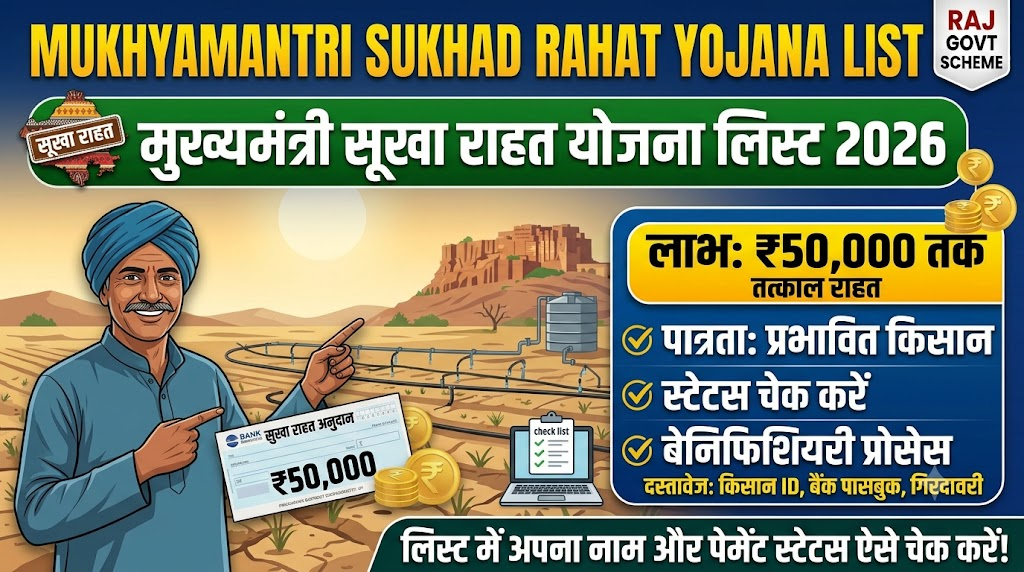
When rainfall declines drastically across Jharkhand’s rural belts, small and marginal farmers face sudden resource loss. This scheme addresses financial stress immediately by bypassing lengthy administrative cycles, using direct fund management to stabilize household budgets. The program operates alongside the Jharkhand Rajya Fasal Rahat Yojana (JRFRY) to build an institutional fallback mechanism for affected families.
Sinchai Pipeline Yojana 2026: Apply Online, Subsidy Rates & Farmer Registration Guide
Comprehensive Overview of the Financial Structure
The initiative functions as a temporary income relief system rather than a commercial crop insurance policy. By distributing uniform financial aid across declared zones, the state ensures all verified agrarian families receive equal financial breathing room.
| Operational Indicator | Institutional Policy and Disbursal Framework |
|---|---|
| Official Scheme Title | Mukhyamantri Sukhad Rahat Yojana (MSRY) |
| Sponsoring Authority | Department of Home, Jail, and Disaster Management, Jharkhand |
| Primary Financial Benefit | ₹3,500 fixed cash assistance per eligible farmer family |
| Target Population | Vulnerable small, marginal, tenant, and landless agricultural laborers |
| Implementation Mode | Direct Benefit Transfer (DBT) directly into Aadhaar-linked bank accounts |
| Core Verification Route | Unified State Portal linked with Pragya Kendras (CSC) and Land Records |
| Primary Exclusion Factor | Institutional employees, current taxpayers, and non-resident landholders |
Targeted Categories of Beneficiaries Covered
The disaster relief framework divides affected agrarian families into three distinct functional categories to systematically reach all layers of the rural economy.
- Category A (Raiyat Landowners with Crop Damage): Registered landowning farmers who cultivated crops during the season but experienced more than a 33% harvest decline due to erratic rainfall patterns.
- Category B (Affected Raiyat Landowners with Unregistered/Uncultivated Land): Small landowners who could not sow seeds or begin cultivation because of early-season drought conditions.
- Category C ( भूमिहीन किसान – Landless and Tenant Farmers): Sharecroppers and manual agricultural laborers who do not own land titles but depend entirely on seasonal farming tasks for income.
Eligibility Conditions for Applicant Evaluation
To ensure financial aid flows to those who need it most, the state enforces clear eligibility benchmarks during digital and physical evaluation cycles.
- Residential Status: The primary applicant must be an official, long-term resident of Jharkhand with an authentic domicile certificate.
- Geographical Criteria: The agricultural land or workspace must fall inside districts and blocks officially declared drought-hit by the state government.
- Occupational Proof: The individual must be actively engaged in agricultural tasks, verified by village assembly (Gram Sabha) registries or land revenue receipts.
- Financial Linkage: The applicant must possess an active, single-operated bank account mapped with their primary Aadhaar number via the National Payments Corporation of India (NPCI) gateway. Schemes In India 2026
Mandatory Documentation Set for Online Submission
To move quickly through the multi-tiered clearance process, applicants must keep a complete set of digital records ready for authentication.
- Identity Mapping: A clean copy of the Aadhaar Card alongside a valid Voter Identity Card.
- Financial Ledger: The front page of the bank passbook showing clear visibility of the IFSC code, account number, and transaction logs.
- Land Ownership Verification: Historical or current Land Revenue Receipts (Lagan Rasid), Khatiyan records, or formal inheritance certificates (Vanshavali) for verification.
- Tenant Authentication Form: A formal self-declaration certificate signed by the village headman (Pradhan or Mukhiya) for landless laborers and sharecroppers.
Step-by-Step Guide to the Online Registration Process
The registration process runs smoothly via digital channels, allowing individual access or assistance through village-level digital kiosks.
- Step 1: Access the unified digital web interface dedicated to Jharkhand crop and drought relief.
- Step 2: Choose the registration module and input the primary Aadhaar number to verify your details.
- Step 3: Fill in your personal profile details, ensuring your name matches your identity documents exactly.
- Step 4: Provide your banking details, verifying the automated IFSC branch connection.
- Step 5: Upload scanned copies of your land documents or tenant declarations.
- Step 6: Select your district, block, and Gram Panchayat from the drop-down menu to submit the application.
Biometric Verification at Pragya Kendras
To prevent duplicate applications or identity fraud, the state requires e-KYC biometric checks for all submissions.
- CSC Visit: Applicants take their physical tracking receipts to the nearest Pragya Kendra (Common Service Center).
- Biometric Scan: The center operator triggers live fingerprint or iris checks using the Aadhaar authentication engine.
- Verification Confirmation: The software prints a verified transaction receipt once the biometric system confirms the user’s identity.
Tracking Application Status and Beneficiary Lists
Farmers can monitor their application status and view updated beneficiary lists directly through the official portal.
- Portal Login: Users can log in using their registered mobile number or Aadhaar credentials.
- Status Review: The dashboard displays real-time stages, including local review, district approval, or bank payment status.
- District List Access: Districts regularly post public PDF lists of approved beneficiaries on their regional web portals for transparency.
Administrative Flow of Review and Approval
Applications pass through three distinct administrative levels to ensure funds are allocated correctly.
- Level 1 (Village/Halka Officer Verification): Local revenue officers (Karmchari) match your digital uploads with physical village land ledgers.
- Level 2 (Block Development/Anchal Officer Review): The block administration reviews the compiled lists to check for duplicate applications or income exclusions.
- Level 3 (District Task Force Approval): The District Magistrate or Collector signs off on the final database before releasing funds to the state treasury.
Mechanism of Direct Benefit Transfer Disbursal
The disbursement process connects the state treasury directly to your bank account, removing any intermediaries.
Schemes In India 2026
- PFMS Integration: The treasury routes the approved list through the Public Financial Management System (PFMS).
- Aadhaar-Based Bridge Payment: The system clears payments based on the applicant’s Aadhaar number rather than manual account typing, reducing processing errors. Schemes In India 2026
- SMS Notification: Beneficiaries receive a text confirmation on their registered mobile number once the ₹3,500 relief credit clears.
Resolving Payment Failures and Bank Mapping Errors
Incorrect bank details can pause your relief payments. You can fix these issues using standard state correction procedures.
- Identify the Reason: Check the portal to see if your payment failed due to an invalid IFSC code or an inactive account.
- NPCI Linkage: Visit your bank branch to request Aadhaar mapping via the NPCI form.
- Data Updates: Submit your updated passbook or correct account details at your local DIC or Pragya Kendra to restart the processing queue.
Essential Safety Protocols for Digital Security
Keep your personal information safe by following these digital safety guidelines during the registration cycle.
- Secure Logins: Do not share your portal passwords or OTP codes with unverified agents.
- Use Authorized Kiosks: Only complete biometric updates at officially recognized Pragya Kendras.
- Verify Bank Links: The state government never requests advance fees or card details to clear your relief payments.
Differentiating MSRY from Alternate Agricultural Schemes
Understanding how this relief framework differs from other agricultural programs helps you navigate state benefits effectively.
- MSRY vs. Insurance: MSRY provides flat disaster relief, while programs like JRFRY calculate compensation based on precise acreage and specific crop loss models.
- No Premium Cost: Farmers do not pay any premium fees to access these disaster relief funds.
- Broader Coverage: This scheme includes landless laborers, who are typically excluded from traditional crop insurance plans.
Frequently Asked Questions
Can a single family submit multiple applications for different land plots? No, the state limits relief to one payout per family unit. Multiple submissions using the same ration card or household tracking number will trigger an automated rejection.
What should I do if my village is not on the declared drought list? Relief funds apply only to areas officially declared drought-hit by state monitoring systems. If your area is excluded, look into alternative support programs like the Jharkhand Rajya Fasal Rahat Yojana.
Is there a processing fee for submitting applications at Pragya Kendras? The government covers the core service costs. Kiosks charge only a nominal, state-regulated fee for printing and scanning assistance.
Can a farmer with a pending bank loan default record apply? Yes, this program focuses on immediate disaster relief. A past loan default does not disqualify you from receiving emergency funds.
How do landless sharecroppers prove their farming status? Sharecroppers can submit a self-declaration form verified and signed by their local Gram Panchayat head or Mukhiya.
What happens if my biometric verification fails multiple times? If fingerprint verification fails, you can use iris scanning devices or update your mobile-linked Aadhaar OTP at an authorized Aadhaar center.
Can I change my bank account details after submitting the application? You can update your details if an officer flags your application with a correction request, or by visiting a Pragya Kendra before final district approval.
Does the scheme cover losses for horticultural crops like fruits and vegetables? The primary focus is stabilizing general crop losses and livelihoods during seasonal droughts, covering all standard field farming activities.
How do I check why my application status shows “Rejected”? Log into the portal to read the specific rejection note, which often cites mismatched documents, incorrect land numbers, or missing signatures.
Who is the main point of contact for technical portal errors? You can contact the technical helpdesk via email at jrfryhelpdesk@gmail.com or visit your local block administration office.
Essential Portal Links and Resources
- Official Jharkhand Fasal Rahat & Sukhad Portal: https://jrfry.jharkhand.gov.in/
- Jharkhand Agriculture Department Portal: https://www.myscheme.gov.in/schemes/cmdrs
- District Wise Beneficiary Status Portals: Available via the official directory at https://jharkhand.gov.in/