
Water scarcity and traditional open-channel flooding methods significantly lower farm yields while depleting precious groundwater resources. To solve this critical agricultural challenge, the government launched the Sinchai Pipeline Yojana (under the broader Per Drop More Crop initiative). This welfare program provides massive financial subsidies to small, marginal, and large-scale farmers to transition from wasteful open-water channels to underground or surface-pressurized pipe networks.
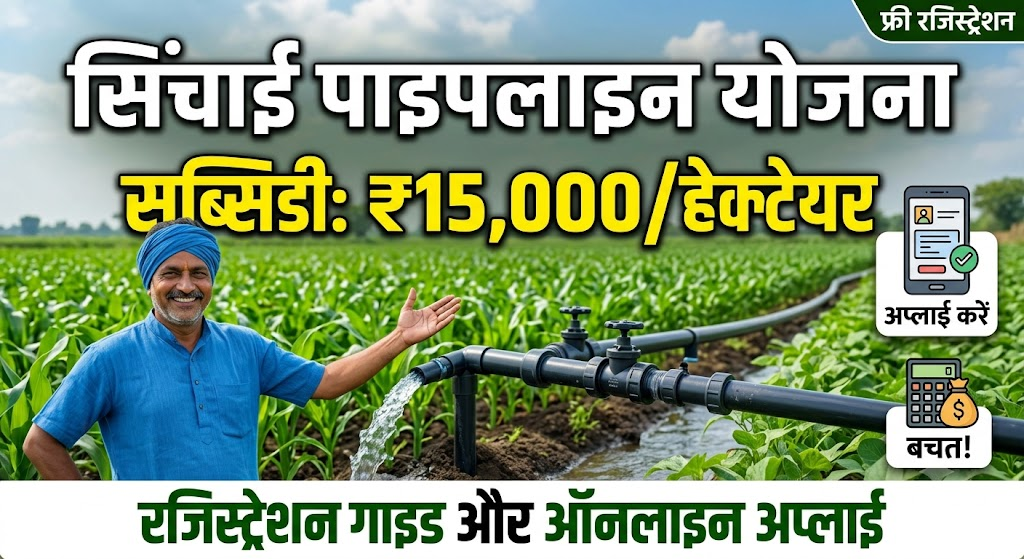
By carrying water directly from the well, tubewell, or farm pond to the crops through closed pipelines, farmers completely eliminate evaporation and seepage losses. The program is specifically targeted at increasing water-use efficiency by 30% to 40% while saving heavy electricity and pumping costs. Managing agricultural water through structured pipelines ensures that localized farm fields get adequate nourishment, directly driving up crop productivity across the country.
Maharashtra Free Silai Machine Yojana 2026: Application Form & Eligibility
Quick Scheme Overview and Highlights
To give agricultural portal visitors a clean, unified snapshot of this major irrigation subsidy framework, the primary structural data points are organized at a glance below.
| Key Feature | Scheme Specifics |
| Scheme Name | Krishi Sinchai Pipeline Yojana (Agriculture Pipeline Subsidy Scheme) |
| Nodal Department | Department of Agriculture and Farmers Welfare (State & Central Level) |
| Financial Assistance | 50% to 60% Subsidy on the overall purchase cost of pipelines |
| Maximum Subsidy Limit | Capped up to ₹15,000 per eligible farmer across specific pipe specifications |
| Approved Pipe Materials | HDPE, PVC, and High-Density Laminated Flat Tubes |
| Target Beneficiaries | Small, Marginal, and Community/Joint Farmers owning clear land titles |
| Application Mode | Online via State DBT Portals (e.g., RajKisan, MahaDBT, Saral Haryana) |
| Official Standard | BIS (Bureau of Indian Standards) certified approved manufacturers only |
Core Objectives of the Pipeline Subsidy Program
The multi-tiered operational framework of this scheme centers around structural eco-efficiency and agricultural wealth creation.
- Minimizing Water Wastage: The core purpose is to block natural water loss from transit evaporation, earth absorption, and leakages during surface flows.
- Reducing Production Cost: Pipeline networks ensure the fields fill faster, dramatically cutting down pump running time and reducing diesel or electricity consumption.
- Expanding Irrigable Land: Saved water means extra fields can now receive proper irrigation, allowing farmers to cultivate multi-seasonal crops on previously dry patches.
- Soil Health Maintenance: Closed pipelines prevent heavy waterlogging and the resultant soil salinity issues common in open channel paths.
Detailed Classification of Eligible Pipeline Materials
Subsidies are not given blindly on any arbitrary flexible pipe bought from local markets. The department honors structural grants only on specific high-grade manufacturing formats:
- HDPE (High-Density Polyethylene) Pipes: Rigorous, weather-resistant plastic channels designed to handle heavy water pressure for underground or semi-permanent routing layouts.
- PVC (Polyvinyl Chloride) Pipes: Rigid, standard structural pipes primarily deployed for fixed underground connection grids running from the water source to deep field sectors.
- HDPE Laminated Lay-Flat Tubes: Flexible, rollable fabric-laminated pipes that can be deployed seasonally and folded back easily, optimal for temporary or renting farmers.
Ultimate Subsidy Structure and Financial Limits
The financial assistance provided under the Sinchai Pipeline Yojana is highly calculated and varies based on the type of material selected by the farmer.
- Grants for HDPE Material: The government issues a subsidy of 50% of the actual unit cost or ₹50 per meter, whichever hits a lower proportional value.
- Grants for PVC Material: Eligible applicants secure an official relief of ₹35 per meter directly credited after the field verification phase.
- Grants for Lay-Flat Tubes: For flexible laminated flat tube purchases, the program offers a standard benefit rate of ₹20 per meter.
- Global Financial Cap: Irrespective of the extensive length of pipe a farmer sets up, the supreme cumulative subsidy limit for an individual is structurally locked at a maximum threshold of ₹15,000.
Mandatory Land and Water Source Eligibility Criteria
To separate authentic field developers from commercial resellers, strict eligibility metrics are strictly evaluated by regional block level officers:
- Clear Land Ownership: The applying farmer must hold valid agricultural land registered uniquely under their name with updated state revenue files.
- Active Water Source: The land parcel must feature a functional water extraction source such as an electric, diesel, or tractor-driven pump set attached to an operational well or tubewell.
- Shared Source Validation: If multiple farmers utilize a single shared water source, each individual can claim separate pipe line allowances, provided they own separated adjoining land tracts.
- Geographical Continuity: The distance from the water source to the ultimate discharge field must align with standard state parameters to justify the pipeline layout.
Essential Documents Portfolio Required for Application
When submitting an entry to claim the technical irrigation grant, the applicant must compile the following documentation stack:
- Aadhaar Card / State Jan-Aadhaar Card: The primary baseline document for running digital citizen profiling and identity checks.
- Updated Jamabandi Copy: A fresh copy of land records or title deeds (not older than 6 months at submission time) to establish valid ownership.
- Bank Passbook Details: A clear front-page copy showing the account number and IFSC code, which must be fully mapped with Aadhaar to facilitate seamless Direct Benefit Transfer (DBT).
- Source Electricity Bill: A fresh payment invoice copy of the power connection driving the primary agriculture pump setup.
- Passport-Sized Photographs: Fresh physical and digital image formats uploaded straight to the state processing portal.
Strategic Advantages of Underground Pipeline Networks
Switching to verified pipeline grids transforms conventional farming economics through multi-dimensional asset gains.
- Zero Land Space Loss: Digging permanent underground channels ensures that valuable upper surface topsoil is fully available for planting rather than building open mud walls.
- Even Nutrient Distribution: Closed pipes allow liquid fertilizers or organic nutrients to flow evenly alongside the water stream right to plant roots without leaking on paths.
- Long Operational Life: High-grade BIS certified materials can withstand heavy climatic variations, serving standard farms efficiently for upwards of 10 to 15 years.
- Labor Cost Savings: Eliminates the grueling manual labor needed constantly to clean weeds, clear silt, and rebuild breaking earthen channel structures.
Step-by-Step Online Registration & Application Workflow
If an agriculturalist wishes to apply, they can process their data via state electronic citizen terminals by adhering to this specific procedure:
- Navigate directly to the certified State Agriculture Portal (such as RajKisan for Rajasthan or MahaDBT for Maharashtra).
- Initiate the tracking interface by clicking the ‘Farmer Scheme Application’ block and complete the single sign-on (SSO) or Aadhaar OTP registration.
- Access the main menu dashboard and select the exact application category labeled “Sinchai Pipeline Karyakram / Pipeline Subsidy”.
- Supply the fresh land identification metrics (like Khata or Khasra numbers) to auto-fetch official field areas from digitised state land portals.
- Upload crisp, legible scanned attachments of the Jamabandi land records and the linked pump connection document.
- Select the preferred pipe variant (HDPE/PVC) from the system drop-down list and finalize the form entry to secure a system-generated unique reference ledger ID.
Technical Vendor and Procurement Guidelines
Farmers must strictly follow official purchasing guidelines to guarantee that their subsidy payment gets disbursed without complex legal rejections:
- Pre-Sanction Mandate: Farmers must never buy pipe inventory prior to receiving a formal digital pre-sanction confirmation via SMS or block letter.
- Registered Dealers Only: Purchases are valid only when executed through an official agricultural manufacturing outlet certified by the state department.
- Mandatory Embossing Check: Every distributed length of pipe must display deep, clear embossed lettering highlighting the manufacturer name, BIS mark, code, and production year.
- Clean Invoice Records: The final invoice must explicitly record the individual serial keys and dimensions of the pipes, matching the field measurements perfectly.
Ground Level Verification and Subsidy Payout Path
The journey of the financial reward from online registration down to the farmer’s personal account involves rigorous field check-ups:
- Step 1 – Desk Evaluation: Block agriculture supervisors scrutinize the land files and pump bills for structural discrepancies.
- Step 2 – Physical Inspection: A dedicated field team travels directly to the farm plot to execute real-time physical verification of the layout, cross-checking dimensions and matching the embossed codes.
- Step 3 – Digital Spot Logging: The inspecting officer takes a real-time geo-tagged photograph of the pipeline in action, anchoring it directly against the system file.
- Step 4 – Central Clearing: Once the digital spot report is authorized, the final verified file moves online to the central finance system, triggering a direct payment into the linked bank account.
Disqualification Rules and Major Grounds for Rejection
Understanding standard exclusion rules prevents applicants from getting stuck in long legal disputes or administrative blocks:
- Previous Scheme Beneficiaries: Farmers who already grabbed a pipeline setup grant on the same land parcel inside a fixed lock-in tenure (usually 7 to 10 years) are excluded.
- Sub-standard Purchases: Buying cheap, unbranded, or generic pipes from non-registered commercial vendors instantly voids the claim.
- No Pump Setup: Submitting papers without an existing power connection or active mechanical water pump causes immediate automatic rejection.
- Data Discrepancy: If the name listed on the state land records fails to match the applicant’s Aadhaar identification matrix, the file is suspended until manual fix.
Comparison of Irrigation Methods: Pipelines vs. Earthen Channels
To understand the immense environmental and financial value, check out how traditional irrigation channels contrast against modern pipe infrastructure.
| Operational Metric | Open Earthen Channels | Modern Closed Pipeline Systems |
| Water Delivery Efficiency | Low (Huge losses through seepage and evaporation) | High (Nearly 98% water reach to fields) |
| Pumping Time Required | High (Takes hours to move water to remote borders) | Low (Instant, pressurized water transition) |
| Weed and Pest Growth | Excessive (Weeds choke the channel lines constantly) | Zero (Water is contained inside smooth plastic tubes) |
| Cultivable Farm Surface | Decreases (Earthen walls occupy 2% to 5% of land) | Intact (Underground tubes free up full surface) |
| Vulnerability to Weather | High (Prone to mud collapses and blockages) | Low (Hidden safe from heavy animal moves or heat) |
Official Web Infrastructure and Document Links
Website users can use these links to safely open primary portals and view official notifications:
- National Agriculture Portal: Ministry of Agriculture & Farmers Welfare, India
- Integrated PMKSY Central Hub: Pradhan Mantri Krishi Sinchayee Yojana Portal
- Official Scheme Framework Details: State Micro Irrigation Guidelines Page
- Official Notification Download: Citizens can check updated technical specifications and certified manufacturer lists by opening the official State Agriculture DBT Portal Guidelines Link.
Frequently Asked Questions
What is the maximum subsidy amount given under the Sinchai Pipeline Yojana?
The maximum cumulative subsidy cap is limited to ₹15,000 per individual farmer, regardless of total field size.
Can I buy pipes from any local shop and claim the subsidy money later?
No. Grants are valid only on BIS-marked pipes purchased from an authorized distributor registered with the agriculture department.
Can two brothers apply separately for the same tubewell water source?
Yes, but only if they have formally split land records under separate names and distinct agricultural land titles.
Which pipe material is best for an underground network?
Rigid PVC or heavy HDPE pipes are highly recommended for permanent underground installations due to their high pressure tolerance.
How many years must I wait to reapply if I already received this pipeline grant once?
Farmers must wait for the standard departmental lock-in period to clear, which typically lasts between 7 and 10 years.
Is it mandatory to have an electricity connection for the irrigation pump?
An electricity bill is ideal, but alternative pumping systems like registered diesel engines or solar pumps are also accepted.
What is the minimum percentage of subsidy provided to small and marginal farmers?
Small and marginal farmers typically receive up to 50% to 60% of the overall cost as financial relief, based on specific state limits.
How long does it take for the subsidy amount to reach my bank account after approval?
Once physical field verification and geo-tagging are complete, the money is transferred via DBT within 30 to 45 business days.
Can I install the pipeline first and apply for the scheme later?
No. You must apply online first and wait for a formal pre-sanction order before making any retail pipe purchases.
What should I do if my land records are not updated on the online portal?
You must visit your local revenue office (Tehsil) to get your land data updated before applying on the scheme engine.