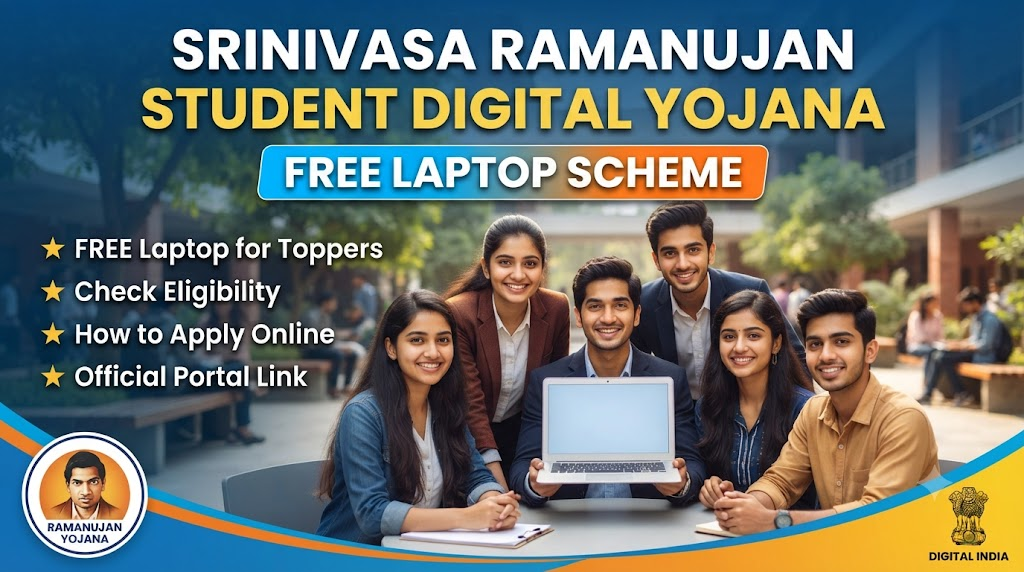
The Srinivasa Ramanujan Student Digital Yojana is a flagship initiative of the Himachal Pradesh Government designed to bridge the digital divide in education. Launched to honour the legacy of the legendary mathematician Srinivasa Ramanujan, the scheme aims to provide free laptops, tablets, and smartphones to meritorious students across the state.
This scheme recognizes that digital tools have become essential for modern education. By providing free digital devices, the government ensures that financial constraints do not hinder the academic growth of talented students. The scheme primarily targets students who have excelled in their Class 10 and Class 12 board examinations, as well as meritorious undergraduate students.
The programme was first launched by former Chief Minister Jai Ram Thakur in June 2022, distributing free laptops worth Rs 83 crore to approximately 20,000 meritorious students. In November 2023, Chief Minister Sukhvinder Singh Sukhu officially re-launched the scheme and initiated the distribution of laptops to students of the prestigious Portmore School in Shimla. The scheme continues to evolve, with a recent shift to distributing e-₹ vouchers, allowing students to choose their own devices. As of December 2025, over 8,450 Class 10 and 12 toppers and 900 final-year undergraduate students have benefited from the scheme.
Jharkhand Free Cycle Scheme 2026: Application Process, Eligibility, and Benefits Guide
Scheme Overview and Key Statistics
The Srinivasa Ramanujan Student Digital Yojana has specific parameters that beneficiaries must understand. Here is a detailed overview of the scheme:
Overview Table:
| Particular | Details |
|---|---|
| Scheme Name | Srinivasa Ramanujan Student Digital Yojana |
| State | Himachal Pradesh |
| Launch Date (Initial) | June 2022 |
| Official Re-Launch | November 2023 |
| Implementing Department | Department of Higher Education, Himachal Pradesh |
| Target Beneficiaries | Meritorious students of Class 10, 12, and Graduation |
| Total Beneficiaries (2022) | 20,000 students |
| Total Cost (2022) | Rs 83 crore |
| Recent Beneficiaries (2025) | 9,350 students (8,450 school + 900 graduation) |
| Device Provided | Initially Laptops; Now E-₹ Vouchers for choice of device |
| Key Feature | 70%+ beneficiaries are girls |
| Official Website | himachal.nic.in / education.hp.gov.in |
Key Benefits Table:
| Benefit Component | Details |
|---|---|
| Laptop/Tablet/Smartphone | Free device provided through vouchers |
| Choice of Device | Students can choose their preferred device |
| Girl Empowerment | Special focus on meritorious girl students |
| Budget Allocation (2022) | Rs 83 crore for 20,000 laptops |
| Voucher System | E-₹ vouchers for flexibility |
Key Takeaway: The scheme provides digital devices to top-performing students, empowering them for higher education and employment.
Objectives of the Scheme
The Srinivasa Ramanujan Student Digital Yojana has been designed with clear, well-defined objectives that address the challenges faced by meritorious students.
Primary Objectives:
1. Digital Empowerment of Students:
- To provide access to modern digital tools for learning and skill development.
- To bridge the digital divide between urban and rural students.
- To enable students to access online educational resources and courses.
2. Promoting Merit and Excellence:
- To reward academic excellence and encourage students to perform better.
- To motivate other students to excel in their studies.
- To create a culture of healthy competition and academic achievement.
3. Women Empowerment:
- To support and encourage girl students with a special focus on their education.
- Over 70% of beneficiaries of this scheme are girls, highlighting the commitment to women’s empowerment.
4. Modernization of Education:
- To help students adapt to the changing technological landscape of education.
- To ensure students have the necessary tools for online learning and research.
5. Building a Digital Future:
- To contribute to the vision of a “Digital India”.
- To prepare students for a technology-driven future economy.
Broader Impact:
The scheme has already benefited thousands of students across Himachal Pradesh, with a significant impact on girl education. The shift to e-₹ vouchers in 2025 has made the scheme even more flexible and student-centric.
Eligibility Criteria for the Scheme
The eligibility framework for the scheme is designed to reward meritorious students. The criteria are straightforward and accessible.
Primary Eligibility Conditions:
| Criteria | Requirement |
|---|---|
| Residency | Must be a permanent resident of Himachal Pradesh |
| Educational Level | Class 10, Class 12, or Final Year Graduation |
| Academic Performance | Must be a topper in the respective board/university examination |
| Institution Type | Students from government schools and colleges are preferred |
| Age Limit | As per standard school/college criteria |
Beneficiary Categories:
1. Class 10 Toppers
- Students who have excelled in the Class 10 board examinations.
- They receive digital devices to support their higher secondary education.
2. Class 12 Toppers
- Meritorious students of Class 12 board exams.
- They receive devices for their graduation and higher studies.
3. Graduation Toppers
- Final year undergraduate students who have performed exceptionally well.
- They receive devices to support their career and further education.
4. Special Focus on Girl Students
- The scheme places special emphasis on meritorious girl students.
- Over 70% of beneficiaries are girls.
Data Verification Process:
As of July 2026, the Department of Higher Education is actively verifying beneficiary data for the academic years 2022-23, 2023-24, and 2024-25. Schools are required to provide verified contact numbers and bank account details to ensure smooth distribution.
How the Scheme Works
The Srinivasa Ramanujan Student Digital Yojana operates through a well-structured implementation framework.
Implementation Structure:
1. Identification of Beneficiaries
- The Department of Higher Education identifies meritorious students based on board/university results.
- Schools and colleges submit the list of eligible students.
2. Data Verification
- Schools verify the contact numbers and bank account details of the beneficiaries.
- It is mandatory to provide the student’s or parent’s contact number, not that of neighbors or relatives.
- For students below 18 years, a joint bank account with parents is required.
3. Distribution Method (Historical)
- Initially, laptops were distributed in a single phase.
- Distribution was done through 55 centres across the state in 2022.
4. Current Distribution Method (E-₹ Vouchers)
- Students now receive e-₹ vouchers.
- These vouchers can be used to purchase laptops, tablets, or smartphones of their choice.
- This provides flexibility and ensures students get the device they need.
5. Distribution Events
- Special distribution events are organized at the state and district levels.
- In November 2023, CM Sukhu launched the scheme at Portmore School in Shimla and distributed laptops to 16 students.
- In December 2025, e-₹ vouchers were distributed at the Mandi Sankalp Rally.
Financial Details and Budget
The state government has allocated significant funds to ensure the success of the scheme.
Financial Assistance Breakdown:
| Support Component | Details | Value |
|---|---|---|
| Total Budget (2022) | Free laptops to 20,000 students | Rs 83 crore |
| Initial Budget (2022) | Originally allocated | Rs 50 crore |
| Additional Allocation | Due to increase in laptop prices | Rs 25 crore |
| Discount from Vendors | Per laptop discount | Rs 5,000 |
| Distribution Centres (2022) | Across the state | 55 centres |
Fund Allocation:
| Year | Allocation | Purpose |
|---|---|---|
| 2021-22 | Rs 25 crore | Laptops for Class 10/12 students |
| 2020-21 | Rs 25 crore | Laptops for meritorious students |
| Additional | Rs 25 crore | Increase in laptop prices |
Recent Changes (2025):
- The government has shifted to an e-₹ voucher system.
- This allows for more flexibility and choice for students.
- Over 9,350 students have already benefited from this system.
Distribution Process and Camps
The distribution of laptops and e-₹ vouchers is done through organized events to ensure efficient and transparent disbursement.
Distribution Process Overview:
| Stage | Activity | Responsible |
|---|---|---|
| Preparation | Compile beneficiary lists | Department of Higher Education |
| Verification | Verify student data | Schools and Colleges |
| Camp Scheduling | Plan events across the state | District Administration |
| Notification | Inform beneficiaries via schools | School Principals |
| Distribution | Laptops/vouchers distributed at events | Chief Minister/Education Minister |
| Documentation | Record keeping of distribution | Department officials |
Major Distribution Events:
1. June 2022 Launch
- Chief Minister Jai Ram Thakur launched the programme at Mandi.
- Laptops worth Rs 83 crore were distributed to 20,000 students.
- Distribution was carried out at 55 centres across the state.
2. November 2023 Re-Launch
- CM Sukhu launched the scheme at Portmore School, Shimla.
- 16 meritorious girls received laptops at the event.
- The school’s classrooms were declared “smart”.
3. December 2025 Voucher Distribution
- CM Sukhu distributed e-₹ vouchers at the Mandi Sankalp Rally.
- 9,350 students received vouchers for laptops, tablets, or smartphones.
What Students Need to Do:
- Ensure your contact number and bank details are updated with your school.
- For students below 18, ensure you have a joint account with a parent.
- Check with your school or the Department of Higher Education for distribution dates.
Recent Data Verification Drive (July 2026)
As of July 2026, the Department of Higher Education in Una district has issued fresh instructions regarding data verification for the scheme.
Key Directives:
1. Mandatory Verified Data:
- Schools must submit verified data for beneficiaries of sessions 2022-23, 2023-24, and 2024-25.
- The data must be submitted in a specified format.
2. Valid Contact Numbers:
- The contact number must be of the student or the student’s parents.
- Numbers of neighbors, relatives, or other persons will not be accepted.
- Duplicate and incorrect numbers are strictly prohibited.
3. Bank Account Details:
- For students below 18 years, a joint bank account with a parent is mandatory.
- Schools must verify bank details (account number, IFSC code, branch name) with original documents.
4. Exclusion of Already Benefitted Students:
- Students whose vouchers have already been successfully redeemed will be excluded from the list.
5. No Corrections After Submission:
- Once the data is submitted, no corrections or modifications will be allowed.
Role of Schools and Colleges
Schools and colleges play a crucial role in the successful implementation of the Srinivasa Ramanujan Student Digital Yojana.
Responsibilities of Educational Institutions:
1. Data Collection and Verification
- Collecting accurate data of eligible students.
- Verifying contact numbers and bank account details.
- Ensuring the data is error-free before submission.
2. Guidance to Students
- Informing students about the scheme and its benefits.
- Assisting students in updating their contact details.
- Guiding students on the requirements for joint bank accounts.
3. Coordination with Government
- Acting as a bridge between students and the Department of Higher Education.
- Submitting data in the prescribed Google Sheet format.
4. Distribution Support
- Supporting the distribution events.
- Ensuring students are present at the distribution events.
Important Notes for Schools:
- Contact numbers must belong to students or their parents, not to school staff.
- Duplicate contact numbers across multiple students will not be accepted.
- After submission, no revisions will be entertained.
Important Links and Official Resources
Having access to correct official resources is crucial for successful application and status tracking. Here are all the essential links and official portals.
Official Websites:
| Portal Name | URL | Purpose |
|---|---|---|
| Himachal Pradesh Government | himachal.nic.in | Main government portal |
| Department of Higher Education, HP | education.hp.gov.in | Scheme updates and notifications |
| HP Online Services | himachal.nic.in/en/online-services | Various government services |
Important Links:
| Resource | Description |
|---|---|
| Data Verification Circular (2026) | For schools to verify beneficiary data |
| E-₹ Voucher System | Online voucher distribution platform |
Helpline:
For any queries or application issues, contact:
- Department of Higher Education, Himachal Pradesh: 0177-2624899
- District Education Officer: Contact your respective district office
Important Resources:
- State Disaster Management Authority: hpsdma.nic.in – For disaster-related services
- HP e-District Portal: edistrict.hp.gov.in – For various government services
Frequently Asked Questions (FAQs)
What is the Srinivasa Ramanujan Student Digital Yojana?
The Srinivasa Ramanujan Student Digital Yojana is a Himachal Pradesh government scheme that provides free laptops, tablets, or smartphones to meritorious students who have excelled in Class 10, Class 12, or graduation examinations. The scheme is named after the famous Indian mathematician Srinivasa Ramanujan.
Who is eligible for the scheme?
Students who are permanent residents of Himachal Pradesh and have performed exceptionally well in their Class 10, Class 12, or final year graduation examinations are eligible. Special emphasis is given to meritorious girl students, who make up over 70% of the beneficiaries.
What is the last date to apply for the scheme?
There is no fixed last date as the scheme is ongoing. However, the Department of Higher Education conducts regular data verification drives. Schools are currently required to submit verified data for the sessions 2022-23, 2023-24, and 2024-25.
What documents are required for the scheme?
Required documents include Aadhaar Card, Residence Certificate, Marksheet of the qualifying examination, verified contact number, and bank account details. For students below 18 years, a joint bank account with a parent is mandatory.
What kind of devices are provided under the scheme?
Initially, the scheme provided free laptops. Now, beneficiaries receive e-₹ vouchers that can be used to purchase laptops, tablets, or smartphones of their choice.
How many students have benefited from the scheme?
In 2022, approximately 20,000 students received laptops. As of December 2025, over 9,350 students have benefited from the e-₹ voucher system, including 8,450 Class 10 and 12 toppers and 900 final-year undergraduate students.
What is the total budget for the scheme?
The initial budget for the scheme was Rs 83 crore for 20,000 laptops. The budget has been adjusted over time to accommodate the e-₹ voucher system and increased device prices.
How are students selected for the scheme?
Students are selected based on their academic performance in board examinations (Class 10 and 12) or university examinations (final year graduation). The Department of Higher Education identifies the toppers and creates the beneficiary list.
How can I check if my name is on the beneficiary list?
You can check with your school or college, as they maintain the list of eligible students. The Department of Higher Education also issues circulars with beneficiary data. As of July 2026, a data verification drive is ongoing.
What should I do if my name is not on the list?
If you believe you are eligible but your name is not on the list, you should contact your school principal or the Department of Higher Education. Make sure your academic records and contact details are accurate and updated.