
Pradhan Mantri Fasal Bima Yojana is India’s flagship crop insurance scheme launched by the Ministry of Agriculture and Farmers’ Welfare in April 2016. This scheme replaced two older and less effective crop insurance programs — the National Agricultural Insurance Scheme and the Modified National Agricultural Insurance Scheme.
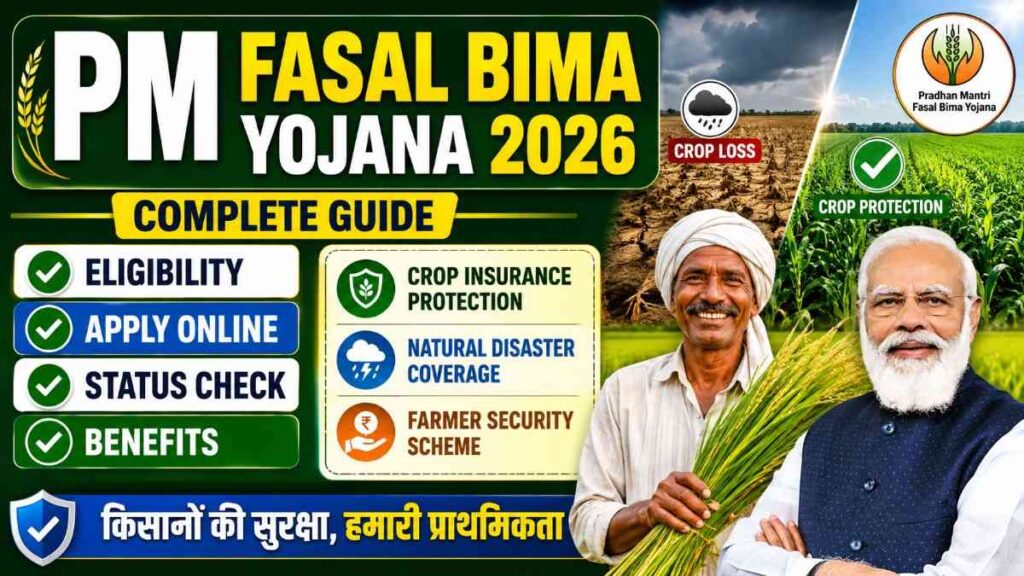
The primary purpose of PMFBY is to provide financial protection to farmers against crop losses caused by natural calamities, weather-related risks, pests, and diseases. Under this scheme, farmers pay a very small portion of the total insurance premium while the central and state governments together bear the major share.
The scheme follows the principle of “One Nation, One Crop, One Premium,” which ensures uniformity and fairness in premium rates across the entire country. Since its inception, over 78.40 crore farmer applications have been insured, and more than Rs. 1.83 lakh crore has been paid out in claims to affected farmers. The scheme covers the entire crop cycle from pre-sowing to post-harvest, making it one of the most comprehensive agricultural risk management tools available to Indian farmers today.
Quick Overview Table of PM Fasal Bima Yojana
| Particulars | Details |
|---|---|
| Scheme Name | Pradhan Mantri Fasal Bima Yojana (PMFBY) |
| Launched By | Ministry of Agriculture & Farmers’ Welfare, Government of India |
| Launch Year | April 2016 |
| Schemes Replaced | NAIS and MNAIS |
| Total Applications Insured | 78.40 crore (since inception till 2024-25) |
| Total Claims Paid | Rs. 1.83 lakh crore |
| Farmers Enrolled (2024-25) | 4.19 crore (highest since inception) |
| Kharif Premium (Farmer Share) | 2% of Sum Insured |
| Rabi Premium (Farmer Share) | 1.5% of Sum Insured |
| Commercial/Horticulture Premium | 5% of Sum Insured |
| Government Subsidy Share | 50:50 (Centre:State); 90:10 for NE & Himalayan states |
| Budget Allocation (2025-26) | Rs. 69,515.71 crore (PMFBY + RWBCIS) |
| Official Portal | pmfby.gov.in |
| National Helpline | 1800-200-7710 |
| Kharif 2026 Registration Deadline | July 31, 2026 |
Main Objectives Behind Launching PMFBY
The Government of India introduced PMFBY with several well-defined objectives that address the long-standing vulnerabilities of Indian agriculture.
- Financial Protection Against Crop Loss: The core objective is to shield farmers from financial ruin when their crops are destroyed by natural disasters like floods, droughts, cyclones, hailstorms, or pest attacks. Without insurance, a single bad season can push a farming family into deep debt.
- Stabilize Farmer Income: Agriculture in India is highly dependent on monsoons and weather patterns. PMFBY aims to stabilize farmer income by providing timely compensation when crop yields fall below the threshold due to insured risks.
- Encourage Modern Farming Practices: When farmers know their crops are insured, they are more willing to invest in better seeds, improved technology, and sustainable farming methods. Insurance reduces the fear of total loss.
- Ensure Continuous Credit Flow: Banks and financial institutions are more confident in lending to insured farmers. PMFBY ensures that credit continues to flow into the agriculture sector without interruption.
- One Nation, One Crop, One Premium: The scheme brings uniformity across states so that a farmer growing paddy in Punjab and a farmer growing paddy in Tamil Nadu pay the same premium rate for the same crop. This removes regional discrimination.
- Comprehensive Coverage: Unlike older schemes, PMFBY covers risks from pre-sowing to post-harvest, including prevented sowing, post-harvest losses, and localized calamities that affect individual farms.
Who Can Apply: Eligibility Criteria in Detail
PMFBY is designed to be inclusive and covers a wide range of farmers across India. Understanding the eligibility criteria is essential before applying.
- All Categories of Farmers: The scheme is open to all farmers, including small and marginal farmers, large landholders, sharecroppers, and tenant farmers. No farmer is excluded based on land size.
- Sharecroppers and Tenant Farmers: Farmers who cultivate land on lease or sharecropping basis are also eligible. They must submit a valid Land Lease Agreement or Consent Certificate signed by the landowner, specifying the leased area and the crop to be grown.
- Notified Crops in Notified Areas: Farmers can only insure crops that have been officially notified by their state government for PMFBY coverage. Similarly, the farm must be located in a notified area or insurance unit.
- Loanee Farmers: Farmers who have taken crop loans or Kisan Credit Cards are automatically enrolled by their banks. The premium is deducted directly from their loan account.
- Non-Loanee Farmers: Farmers who do not have any crop loan can voluntarily enroll themselves through the official portal or at Common Service Centers.
- Valid Land Records: Farmers must possess valid land records such as Records of Rights, Land Possession Certificate, or other documents recognized by the state government.
- Aadhaar-Linked Bank Account: The farmer must have an Aadhaar-linked bank account to receive claim payments through Direct Benefit Transfer.
Complete List of Documents Required for Registration
Having the right documents ready makes the PMFBY registration process smooth and quick. Here is the complete checklist.
| Document Name | Purpose |
|---|---|
| Aadhaar Card | Identity verification of the farmer |
| Land Records (RoR / LPC) | Proof of land ownership or cultivation rights |
| Bank Passbook / Cancelled Cheque | For DBT claim payments |
| Kisan Credit Card (for loanee farmers) | Automatic enrollment proof |
| Land Lease Agreement (for tenant farmers) | Proof of sharecropping or tenancy |
| Mobile Number | For SMS alerts and portal registration |
| Passport Size Photograph | For application form |
| Crop Details | Information about the crop and area to be insured |
Additional Notes:
- Land records must be current and issued by the revenue department of the respective state.
- Tenant farmers must get their lease agreement on stamp paper and signed by the landowner.
- Bank account details must match the Aadhaar database for seamless DBT transfer.
- Non-loanee farmers should keep their mobile number active as OTPs and status updates are sent via SMS.
Step-by-Step Registration Process
Farmers can enroll under PMFBY through multiple channels. Here is the complete process for both loanee and non-loanee farmers.
- For Loanee Farmers (Automatic Enrollment):
- Banks, cooperatives, and Primary Agricultural Credit Societies automatically enroll farmers who have crop loans or KCC.
- The premium amount is deducted directly from the loan account.
- Farmers should check their passbook for “Fasal Bima Premium Deducted” entry.
- Verify policy status at pmfby.gov.in under “Know Your Application Status.”
- For Non-Loanee Farmers (Self-Enrollment):
- Visit the official portal pmfby.gov.in.
- Click on “Farmer Corner” and select “Guest Farmer” if you do not have an account.
- Enter your Aadhaar number, mobile number, and other required details to create an account.
- Fill out the online application form with accurate crop details, land area, and bank information.
- Upload scanned copies of all required documents.
- Pay the premium online through net banking, UPI, or debit card.
- Download and save the policy certificate for future reference.
- Through Common Service Centers (CSC):
- Visit your nearest CSC with all documents.
- The CSC operator will fill the form and upload documents on your behalf.
- Pay the premium in cash or digitally at the CSC.
- Collect the acknowledgment receipt and policy certificate.
- Through Insurance Company Offices:
- Some insurance companies have physical offices where farmers can enroll.
- Carry all documents and complete the enrollment form.
- Pay premium and collect the policy document.
Premium Structure and Government Subsidy Breakdown
One of the most attractive features of PMFBY is its highly subsidized premium structure. Farmers pay only a small fraction of the actual insurance cost.
| Crop Season | Crop Type | Farmer’s Premium | Government Subsidy |
|---|---|---|---|
| Kharif | Food grains & Oilseeds | 2% of Sum Insured | Remaining 98% (50:50 Centre:State) |
| Rabi | Food grains & Oilseeds | 1.5% of Sum Insured | Remaining 98.5% (50:50 Centre:State) |
| Kharif & Rabi | Annual Commercial / Horticultural | 5% of Sum Insured | Remaining 95% (50:50 Centre:State) |
| All Seasons | NE & Himalayan States | Same as above | 90% Centre, 10% State |
How Premium Calculation Works:
- The Sum Insured is determined by the state government based on the cost of cultivation per hectare for each crop in each district.
- The actuarial premium rate is calculated by insurance companies based on risk assessment.
- The farmer pays only the capped percentage mentioned above, regardless of how high the actuarial rate is.
- For example, if the Sum Insured is Rs. 35,000 per hectare and the total premium is Rs. 4,000, a Kharif farmer pays only Rs. 700 (2%), while the government pays Rs. 3,300.
- Some states have waived the farmer’s share entirely, meaning farmers pay zero premium and the state government covers the farmer’s portion too.
What Risks and Losses Are Covered Under PMFBY
PMFBY provides comprehensive protection against a wide range of risks that affect crop production. Understanding what is covered helps farmers know when they can file a claim.
Yield Losses (Standing Crops): This is the main coverage. It protects against losses due to non-preventable natural risks such as:
- Natural fire and lightning
- Storm, hailstorm, cyclone, typhoon, tempest, hurricane, tornado
- Flood, inundation, and landslide
- Drought, dry spells, and unseasonal rains
- Pest attacks and diseases
- Prevented Sowing: If adverse weather conditions prevent the majority of insured farmers in a notified area from sowing their crops despite having prepared the land and spent money, they are eligible for indemnity claims up to 25% of the Sum Insured.
- Post-Harvest Losses: Coverage is available for up to 14 days after harvesting for crops kept in “cut and spread” condition in the field to dry. This covers damage from cyclonic rains and unseasonal rains.
- Localized Calamities: Loss or damage from localized risks affecting individual farms in a notified area, including:
- Hailstorm
- Landslide
- Inundation
- Cloud burst
- Wild Animal Attacks (NEW from Kharif 2026): Crop loss due to wild animal attacks has been added as a new add-on cover under localized risks. States will notify the list of wild animals and vulnerable districts based on historical data.
- Paddy Inundation (Restored from Kharif 2026): Paddy inundation coverage, which was removed in 2018, has been restored as a localized calamity cover for Kharif 2026 onwards.
How to File a Claim for Crop Loss
Filing a claim under PMFBY is time-sensitive. Farmers must act quickly after a loss event to ensure their claim is processed.
| Loss Situation | How to Report | Time Limit |
|---|---|---|
| Hailstorm, landslide, or localized flood | Call 1800-200-7710 and inform local Agriculture Officer within 72 hours | 72 hours of loss |
| Drought or widespread flood | State government assesses via Crop Cutting Experiments — automatic claim if yield falls below threshold | After harvest yield data |
| Post-harvest loss (cut crop damaged by rain) | Report within 14 days of harvest if cyclone or rain damages harvested crop left in field | 14 days after harvest |
| Prevented sowing (no rain before sowing season) | State government declares and triggers automatic 25% payout — no individual reporting needed | Before sowing season ends |
| Pest or disease attack | Report to district agriculture office with photos; they arrange a joint inspection | Within 72 hours of noticing |
Step-by-Step Claim Process:
- Report the loss immediately through the PMFBY helpline or crop insurance app.
- Take geo-tagged photographs of the damaged crop using the official app.
- An agricultural inspector or surveyor will visit your field to assess damage and conduct a Crop Cutting Experiment.
- The insurance company processes the claim based on the assessment report.
- If approved, the compensation is credited directly to your Aadhaar-linked bank account via DBT.
- For widespread calamities, claims are calculated based on area yield data and paid automatically to all insured farmers in the affected unit.
Technology Integration in PMFBY: YES-TECH, WINDS, and Crop Insurance App
PMFBY has embraced modern technology to make the scheme more transparent, efficient, and farmer-friendly.
- YES-TECH (Yield Estimation System based on Technology): This system uses satellite imagery, remote sensing, and smartphone-based data collection to estimate crop yields more accurately. It reduces the dependence on manual Crop Cutting Experiments and speeds up the assessment process.
- WINDS (Weather Information and Network Data Systems): WINDS integrates weather data from multiple sources to monitor rainfall, temperature, humidity, and other parameters. This helps in early warning, prevented sowing declarations, and validating claims related to weather events.
- Crop Insurance Mobile App: Farmers can download the official PMFBY app from Google Play Store. The app allows farmers to:
- Register and enroll for the scheme
- Check application and claim status
- Report crop losses with geo-tagged photos
- Receive real-time updates and notifications
- Access helpline numbers and grievance redressal
- National Crop Insurance Portal: The centralized portal at pmfby.gov.in handles enrollment, premium subsidy disbursement, claims tracking, and grievance management. It ensures data transparency and reduces manual errors.
- Geo-Tagging and Timestamping: All field visits, crop cutting experiments, and loss assessments are geo-tagged and time-stamped. This prevents fraud and ensures that assessments are conducted at the correct location.
Key Features That Make PMFBY Unique
PMFBY stands out among agricultural insurance schemes globally due to its farmer-centric design and comprehensive coverage.
- Lowest Farmer Premium Globally: Farmers pay only 1.5% to 5% of the premium, which is among the lowest farmer contribution rates for crop insurance anywhere in the world.
- Coverage for Sharecroppers and Tenants: Unlike many insurance schemes that only cover landowners, PMFBY explicitly includes sharecroppers and tenant farmers, recognizing the reality of Indian agriculture.
- Automatic Enrollment for Loanee Farmers: Banks automatically enroll farmers with crop loans, ensuring maximum coverage without requiring farmers to take any extra steps.
- Direct Benefit Transfer: All claim payments are made directly to the farmer’s bank account, eliminating middlemen and reducing corruption.
- Interest on Delayed Claims: If claim payment is delayed beyond three months, farmers are entitled to receive 12% interest per annum on the pending amount.
- Voluntary for States Since 2020: States can choose to participate or opt out, giving them flexibility. However, most states continue to participate due to the scheme’s popularity.
- Continuous Improvement: The scheme has been revised in 2018, 2020, and 2023, with new additions like wild animal attack coverage and paddy inundation restoration in 2026.
Common Mistakes to Avoid While Enrolling or Claiming
Many farmers face delays or rejections due to simple errors. Avoiding these mistakes can save time and ensure faster processing.
- Missing the Registration Deadline: Kharif 2026 registration closes on July 31, 2026. Missing this date means no coverage for the entire season.
- Not Checking Bank-Aadhaar Link: If your bank account is not linked to Aadhaar, claim payments will fail. Verify this before enrolling.
- Incorrect Crop Details: Entering the wrong crop name or area can lead to claim rejection. Double-check all details in the application form.
- Delay in Reporting Loss: For localized calamities, you must report within 72 hours. Delayed reporting often leads to claim denial.
- Not Taking Geo-Tagged Photos: When reporting loss through the app, always take clear geo-tagged photos of the damaged crop. Photos without location data may not be accepted.
- Ignoring Policy Certificate: Download and save your policy certificate. It contains your policy number, Sum Insured, and insurance company details needed for claims.
- Applying for Non-Notified Crops: Only notified crops in notified areas are covered. Do not assume all crops are eligible.
- Not Updating Mobile Number: Keep your registered mobile number active. All OTPs, status updates, and claim notifications are sent via SMS.
Comparison with Restructured Weather Based Crop Insurance Scheme
PMFBY and RWBCIS are the two main crop insurance schemes in India. Understanding the difference helps farmers choose the right option.
| Feature | PMFBY | RWBCIS |
|---|---|---|
| Basis of Claim | Actual yield loss measured through CCE | Weather parameters (rainfall, temperature, humidity) |
| Claim Trigger | Area yield falls below threshold yield | Weather index crosses predefined threshold |
| Individual Farm Assessment | Yes, for localized calamities | No, purely index-based |
| Premium Rates | Same as PMFBY (2%, 1.5%, 5%) | Same as PMFBY |
| Suitable For | All farmers, especially in areas with yield data | Areas with reliable weather stations |
| Claim Speed | Depends on CCE completion | Faster, as weather data is automatic |
| Coverage | Comprehensive (pre-sowing to post-harvest) | Weather-specific risks only |
Which One to Choose:
- PMFBY is better for farmers who want comprehensive coverage against all types of crop losses.
- RWBCIS is suitable for farmers in areas with good weather station networks who want faster claim settlements based on weather data.
- Some states offer both schemes, and farmers can choose based on their specific needs and location.
Impact and Achievements of PMFBY Since Launch
PMFBY has transformed crop insurance in India and delivered measurable benefits to millions of farmers.
- Massive Scale: Since 2016, over 78.40 crore farmer applications have been insured under the scheme. In 2024-25 alone, 4.19 crore farmers were enrolled — the highest number since inception.
- Huge Claim Payouts: More than Rs. 1.83 lakh crore has been paid to 22.66 crore farmers who suffered crop losses. This money has helped farming families recover and restart cultivation.
- Increased Non-Loanee Participation: Non-loanee farmer applications rose from just 20 lakh in 2014-15 to 522 lakh in 2024-25, showing that voluntary enrollment is working.
- Expanded Coverage: Total insured applications grew from 371 lakh in 2014-15 to 1,510 lakh in 2024-25 — a four-fold increase.
- Inclusive Reach: In 2024-25, 6.5% of enrolled farmers were tenants, 17.6% were marginal farmers, and 48% were loanee farmers, showing the scheme’s broad social reach.
- State-Level Waivers: Several states have waived the farmer’s share of premium entirely, making the scheme effectively free for farmers and boosting enrollment further.
- Global Recognition: PMFBY is now the largest crop insurance scheme in the world in terms of farmer applications, setting a benchmark for other countries.
Important Links, PDF Notifications, and Official Resources
| Resource | Link / Contact |
|---|---|
| Official PMFBY Portal | pmfby.gov.in |
| PMFBY Farmer Corner (Registration) | pmfby.gov.in → Farmer Corner |
| Know Your Application Status | pmfby.gov.in → Know Your Application Status |
| Crop Insurance Mobile App | Search “Pradhan Mantri Fasal Bima Yojana” on Google Play Store |
| National Helpline Number | 1800-200-7710 (Toll-free, 24×7) |
| Grievance Portal | pgportal.gov.in → Agriculture & Farmers Welfare → PMFBY |
| PIB Official Notification (PMFBY Modifications) | pib.gov.in/PressReleasePage.aspx?PRID=2222799 |
| PMFBY Operational Guidelines PDF | Available at pmfby.gov.in under “Downloads” section |
| MyScheme Portal – PMFBY | myscheme.gov.in |
| Email Support | help.agri-insurance@gov.in |
How to Use These Resources:
- Visit the official PMFBY portal for the latest notifications, enrollment forms, and scheme guidelines.
- Download the Crop Insurance App for easy registration, claim reporting, and status tracking on your mobile phone.
- Use the “Know Your Application Status” feature to verify your enrollment and track claim progress anytime.
- For grievances, first contact the District Agriculture Officer. If unresolved, file a complaint at pgportal.gov.in under the Agriculture & Farmers Welfare department.
- Always refer to official government sources for accurate and updated information before making any financial decisions related to crop insurance.
Frequently Asked Questions
Q1. What is the last date to register for PMFBY Kharif 2026?
The registration deadline for Kharif 2026 crops is July 31, 2026. Farmers must enroll before this date to be eligible for coverage during the Kharif season.
Q2. How much premium does a farmer actually pay under PMFBY?
A farmer pays only 2% of the Sum Insured for Kharif food and oilseed crops, 1.5% for Rabi food and oilseed crops, and 5% for annual commercial and horticultural crops. The remaining premium is paid by the central and state governments.
Q3. Am I automatically covered if I have a Kisan Credit Card?
Yes, loanee farmers with KCC or crop loans are mandatorily enrolled by their banks. The premium is deducted from your loan account. You can verify your policy at pmfby.gov.in.
Q4. Can tenant farmers and sharecroppers apply for PMFBY?
Yes, tenant farmers and sharecroppers are eligible. They must submit a valid Land Lease Agreement or Consent Certificate signed by the landowner along with their application.
Q5. What should I do if my crop is destroyed by hailstorm?
Act within 72 hours. Call the PMFBY helpline at 1800-200-7710, inform your local Agriculture Officer, and report the loss through the Crop Insurance App with geo-tagged photos of the damage.
Q6. How long does it take to receive claim payment?
For localized calamities with individual assessment, payment should come within 30 days of the CCE report. For widespread yield losses, payment is made within two months after the state submits yield data.
Q7. What happens if my claim payment is delayed?
If claim payment is delayed beyond three months, you are entitled to receive 12% interest per annum on the pending amount from the insurance company.
Q8. Are losses due to wild animal attacks covered?
Yes, from Kharif 2026 onwards, crop loss due to wild animal attacks is covered as an add-on under localized risks. States will notify the specific animals and vulnerable districts.
Q9. How can I check my PMFBY application and claim status?
Visit pmfby.gov.in and click on “Know Your Application Status.” Enter your Aadhaar number or application number. You can also use the Crop Insurance App for real-time updates.
Q10. What crops are covered under PMFBY in my district?
Covered crops vary by state and district. Visit pmfby.gov.in, go to “Notified Crops and Areas,” select your state and district to see the exact list of crops, Sum Insured amounts, and premium rates.