Pradhan Mantri Awas Yojana Gramin, commonly known as PMAY-G, is the Government of India’s flagship rural housing scheme launched in April 2016 with the ambitious vision of “Housing for All” by 2029. This scheme was built on the foundation of the earlier Indira Awas Yojana and has since transformed into one of the largest rural housing programs in the world.
Under PMAY-G, the government provides direct financial assistance to economically weaker rural households who do not own a permanent pucca house, enabling them to construct safe and durable homes with basic amenities. The scheme operates on a cost-sharing model between the central and state governments, with funds transferred directly to beneficiaries’ Aadhaar-linked bank accounts through Direct Benefit Transfer in three instalments tied to construction milestones.
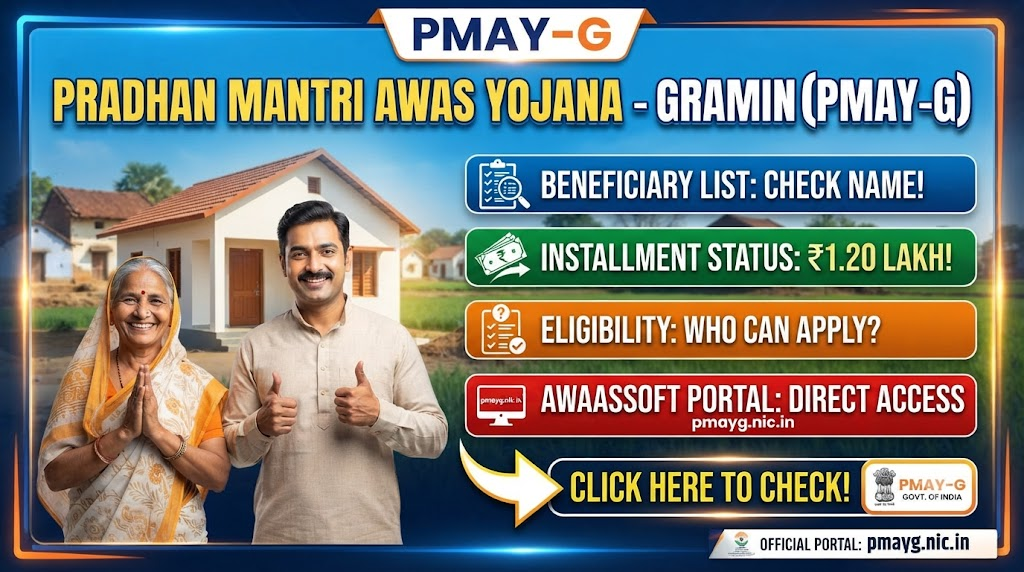
As of 2026, the scheme has achieved remarkable progress with over 3.91 crore houses sanctioned and more than 3.05 crore houses completed across India. The government has expanded the target to approximately 4.95 crore houses by 2029, demonstrating an unwavering commitment to eliminating rural homelessness. The scheme is uniquely integrated with other rural development initiatives like Swachh Bharat Mission-Gramin for toilet construction, Jal Jeevan Mission for piped water supply, PM Ujjwala Yojana for LPG connections, and PM Surya Ghar for rooftop solar panels, ensuring that every new home is a complete living unit.
Punjab Farishtey Yojana 2026: Free Accident Treatment, ₹2,000 & Helpline
Quick Overview Table of PMAY-G 2026
| Particulars | Details |
|---|---|
| Scheme Name | Pradhan Mantri Awas Yojana Gramin (PMAY-G) |
| Launched By | Ministry of Rural Development, Government of India |
| Launch Year | April 2016 |
| Total Target (Extended) | 4.95 crore houses by 2029 |
| Houses Sanctioned (till 2026) | 3.91 crore |
| Houses Completed (till 2026) | 3.05 crore |
| Financial Assistance — Plain Areas | ₹1.20 lakh per house |
| Financial Assistance — Hilly/Difficult Areas | ₹1.30 lakh per house |
| Toilet Construction Support (SBM-G) | ₹12,000 per house |
| MGNREGA Labour Wages | 90-95 days at ₹90.95/day |
| Budget Allocation (2026-27) | ₹54,916.70 crore |
| Additional Approval (2026) | ₹10,021.42 crore for 12 states |
| Official Portal | pmayg.nic.in |
| AwaasSoft Portal | pmayg.nic.in → AwaasSoft |
| UMANG App | Available on Google Play & Apple App Store |
| Helpline | Through Gram Panchayat / Block Development Office |
Main Objectives Behind Launching PMAY-G
The Government of India introduced PMAY-G with a comprehensive vision that goes far beyond simply building houses.
- Housing for All by 2029: The primary goal is to ensure that every rural family in India has access to a safe, permanent pucca house with basic amenities. This is a constitutional commitment to the right to shelter.
- Eliminate Rural Homelessness: Millions of rural families still live in kutcha houses made of mud, thatch, or temporary materials that collapse during monsoons or natural disasters. PMAY-G replaces these with earthquake-resistant, durable homes.
- Empower Women Through Asset Ownership: The scheme mandates that the house must be registered in the name of the female head of the household or jointly with her husband. This is a powerful tool for women’s economic empowerment and social security.
- Integrated Rural Development: PMAY-G is not just about bricks and mortar. Every house must include a toilet (through SBM-G), piped water connection (through Jal Jeevan Mission), LPG connection (through PM Ujjwala), and rooftop solar (through PM Surya Ghar), creating holistic living environments.
- Generate Rural Employment: The construction of each house generates 90 to 95 days of unskilled labour under MGNREGA at ₹90.95 per day, providing income to local workers and boosting the rural economy.
- Leverage Technology for Transparency: The AwaasSoft portal and mobile app provide end-to-end digital tracking from beneficiary identification to fund disbursement, eliminating middlemen and corruption.
- Inclusive Targeting: The scheme prioritizes SC/ST households, widows, female-headed families, persons with disabilities, and families with no earning adult male member, ensuring that the most vulnerable are served first.
Who is Eligible: Criteria for Inclusion in Beneficiary List
Understanding the eligibility criteria is essential for rural families to determine whether they qualify for PMAY-G benefits and can expect to see their names on the beneficiary list.
- No Pucca House Ownership: The most fundamental criterion is that no member of the household should own a permanent house anywhere in India. Families living in zero, one, or two-room kutcha houses are given top priority.
- SECC Data-Based Selection: Beneficiaries are primarily identified using Socio-Economic and Caste Census (SECC) 2011 data. The selection follows a transparent deprivation-based scoring system that ranks households by vulnerability.
- Priority Categories:
- SC and ST households
- Widows and female-headed households
- Families with no earning adult male member
- Persons with disabilities
- Landless families deriving income from manual casual labour
- Minority communities
- Families of ex-servicemen and serving armed forces personnel
- Income Ceiling (Revised 2026): Under the expanded PMAY-G 2.0 phase (2024-2029), the monthly household income limit has been raised to ₹15,000 (previously ₹10,000). This allows more families to qualify.
- Relaxed Exclusion Criteria (2026): Several earlier exclusion criteria have been relaxed:
- Owning a motorized two-wheeler is no longer a ground for exclusion
- Owning a refrigerator no longer disqualifies a family
- Families with a Kisan Credit Card (KCC) limit below ₹50,000 remain eligible
- Income Tax Exclusion: If any family member pays income tax, the household is excluded from the scheme.
- Government Employee Exclusion: Families with a government employee as a member are not eligible.
- Awaas+ Survey for Missed Families: Households missed in the original SECC survey can now be identified through the Awaas+ 2024 mobile application survey, ensuring no eligible family is left behind.
How to Check PMAY-G Beneficiary List on pmayg.nic.in
The official portal provides multiple ways to check whether your name appears on the PMAY-G beneficiary list. Here are all the methods explained in detail.
| Method | What You Need | Best For |
|---|---|---|
| Method 1: By Registration Number | PMAY-G Registration Number | Fastest way if you have your number |
| Method 2: By Village (No Registration Number) | State, District, Block, Gram Panchayat | If you don’t have your registration number |
| Method 3: By Aadhaar Number | Aadhaar Number + Location Details | Alternative verification method |
| Method 4: UMANG App | Mobile Number + Registration/Aadhaar | Mobile-friendly checking |
Method 1 — Check by Registration Number:
- Visit the official portal at pmayg.nic.in
- Click on “Stakeholders” in the top menu
- Select “IAY/PMAYG Beneficiary” from the dropdown
- Enter your Registration Number in the search field
- Click “Submit”
- Your beneficiary details will appear, including name, sanction status, amount released, and instalment details
Method 2 — Check by Village (No Registration Number Needed):
- Visit pmayg.nic.in
- Click on “AwaasSoft” in the top menu
- Select “Reports” from the dropdown
- Under “Social Audit Reports,” click “Beneficiary Details for Verification”
- Enter your State, District, Block, and Gram Panchayat
- Enter the CAPTCHA code and click “Submit”
- The complete beneficiary list for your village will appear
- Scroll through or use Ctrl+F to search for your name
Method 3 — Check Using Aadhaar Number:
- Visit the AwaasSoft portal linked from pmayg.nic.in
- Go to Stakeholders → IAY/PMAYG Beneficiary
- Select “Advanced Search”
- Enter your Aadhaar number along with State, District, Block, and Panchayat
- Click “Search” to view your details
Method 4 — Check via UMANG App:
- Download the UMANG app from Google Play Store or Apple App Store
- Log in with your registered mobile number
- Search for “PMAY-G” in the services section
- Select “Beneficiary Details” and enter your Aadhaar or Registration Number
- Your status and payment details will appear
How to Check PMAY-G Installment Payment Status
Once your name is on the beneficiary list, tracking your instalment payments is crucial to ensure timely construction.
| Instalment | Construction Milestone | Amount Released |
|---|---|---|
| First Instalment | Foundation laying / Plinth level | Approx. ₹40,000 (plain areas) |
| Second Instalment | Lintel level completion | Approx. ₹40,000 (plain areas) |
| Third Instalment | Roof completion / House ready | Approx. ₹40,000 (plain areas) |
| Toilet Support (SBM-G) | Toilet construction | ₹12,000 |
Steps to Check Instalment Status:
- Visit pmayg.nic.in and go to Stakeholders → IAY/PMAYG Beneficiary
- Enter your Registration Number and click “Submit”
- Your details page will show the instalment history
- You can see which instalments have been released, the dates of release, and amounts credited to your bank account
Using UMANG App for Instalment Tracking:
- Open UMANG app and log in
- Search for “PMAY-G”
- Select “Installment Details” or “PMAY-G Installment Details”
- Enter your Registration Number
- View complete instalment history including pending and released amounts
Common Reasons for Delayed Instalments:
- Aadhaar not linked to bank account (mandatory for DBT)
- Construction milestone not yet reached or not verified
- Previous instalment’s Utilisation Certificate not submitted
- Bank account details incorrect or account frozen
- Gram Panchayat verification pending
State-Wise PMAY-G Progress and List Availability
The PMAY-G beneficiary list is available for all states and union territories. Here is the progress data for major states as of 2026.
| State | Target Allocated | Houses Completed | List Availability |
|---|---|---|---|
| Uttar Pradesh | 36,85,704 | 36,40,816 | Available on pmayg.nic.in |
| Bihar | 50,12,752 | 39,14,607 | Available on pmayg.nic.in |
| Madhya Pradesh | 57,74,572 | 40,55,700 | Available on pmayg.nic.in |
| West Bengal | 45,69,423 | 34,20,259 | Available on pmayg.nic.in |
| Odisha | 28,49,889 | 24,78,235 | Available on pmayg.nic.in |
| Rajasthan | 24,97,121 | 17,91,963 | Available on pmayg.nic.in |
| Jharkhand | 22,34,176 | 15,83,887 | Available on pmayg.nic.in |
| Chhattisgarh | 26,42,224 | 16,84,839 | Available on pmayg.nic.in |
| Assam | 29,87,868 | 21,00,511 | Available on pmayg.nic.in |
| Gujarat | 9,02,354 | 6,39,637 | Available on pmayg.nic.in |
| Maharashtra | 43,70,829 | 15,18,703 | Available on pmayg.nic.in |
How to Access Your State’s List:
- Visit pmayg.nic.in and click on “AwaasSoft” → “Reports”
- Select your state from the dropdown menu
- Choose your district, block, and gram panchayat
- The beneficiary list will load automatically
- You can download the list in PDF or Excel format for offline reference
How to Apply for PMAY-G If Your Name Is Not on the List
If you believe you are eligible but your name does not appear on the beneficiary list, here are the steps to get registered.
- Step 1 — Check Awaas+ 2024 Survey:
- Download the Awaas+ mobile application from the official source
- Enter your household details including family composition, housing status, and deprivation indicators
- Submit the survey — state authorities review Awaas+ submissions quarterly for inclusion in updated beneficiary lists
- Step 2 — Apply Online:
- Visit pmayg.nic.in
- Enter your gender, mobile number, and Aadhaar number
- Search for your name in the SECC database
- Click “Select to Register”
- Fill in the complete application form including:
- Ownership type (self-owned, ancestral, etc.)
- Bank account details (Aadhaar-linked)
- MGNREGA job card number
- Swachh Bharat Mission (SBM) number
- BPL ration card details
- Submit and save your registration number
- Step 3 — Apply Offline Through CSC:
- Visit your nearest Common Service Centre (CSC)
- The CSC operator will help you fill the digital application
- Biometric verification via Aadhaar will be done
- Collect the acknowledgment receipt with your registration number
- Step 4 — Gram Sabha Verification:
- Your application will be placed before the Gram Sabha for community-level verification
- The Gram Sabha reviews and approves eligible applicants
- Approved applicants are added to the Permanent Waiting List (PWL)
- Step 5 — Transition to Sanctioned Status:
- Once approved, your name moves from the waiting list to the sanctioned beneficiary list
- You will receive an SMS notification on your registered mobile number
- The first instalment is released upon commencement of construction
Documents Required for PMAY-G Application and Verification
Having the correct documents ready ensures smooth application processing and faster inclusion in the beneficiary list.
| Document Name | Purpose |
|---|---|
| Aadhaar Card | Primary identity verification and DBT linkage |
| BPL Ration Card | Proof of Below Poverty Line status |
| MGNREGA Job Card | For labour wage component |
| Swachh Bharat Mission (SBM) Number | For toilet construction support |
| Bank Passbook / Cancelled Cheque | For DBT transfer of instalments |
| Land Ownership Proof / Land Possession Certificate | Confirms right to build house |
| Caste Certificate (SC/ST/OBC) | For priority category verification |
| Disability Certificate (if applicable) | For PwD priority |
| Income Certificate | To verify income below ₹15,000/month |
| Passport Size Photographs | For application records |
| Mobile Number (Aadhaar-linked) | For OTP and SMS notifications |
Important Notes:
- The Aadhaar card is mandatory. Without Aadhaar linkage, DBT payments cannot be processed.
- The bank account must be in the name of the female head of the household or a joint account, as per the scheme’s women-empowerment mandate.
- Land ownership is not mandatory — families with land allotted by the government or possessing a Land Possession Certificate can also apply.
- All documents should be scanned clearly before uploading on the portal.
Common Issues When Checking Beneficiary List and Their Solutions
Many applicants face problems while checking their status. Here are the most common issues and how to resolve them.
| Problem | Likely Cause | Solution |
|---|---|---|
| Name not found by village search | Data not yet updated for current financial year | Try previous year’s filter; check back after a few weeks as lists are updated periodically |
| Registration number not working | Incorrect number or number from a different scheme | Cross-check against your original application acknowledgement receipt |
| Aadhaar search returns no result | Aadhaar not linked to PMAY-G application | Contact your Gram Panchayat or Block Development Office for Aadhaar linkage |
| Instalment not received despite milestone completion | Aadhaar-bank account linkage issue or Utilisation Certificate pending | Verify Aadhaar-bank linkage at your bank; submit outstanding Utilisation Certificate to Gram Panchayat |
| Portal downtime or slow loading | High traffic or server maintenance | Try during off-peak hours (early morning or late night); use UMANG app as alternative |
| Name appears but status shows “Pending” | Gram Sabha verification or district approval pending | Contact your Block Development Officer for status update |
| Beneficiary details show incorrect information | Data entry error during registration | Visit Block Development Office with original documents for correction |
| House completed but final instalment not released | Final inspection report not submitted | Request your Gram Panchayat secretary to schedule the final inspection |
Key Features That Make PMAY-G Unique
PMAY-G stands out among global rural housing programs due to its integrated and technology-driven approach.
- Direct Benefit Transfer (DBT): All funds are transferred directly to beneficiaries’ Aadhaar-linked bank accounts, eliminating leakages and ensuring that every rupee reaches the intended family.
- Women-Centric Design: The mandatory registration of houses in the name of the female head or joint ownership is a revolutionary step toward women’s property rights in rural India.
- Convergence with Multiple Schemes: No other housing program in the world integrates toilet construction, piped water, LPG, and solar power as standard components. PMAY-G creates complete living units, not just shelters.
- AwaasSoft Digital Platform: The end-to-end digital tracking from beneficiary identification to final payment is a global benchmark for transparency in public welfare.
- Social Audit and Gram Sabha Oversight: Community-level verification through Gram Sabha ensures that selection is fair and corruption is minimized.
- Geo-Tagging: Every house is geo-tagged at three stages — foundation, lintel, and completion — preventing fraud and enabling remote monitoring.
- Disaster-Resistant Design: Houses are designed to withstand earthquakes and other natural disasters based on local topography and climate conditions.
- MGNREGA Integration: The provision of 90-95 days of unskilled labour wages ensures that construction also generates local employment.
Comparison with PMAY-Urban and Other Housing Schemes
Understanding how PMAY-G differs from other housing programs helps beneficiaries and applicants make informed decisions.
| Feature | PMAY-G (Rural) | PMAY-U (Urban) | State Housing Schemes |
|---|---|---|---|
| Target Area | Rural areas | Urban areas | Varies by state |
| Financial Assistance | ₹1.20 lakh (plain); ₹1.30 lakh (hilly) | Up to ₹2.50 lakh (CLSS) | Varies |
| Beneficiary Selection | SECC data + Gram Sabha | Income-based + lottery | Varies |
| Toilet Support | ₹12,000 (SBM-G) integrated | Separate application | Varies |
| Water Connection | Jal Jeevan Mission integrated | Separate | Varies |
| LPG Connection | PM Ujjwala integrated | Separate | Varies |
| Solar Power | PM Surya Ghar integrated | Separate | Varies |
| MGNREGA Wages | 90-95 days included | Not applicable | Not applicable |
| Application Portal | pmayg.nic.in | pmaymis.gov.in | State-specific |
Why PMAY-G is More Comprehensive:
- Unlike urban schemes that focus primarily on credit-linked subsidies, PMAY-G provides direct cash assistance for construction.
- The convergence model ensures that every PMAY-G house is a complete home with all basic amenities, whereas urban beneficiaries must apply separately for each service.
- The Gram Sabha verification process makes rural selection more community-driven and transparent compared to urban lottery systems.
Impact and Achievements of PMAY-G Since Launch
PMAY-G has transformed rural India and delivered measurable, life-changing benefits to millions of families.
- Massive Scale: As of 2026, 3.91 crore houses have been sanctioned and 3.05 crore houses completed. The total cumulative completion since 2016 stands at approximately 2.99 crore houses, with 26.01 lakh houses completed in 2025-26 alone.
- Year-Wise Progress:
- 2016-17: 2,115 houses
- 2017-18: 38,15,966 houses
- 2018-19: 44,92,951 houses
- 2019-20: 21,31,192 houses
- 2020-21: 33,99,570 houses
- 2021-22: 42,39,725 houses
- 2022-23: 57,74,696 houses
- 2023-24: 20,83,730 houses
- 2024-25: 13,73,546 houses
- 2025-26: 26,01,907 houses
- Budget Commitment: The 2026-27 budget allocation of ₹54,916.70 crore, plus an additional ₹10,021.42 crore approved for 12 states, shows the government’s massive financial commitment.
- Women Empowerment: Millions of rural women now own houses in their names for the first time in their lives, giving them social security and collateral for future loans.
- Health Improvement: The integration of toilets and clean water has significantly reduced waterborne diseases in PMAY-G villages.
- Economic Multiplier: Every house built generates local employment, boosts demand for construction materials, and stimulates the rural economy.
- Digital Transparency: The AwaasSoft platform has set a global standard for transparent public welfare delivery, with real-time tracking available to every citizen.
Frequently Asked Questions
Q1. How can I check my name on the PMAY-G beneficiary list 2026?
Visit pmayg.nic.in, click on “Stakeholders” → “IAY/PMAYG Beneficiary,” enter your Registration Number, and click “Submit.” If you don’t have your registration number, use the “Advanced Search” option with your State, District, Block, and Gram Panchayat details.
Q2. What is the official website to check the PMAY-G list?
The official portal is pmayg.nic.in. The AwaasSoft system integrated within this portal handles all beneficiary list queries, reports, and status tracking.
Q3. How much financial assistance does PMAY-G provide?
Eligible rural families receive ₹1.20 lakh in plain areas and ₹1.30 lakh in hilly, difficult, and IAP districts. Additionally, ₹12,000 is provided for toilet construction under SBM-G, and 90-95 days of MGNREGA wages are included.
Q4. Can I check the beneficiary list without a registration number?
Yes. Go to pmayg.nic.in → AwaasSoft → Reports → Social Audit Reports → Beneficiary Details for Verification. Enter your State, District, Block, and Gram Panchayat to view the complete village-wise list.
Q5. How many instalments are released under PMAY-G?
Funds are released in three instalments tied to construction milestones: first at foundation/plinth level, second at lintel level, and third at roof completion. The toilet support is released separately.
Q6. What should I do if my instalment is delayed?
First, verify that your Aadhaar is linked to your bank account. Then check if your construction milestone has been verified and if the Utilisation Certificate for the previous instalment has been submitted to your Gram Panchayat. Contact your Block Development Officer if the issue persists.
Q7. Is Aadhaar mandatory for PMAY-G?
Yes, Aadhaar is mandatory for beneficiary identification and Direct Benefit Transfer. Without Aadhaar linkage to your bank account, instalment payments cannot be processed.
Q8. Can I apply for PMAY-G if my name is not on the SECC list?
Yes. Download the Awaas+ 2024 mobile application and submit your household details. The government reviews these submissions quarterly for inclusion. You can also apply online at pmayg.nic.in or through your nearest CSC.
Q9. What is the income limit for PMAY-G in 2026?
Under the expanded PMAY-G 2.0 phase, the monthly household income limit has been raised to ₹15,000. Families with income below this threshold and meeting other criteria are eligible.
Q10. How can I track my instalment payments?
Use the UMANG app or visit pmayg.nic.in → Stakeholders → IAY/PMAYG Beneficiary, enter your Registration Number, and view your complete instalment history including released amounts, dates, and pending payments.
Important Links, PDF Notifications, and Official Resources
| Resource | Link / Details |
|---|---|
| Official PMAY-G Portal | pmayg.nic.in |
| AwaasSoft Reports Section | pmayg.nic.in → AwaasSoft → Reports |
| UMANG App (Mobile) | Google Play Store / Apple App Store — Search “UMANG” |
| Ministry of Rural Development | rural.nic.in |
| Awaas+ 2024 Survey App | Available through Gram Panchayat / Block Office |
| State-wise Beneficiary Lists | pmayg.nic.in → AwaasSoft → Reports → State-wise |
| Social Audit Reports | pmayg.nic.in → AwaasSoft → Social Audit Reports |
| PMAY-G Guidelines PDF | Available on pmayg.nic.in under “Downloads” |
| Gram Panchayat / Block Development Office | Visit in person for offline application and status inquiry |
| Common Service Centre (CSC) | Nearest CSC for assisted digital application |
How to Use These Resources:
- Visit pmayg.nic.in for the official beneficiary list, application forms, scheme guidelines, and real-time status tracking.
- Download the UMANG app for mobile-friendly access to beneficiary details, instalment tracking, and waiting list status.
- For households missed in SECC 2011, use the Awaas+ 2024 survey app or contact your Gram Panchayat secretary for inclusion.
- All state-wise beneficiary lists, progress reports, and social audit data are available under the AwaasSoft → Reports section of the official portal.
- For grievances, first contact your Gram Panchayat secretary or Block Development Officer. If unresolved, escalate to the District Rural Development Agency (DRDA).
SEO Title: PMAY-G Beneficiary List 2026: Check Your Name on pmayg.nic.in, Installment Status, Eligibility & AwaasSoft Portal
Meta Description: Complete guide on Pradhan Mantri Awas Yojana Gramin (PMAY-G) 2026. Check beneficiary list on pmayg.nic.in, instalment status via UMANG app, ₹1.20 lakh aid eligibility, state-wise progress, how to apply if name not on list, and FAQs.