
The Chhattisgarh Krishak Unnati Yojana represents a monumental structural shift in how agricultural input support and price stabilization mechanisms operate in Central India. Launched by the Department of Agriculture, Government of Chhattisgarh under the leadership of Chief Minister Vishnu Deo Sai, this welfare initiative fulfills a critical agrarian assurance designed to maximize economic returns for local farmers. Popularly recognized as the vehicle delivering the highest effective price for paddy in India, the scheme bridges the massive financial gap between standard market values and actual production costs incurred by rural cultivators.
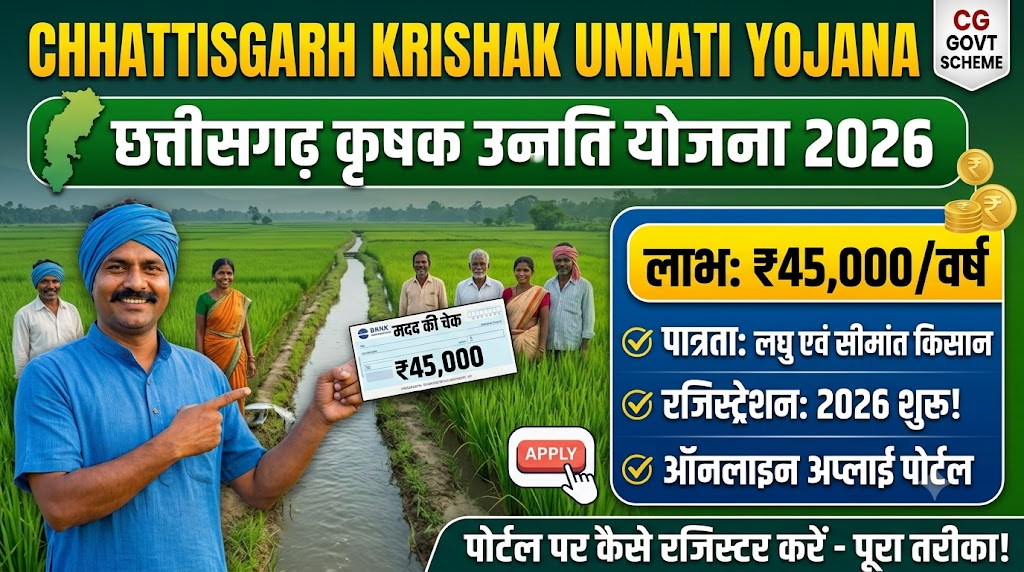
The strategy behind the framework extends beyond plain financial handouts; it seeks to formalize an economic cushion that shields over 25 lakh agrarian households from volatile market fluctuations. By structurally raising the disposable income of farmers in the “Rice Bowl of India,” the government directly triggers multi-sectoral economic growth across rural, semi-urban, and tribal markets. The operational blueprint guarantees that agricultural endeavors remain deeply profitable, highly sustainable, and resilient against evolving ecological challenges.
UP Awas Vikas Yojana 2026: Online Registration, New Housing Schemes & Allotment
Comprehensive Structural Overview Matrix
The governance of the program relies on seamless coordination between the Primary Agricultural Credit Societies (PACS), the Food Department, and state agricultural nodal bodies. This centralized architecture ensures absolute transparency across all phases, from seasonal crop registration to the final electronic clearance of input assistance funds.
| Implementation Parameter | Operational Specifications and Data Points |
|---|---|
| Name of Scheme | Chhattisgarh Krishak Unnati Yojana |
| Nodal Department | Department of Agriculture and Farmers Welfare, Chhattisgarh |
| Primary Objective | Direct Input Assistance, Paddy Price Enhancement, and Crop Diversification |
| Effective Paddy Payout Rate | ₹3,100 per Quintal (Inclusive of Central MSP and State Top-Up) |
| Maximum Procurement Limit | 21 Quintals per Acre from Registered Cultivators |
| Crop Diversification Incentive | ₹15,000 per Acre for transitioning from Paddy to alternative crops |
| Beneficiary Base Reached | Over 25.24 Lakh Farmers actively enrolled and credited |
| Fund Disbursement Model | Direct Benefit Transfer (DBT) via Aadhaar-Enabled Payment System |
| Official Registration Portal | Integrated Farmer Portal (Unified CG Krishi Portal) |
Primary Objectives Targeting Rural Economic Empowerment
- Providing Record Financial Returns: Assuring a guaranteed total payout of ₹3,100 per quintal for paddy crops to systematically eliminate rural distress.
- Minimizing Production Cost Overhead: Delivering heavy input subsidies directly into bank accounts to offset the rising prices of chemical fertilizers, certified seeds, and mechanical labor.
- Accelerating Strategic Crop Diversification: Providing major fiscal rewards for farmers shifting from low-margin, water-intensive paddy crops to high-value pulses, oilseeds, and horticultural produce.
- Protecting Tenants and Sharecroppers: Restructuring the traditional registration rules so that small sharecroppers (Bataidars) gain equal access to state market interventions alongside primary landowners.
- Preventing Exploitation by Middlemen: Utilizing strict digital grain accounting tools and electronic token systems to eliminate unauthorized local traders and predatory commission agents.
Decoupled Financial Subsidy Architecture and Pricing Breakdowns
The economic mechanics of this initiative provide a distinct combination of central minimum support prices and state-sponsored differential financial payments. This specific financial configuration ensures that local farmers receive immediate crop payments alongside subsequent top-up assistance clearing the promised target rates.
- Central Minimum Support Price Foundation: When farmers bring their harvest to the local cooperative procurement centers (Paddy Mandis), they receive immediate clearing based on the prevailing Central Government MSP, which hovers around ₹2,300 per quintal depending on the grain quality grade.
- State Differential Input Top-Up: The Krishak Unnati Yojana acts as the official financial top-up tool, adding a direct state bonus payment of approximately ₹800 per quintal to reach the ultimate uniform payout threshold of ₹3,100 per quintal.
- Per-Acre Input Support Allocation: Translated into geographical land dimensions, the state government transfers a highly substantial input support amount averaging up to ₹19,257 per acre directly into the active accounts of participating farmers.
Strict Per-Acres Procurement and Production Limits
To maintain systematic fiscal budgeting and prevent cross-border grain smuggling from adjacent states, the cabinet enforces explicit volume limits per agricultural landholding unit.
- Paddy Volume Limitations: The maximum volume permissible for official purchase at state cooperative societies stands locked at exactly 21 quintals per acre of registered land.
- Excess Yield Disposal Protections: Any surplus grain generated beyond the 21-quintal cap can be retained by the household for personal consumption or sold independently in the open commercial market without state intervention.
- Land Area Rounding Regulations: The digital land accounting engines evaluate acreage utilizing official digitized revenue maps, matching crop production estimates directly to verified village land databases.
Financial Infusion Milestones and Macroeconomic Impact
The massive scale of funds deployed under this framework establishes it as one of the largest state-level direct benefit transfers in Indian agricultural history, injecting substantial liquidity into the rural economy.
- Single-Day Massive Transfers: The administration executed historically significant bulk transfers, clearing over ₹13,320 crore in a single digital wave to more than 24.72 lakh active farming households across the state.
- Recent Consolidated Fiscal Releases: In recent budget intervals, including major releases timed right before major rural festivals, the cabinet authorized consecutive capital tranches exceeding ₹10,000 crore to settle differential balances for the Kharif marketing cycle.
- Aggregate Agricultural Capital Infusion: The cumulative capital delivered through this specific agricultural engine has successfully crossed the ₹35,000 crore mark, drastically improving rural banking liquidity.
Strategic Shift Towards High-Value Crop Diversification
A defining evolution of the initiative is its structural pivot away from monoculture paddy cultivation toward long-term environmental sustainability and crop balance.
- The Alternative Crop Bonus: The administration has introduced a specialized incentive payment of ₹15,000 per acre for farmers who convert traditional paddy fields into cultivation zones for pulses, oilseeds, or specialized cash crops.
- Water Table Preservation Focus: This strategic premium acts as a direct financial offset to encourage farmers to move away from water-guzzling varieties, preserving depleting groundwater tables across critical blocks.
- Strengthening Local Nutritional Supply Chains: By supporting alternative crops like gram, mustard, groundnut, and targeted lentils, the policy drives up the domestic production of essential protein and oil sources.
Comprehensive Eligibility Framework for Applicants
- State Residency Restrictions: The primary applicant must hold verified permanent resident status or a valid domicile certificate within Chhattisgarh.
- Arable Land Ownership Records: The individual must own active, registered agricultural land within the state, or possess legal, documented tenant cultivation rights.
- Mandatory Unified Portal Enrolment: Farmers must be fully registered with verified accounts on the Integrated Farmer Portal of Chhattisgarh before seasonal procurement deadlines expire.
- Cooperative Society Compliance: The applicant must maintain an active, unflagging membership and a clean account standing with their local Primary Agricultural Credit Society (PACS).
Mandatory Documentation for Seamless Verification
- Aadhaar Identification Infrastructure: A clear copy of the individual’s biometric Aadhaar card, which must be systematically linked to their primary operational mobile number.
- Digitized Land Revenue Certificates: Updated copies of the official B-1 (Land Ownership Document) alongside Khasra and Khatauni documents containing precise cadastral map coordinates.
- Bank Account Passbook Architecture: A clean copy of the nationalized bank passbook displaying the correct bank account number, branch location, and valid IFSC codes.
- Aadhaar Seeded Status Document: Official confirmation from the bank branch stating that the account is fully integrated with the National Payments Corporation of India (NPCI) for error-free DBT processing.
- Tenant Farmer Mutual Agreements: For sharecroppers, signed land usage consent letters authenticated by the local village Patwari are strictly mandatory.
Step-by-Step Online Registration Process on the Integrated Portal
The enrollment workflow has been deeply streamlined, integrating multiple separate departmental logins into a single, straightforward digital portal.
- Portal Access Initialization: Navigate directly to the official Unified CG Krishi Portal or the Integrated Farmer Portal of Chhattisgarh using an internet browser.
- Account Creation Module: Select the New Farmer Registration link and enter your functional mobile number to receive a secure, timed One-Time Password (OTP).
- Demographic Information Input: Fill in your personal details, including full legal name, district name, block name, and village administrative codes exactly as recorded in your Aadhaar card.
- Land Parcel Mapping: Enter your specific digitized Khasra numbers to fetch and link your exact land size directly from the centralized Bhuiyan land records database.
- Bank Mapping Integration: Input your banking coordinates and upload a high-resolution scanned copy of your bank passbook or a canceled cheque leaf.
- Final Form Submission: Review all linked entry data fields, submit the document packet digitally, and print out the auto-generated acknowledgment receipt containing your registration tracking ID.
Offline Enrollment Channels Through Village Cooperative Networks
For farmers facing limited digital access or living in remote tribal areas, the government maintains a widespread offline application support structure.
- Procurement Center Help Desks: Farmers can easily collect free paper application forms directly from their nearest Primary Agricultural Credit Society (PACS) office or local Paddy Mandi.
- Patwari Verification Assistance: The local village revenue officer (Patwari) is legally assigned to assist farmers in compiling, verifying, and signing off on land parcel logs without charging administrative fees.
- Cooperative Data Digitization: Completed physical forms can be handed over to authorized cooperative society clerks, who are responsible for uploading the details into the state’s digital systems.
- Physical Receipt Issuance: Upon receiving the physical application pack, the society coordinator issues a stamped, signed paper voucher that serves as permanent proof of enrollment.
Direct Benefit Transfer Protocol and Anti-Corruption Guardrails
The state infrastructure utilizes an automated electronic architecture to prevent cash leakage, ensuring every single rupee reaches its intended recipient.
- Direct Electronic Routing: All top-up cash sums move via Direct Benefit Transfer (DBT) channels, bypassing intermediate bureaucratic departments and local authorities entirely.
- Aadhaar-Enabled Payment Safety: The banking engines verify account ownership matching the Aadhaar identity before releasing payments, which dramatically reduces data entry errors.
- Mandatory Digital Grain Accounting: Every sack of paddy brought to the purchasing yard is electronically weighed, barcoded, and matched live against the farmer’s registered land acreage to prevent illegal off-market sales.
Common Implementation Bottlenecks and Practical Troubleshooting
- Aadhaar Mismatch Errors: Minor spelling variations between land titles and Aadhaar cards can block digital validation. Resolving this requires submitting a correction request through the local block revenue office.
- NPCI Inactive Seeding Failures: If a bank account is not properly integrated with the central NPCI database, DBT payments will bounce. Farmers must visit their branch to fill out a standard Aadhaar seeding form.
- Disputed Land Parcel Locks: Overlapping ownership claims can lock Khasra entries in the database. Resolving these issues requires submitting verified partition documents directly to the Tehsildar court.
Important Links and Official Digital Resources
Access the authorized channels below to monitor application statuses, download guidelines, and check current procurement calendars.
- State Government Web Hub: Chhattisgarh Government Portal
- Integrated Farmer Portal Link: CG Integrated Farmer Registration Engine
- Land Records Access Engine: Chhattisgarh Bhuiyan Digital Land Records
- Department Operations Desk: CG Directorate of Agriculture
Frequently Asked Questions
What is the primary purpose of the Chhattisgarh Krishak Unnati Yojana?
The initiative delivers a substantial state top-up payment on top of central crop prices to guarantee farmers a record payout of ₹3,100 per quintal for paddy, while also providing financial support to encourage crop diversification.
How much total money do farmers receive per quintal for paddy?
Enrolled farmers receive a total price of ₹3,100 per quintal, combining the base Central Minimum Support Price (MSP) with the state’s Krishak Unnati top-up.
What is the maximum volume of paddy a farmer can sell under this scheme?
The state caps procurement at a maximum volume of 21 quintals per acre of verified agricultural land.
How much financial aid is provided if a farmer switches away from paddy?
Farmers who shift their fields from paddy to alternative crops like pulses or oilseeds receive a crop diversification bonus of ₹15,000 per acre.
How is the financial support transferred to the beneficiaries?
All financial grants and differential price payments are credited directly into the farmer’s bank account via the secure Direct Benefit Transfer (DBT) network.
Are sharecroppers and tenant farmers allowed to participate in this scheme?
Yes, small sharecroppers and tenant cultivators can apply, provided they submit a verified land usage agreement authenticated by the local village Patwari.
What should I do if my DBT payment fails due to an NPCI issue?
You must visit your bank branch immediately and submit a signed Aadhaar seeding application form to link your account to the central NPCI clearing network.
Can I track my land parcel and registration data online?
Yes, farmers can log into the official Integrated Farmer Portal (kisan.cg.nic.in) or use the Bhuiyan portal to verify their registered land details and tracking status.
Is there any registration fee for joining the portal?
No, the registration process is completely free of cost across all online web forms and offline cooperative society help desks.
Which department is responsible for managing this scheme?
The program is administered and monitored by the Department of Agriculture and Farmers Welfare, Government of Chhattisgarh.
To view a detailed visual breakdown of how the payment distribution operates and how the state coordinates these large-scale bank transfers, you can check out this informative Chhattisgarh Krishak Unnati Yojana Payment Guide. This clip explains the real-world impact of the scheme on rural banking liquidity and direct benefit transfers.