
The Uttar Pradesh Khet Talab Yojana is an ambitious agricultural initiative launched by the Department of Agriculture, Government of Uttar Pradesh, under the Rashtriya Krishi Vikas Yojana (RKVY) and the “Per Drop More Crop” framework. The core objective of this scheme is to address the rapid depletion of groundwater tables and mitigate irrigation water scarcities across agricultural blocks in Uttar Pradesh. By helping farmers build dedicated farm ponds inside their personal agricultural plots, the government facilitates the storage of surplus monsoon rainwater.
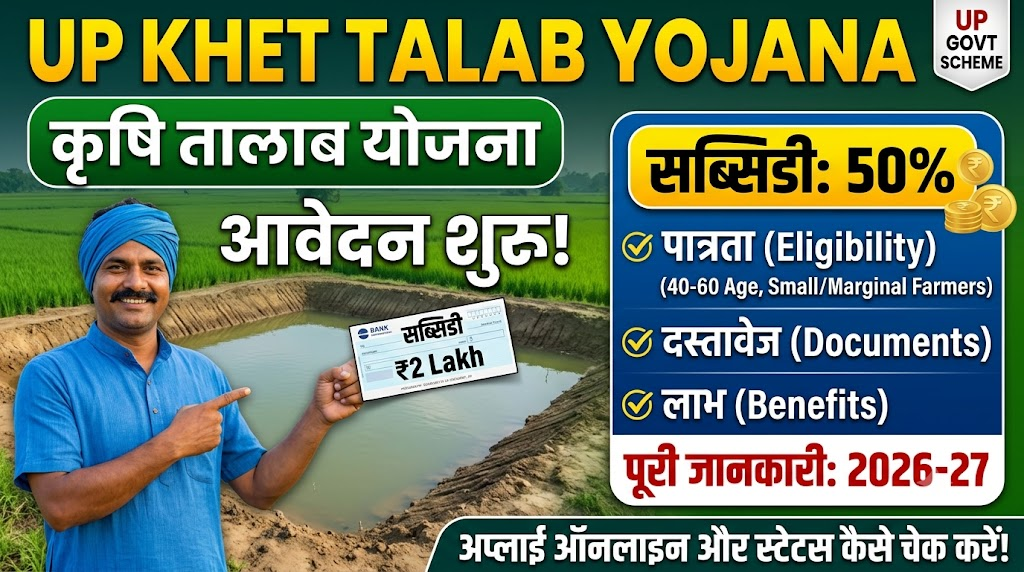
This captured water serves as an emergency resource during dry spells and reduces heavy operational reliance on electric and diesel tube wells. Ground implementation shows that setting up farm ponds protects standing crops from unexpected droughts while driving eco-friendly agricultural expansion across all agro-climatic zones of the state.
Scheme Overview Table and Financial Milestones
The Department of Agriculture handles administrative operations, allocating specific regional targets across districts each fiscal year. Farmers booking a farm pond get access to direct financial subsidies through digital channels. The program prioritizes small, marginal, and historically underrepresented demographic groups to ensure balanced rural growth.
MGNREGA Work List 2026: Check Village Gram Panchayat Wise Works & Allocation Status
Official Operational Matrix
| Parameter Detail | Information Specifics |
|---|---|
| Scheme Name | UP Khet Talab Yojana |
| Nodal Department | Department of Agriculture, Government of Uttar Pradesh |
| Primary Objective | Rainwater Harvesting, Groundwater Recharge, and Micro-Irrigation Promotion |
| Subsidy Rate Provided | 50% of the standard construction cost guidelines |
| Maximum Subsidy Amount | Up to ₹52,500 for construction + Up to ₹15,000 for Pump Sets |
| Mode of Application | Online Token Booking via Official UP Agriculture Portal |
| Beneficiary Selection Method | First-Come, First-Served basis combined with E-Lottery system |
| Fund Transfer Mode | Direct Benefit Transfer (DBT) directly into linked bank accounts |
| Official Digital Portal | upagriculture.com / agriculture.up.gov.in |
Key Objectives Behind the Farm Pond Initiative
- Mitigating Groundwater Exploitation: Shifting primary irrigation reliance away from deep-bore tube wells to preserve vital aquifers. dehaat.in
- Harvesting Surface Runoff: Retaining heavy monsoon precipitation that would otherwise drain out of fields and cause local soil erosion.
- Securing Double-Cropping Systems: Assuring dependable water access for both Kharif and Rabi crop cycles.
- Lowering Cultivation Costs: Cutting down on fuel and electric costs spent pumping deep groundwater throughout the year.
- Enabling Agricultural Diversification: Promoting profitable secondary setups like freshwater fish farming, duck rearing, and aquatic cash crop cultivation on the pond borders. dehaat.in
Financial Assistance and Subsidy Structure Breakdown
The financial support structure is strictly mapped out to clear 50% of standard project costs, making pond excavation highly affordable. The government calculates standard construction costs for a typical small pond (22 meters length × 20 meters width × 3 meters depth) at ₹1,05,000.
- Direct Infrastructure Subsidy: Eligible applicants receive a direct financial grant of 50%, capped at a maximum limit of ₹52,500. dehaat.in
- Water-Lifting Device Support: Approved beneficiaries can secure an additional 50% subsidy up to ₹15,000 to purchase and install an electric or diesel-powered pump set. CMV360
- Micro-Irrigation Setup Enhancements: Farmers integrating drip or sprinkler irrigation systems can access specialized sub-grants covering 80% to 90% of those equipment installation costs through the Horticulture Department.
Split Installment Disbursement Protocol
To guarantee high-quality execution and prevent misallocation of public funds, the state releases the construction grant in two distinct phases tied to clear physical progress.
- First Installment Phase (75% Release): A sum of ₹39,375 is credited via Direct Benefit Transfer right after the initial excavation work to the designated depth is verified by ground teams. Amar Ujala
- Second Installment Phase (25% Release): The final sum of ₹13,125 is cleared once structural masonry work, including the specialized water inlet/outlet systems, is fully set up, geo-tagged, and signed off by the Land Conservation Officer.
Technical Specifications and Dimensions of Authorized Ponds
The scheme recognizes structured dimension designs to ensure optimal volume retention without taking up too much productive arable land.
- Small Farm Pond Model: Standard layout spans 22 meters in length, 20 meters in width, and 3 meters in depth, perfectly optimized for small or marginal holdings. Jagran
- Medium Farm Pond Model: Larger formats span 35 meters in length, 30 meters in width, and 3 meters in depth, designed for larger clusters or high-water-demand crops.
- Inlet/Outlet Masonry Work: Every pond plan must feature a solid brick-and-mortar inlet structure to filter incoming silt and an outlet channel to safely route overflow during severe downpours.
Comprehensive Eligibility Criteria for Applicants
- Residential Standing: The applicant must be a permanent resident holding valid domicile status within Uttar Pradesh.
- Land Ownership Rights: Applicants must possess clear, undisputed land titles (Bhumidhar status) with updated revenue numbers.
- Mandatory Micro-Irrigation Alignment: To prevent water waste, applicants must have a working drip or sprinkler irrigation system installed within the last 7 years, or sign a formal integration agreement with the Horticulture Department. CMV360
- Target Demographic Distribution: Reservations protect structural targets, setting aside 50% for small and marginal farmers, 15% for Scheduled Castes/Scheduled Tribes, and giving preference to verified women farmers. Jagran
Mandatory Documents Checklist for Verification
- Identification Identity: Clear copies of the applicant’s Aadhaar Card linked to an active mobile number.
- Land Record Certificates: Recent official copies of Khasra and Khatauni land revenue certificates confirming ownership. CMV360
- Bank Account Details: Passbook copy showing clear account numbers, IFSC codes, and a linked Aadhaar profile. dehaat.in
- Demographic Certificates: Valid Caste Certificate issued by competent revenue authorities for reservation categories. dehaat.in
- Visual Proofs: Recent passport-size photographs of the farmer along with signed self-declaration forms.
Step-by-Step Online Application and Token Booking Procedure
The application workflow operates on a secure online platform hosted by the state agriculture team.
- Portal Navigation: Open the official portal at
upagriculture.comon a web browser. - Token Section Access: Locate and select the menu option labeled Grant on Agricultural Implements / Farm Pond Token Generation.
- Registration Entry: Provide your unique Farmer Registration Number to load personal records from the central state database.
- Pond Category Selection: Choose your desired farm pond size from the available options.
- Token Security Fee Deposit: Pay the mandatory ₹1,000 security token deposit through the integrated online payment gateway. CMV360
- Document Uploading: Scan and upload clear copies of your Khasra, Khatauni, and signed declaration forms within the system’s deadline. CMV360
- Acknowledgment Receipt: Download and print the automatically generated booking slip containing your unique tracker ID.
Beneficiary Selection and the E-Lottery Protocol
Due to tight district-level targets and high demand, the state uses a structured selection system to maintain absolute fairness.
- Target Capping: Each district receives a set annual allocation quota for farm ponds from the central headquarters.
- First-Come Validation: Initial processing ranks incoming online token submissions based on the exact timestamps of their security fee payments.
- E-Lottery Activation: If applications overshoot the district’s allocated quota, the system triggers an automated E-Lottery draw monitored by a district magistrate committee.
- Waiting List Management: Unselected applicants are placed on an organized waiting list, moving up automatically if a selected applicant fails document verification.
Mandatory Asset Tracking and Geo-Tagging Standards
To maintain high transparency, every pond built under the project undergoes rigorous digital mapping tracking.
- Baseline Imagery Capture: Ground technical officers use specialized mobile apps to take initial photos of the empty plot site before excavation begins.
- Mid-Stage Inspections: Progress photos are uploaded once the heavy digging phase is completed to trigger the first installment.
- Final Structural Tagging: Final clearance requires embedded GPS coordinates, a time stamp, and a photo showing the finished masonry work with the farmer standing next to the official scheme information board.
High-Yield Integrated Farming Models
A farm pond creates a micro-ecosystem that allows farmers to set up multiple highly profitable complementary ventures.
- Freshwater Aquaculture: Stocking deep pond waters with rapid-growing fish fingerlings like Rohu, Catla, and Mrigal to generate continuous seasonal income.
- Pond Border Agriculture: Utilizing the moist raised embankments to cultivate short-duration vegetables, pulses, or herbal crops.
- Aquatic Cash Crops: Cultivating specialized aquatic flora like Water Chestnut (Singhara) or Lotus roots directly inside the shallow edges of the pond. Krishi Jagran
Ground Reality and Implementation Challenges
- Hard Clay Obstructions: Encountering dense rocky strata or heavy clay formations during digging can drive up labor costs past initial estimates.
- Silt Accumulation Risks: Heavy inflows of soil mud during monsoons can fill up storage capacity if silt traps are not regularly cleared out.
- Token Forfeiture Rules: Missing the strict document upload deadlines causes automatic token cancellation and forfeits the security deposit.
Important Links and Official PDF Notifications
For official documentation, rules, and direct application links, refer to the authorized portals listed below.
- Official UP Agriculture Portal: UP Agriculture Official Website
- Department Application Engine: UP Agriculture Services Portal
- Token Tracking Tool: UP Agriculture Token Generation System
Frequently Asked Questions
What is the primary purpose of the UP Khet Talab Yojana?
The scheme helps farmers construct personal farm ponds to collect rainwater, recharge dry aquifers, and provide dependable water for irrigation.
dehaat.in
What is the maximum subsidy amount for constructing a small pond?
The state provides a 50% subsidy up to a maximum financial cap of ₹52,500 for a standard small pond.
dehaat.in
Is there a subsidy available for purchasing irrigation pump sets?
Yes, farmers with an approved farm pond can get an extra 50% subsidy up to ₹15,000 to buy electric or diesel pump sets.
CMV360
What is the standard size of a small farm pond under this scheme?
The standard dimensions for a small pond are 22 meters in length, 20 meters in width, and 3 meters in depth.
Jagran
How much token money must be deposited during online booking?
Applicants must pay a refundable/adjustable security token deposit of ₹1,000 during the online registration process.
CMV360
Can I build a farm pond if I do not have a micro-irrigation system?
You must either have an active drip/sprinkler system installed or sign a tripartite agreement to set one up with the Horticulture Department.
CMV360
How is the financial grant disbursed to the selected farmer?
The subsidy is transferred across two distinct installments (75% and 25%) directly into the farmer’s linked bank account using Direct Benefit Transfer (DBT).
Jagran
What happens if I miss the document upload deadline after booking?
Your temporary token booking is automatically canceled, the security fee is forfeited, and the slot goes to the next farmer on the waiting list.
Is fish farming permitted inside these sponsored farm ponds?
Yes, the government actively encourages integrated farming setups like aquaculture, duck rearing, and border vegetable cultivation to boost farm incomes.
dehaat.in
Who is eligible to apply for this water conservation scheme?
Any permanent resident farmer in Uttar Pradesh holding valid land titles (Khasra/Khatauni) and meeting the target demographic criteria can apply.
For a visual overview of how the registration system works and how to secure your booking token, you can watch this UP Khet Talab Yojana Registration Guide. This video explains the exact steps on the UP Agriculture portal to lock in your application before district quotas fill up.