
The Nagar Van Scheme (City Forest Scheme) is a landmark environmental initiative by the Ministry of Environment, Forest and Climate Change (MoEFCC), Government of India. Designed to combat the rapid degradation of natural resources caused by unchecked urban expansion, this scheme acts as a bridge between urban planning and forest science. By creating forested green spaces within or near municipal limits, the program aims to provide a sustainable “lung” for cities.
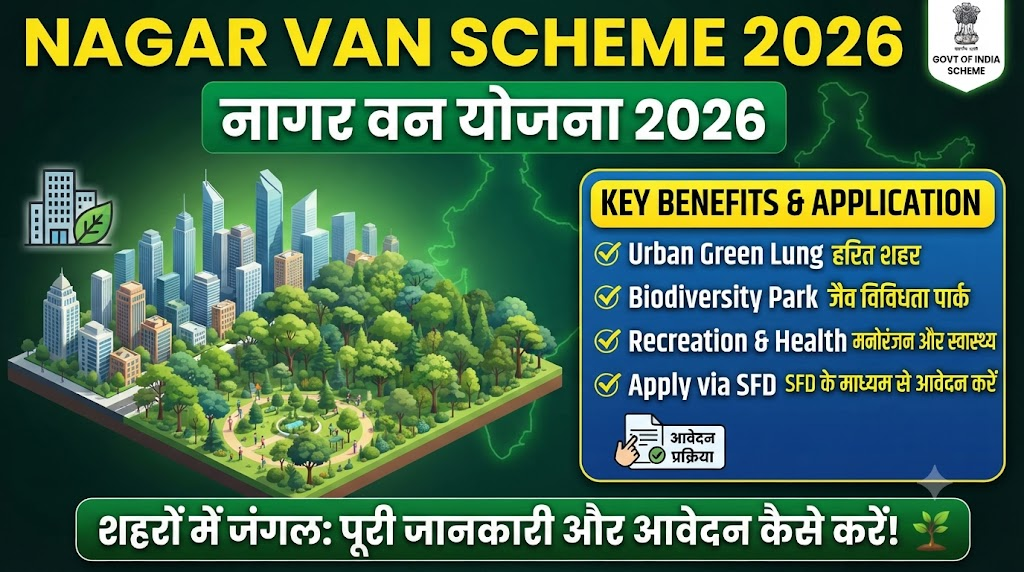
Unlike traditional parks, the Nagar Van Yojana focuses on creating self-sustaining, biodiverse ecosystems. It utilizes native species, natural regeneration processes, and layered vegetation to align urban development with India’s climate commitments. For residents of increasingly concrete-heavy urban centers, these “city forests” offer a sanctuary that mitigates the heat island effect, purifies the air, and serves as a hub for environmental education and community recreation.
Overview of the Nagar Van Yojana
This table summarizes the core operational parameters of the scheme for quick reference.
| Key Feature | Description / Criteria |
|---|---|
| Scheme Name | Nagar Van Yojana (City Forest Scheme) |
| Nodal Ministry | Ministry of Environment, Forest and Climate Change (MoEFCC) |
| Target Locations | Cities with Municipal Corporations, Councils, or Urban Local Bodies (ULBs) |
| Nagar Van Area | Minimum 10 hectares, Maximum 50 hectares |
| Nagar Vatika Area | Minimum 1 hectare, Maximum 10 hectares |
| Financial Assistance | Up to ₹4 lakh per hectare for core development |
| Funding Source | National CAMPA (Compensatory Afforestation Fund) |
| Distance Limit | Within 5 km of city limits |
Core Objectives of Developing City Forests
The primary goal of the Nagar Van Scheme is to integrate forest-like cover into the urban fabric. This isn’t merely about aesthetics; it is a science-backed effort to revitalize city ecology. By establishing these zones, the government intends to facilitate in-situ conservation, meaning plants and wildlife are protected in their natural local habitat rather than being relocated.
Catch Foundation
- Mitigation of Pollution: These forests act as massive carbon sinks, absorbing particulate matter and harmful gases. Catch Foundation
- Heat Island Reduction: Dense tree cover naturally lowers ambient temperatures in congested urban corridors. Catch Foundation
- Water Conservation: The soil in these forested areas enhances groundwater recharge and serves as a sponge for rainwater, reducing urban flash flooding. Catch Foundation
- Climate Resilience: By creating a network of green spaces, cities become better equipped to handle weather-related stressors.
Eligibility Criteria for Implementation Agencies
The scheme is not limited to Forest Departments alone; it encourages a multi-agency approach to foster ownership and sustainability. Eligible agencies include:
IMPRI Impact and Policy Research Institute
- Urban Local Bodies (ULBs): Municipal Corporations, Municipal Councils, and Nagar Panchayats can lead the development. IMPRI Impact and Policy Research Institute
- State Forest Departments: They often act as the primary technical partner, providing scientific guidance on species selection. Catch Foundation
- Institutional Partners: Universities, research bodies, and large public institutions with vacant, non-forest public land can propose Nagar Van projects. Catch Foundation
- Public-Private Collaborations: Civil society organizations, NGOs, and corporate bodies (under CSR) are encouraged to partner with local governments to help maintain these spaces. IMPRI Impact and Policy Research Institute
Land Suitability and Selection Guidelines
A major strength of the Nagar Van Yojana is its flexible approach to land use, allowing cities to repurpose underutilized land. The land must be public or non-forest land in most cases, or degraded forest land within city fringes.
- Degraded Forest Land: Sites where the ecosystem has been damaged due to encroachment or neglect are prime candidates for restoration.
- Vacant Public Land: Unused municipal properties or buffer zones near water bodies are highly encouraged. Catch Foundation
- Institutional Campuses: Large tracts of land owned by government institutions that are currently lying vacant can be transformed. Catch Foundation
- Accessibility: A primary requirement is that the selected site must be accessible to the general public, ensuring that these forests remain community assets rather than restricted zones.
Financial Assistance and Budgetary Provisions
The Government of India provides a structured grant to ensure the project is viable without putting an undue burden on municipal finances. The funding is primarily sourced from the National CAMPA fund.
- Grant Structure: The Ministry provides a one-time non-recurring grant of ₹4 lakh per hectare. Catch Foundation
- Utilization: These funds are earmarked for vital tasks such as fencing, soil moisture conservation, water harvesting structures, and initial plantation. Catch Foundation
- Financial Discipline: The grant is released to the State Forest Development Agency (SFDA), which is mandated to pass the funds to the implementing agency within seven days.
- Sustainability: Because the grant is one-time, the scheme encourages agencies to develop a model where user fees or CSR contributions help sustain the forest after the establishment phase.
Development Components: What’s Inside a Nagar Van?
A Nagar Van is not just a collection of trees; it is a designed natural space. The guidelines suggest integrating the following components to make these areas attractive and educational for citizens:
- Woodlands: At least two-thirds of the area must be under native tree cover to ensure ecological function. Catch Foundation
- Theme Gardens: Implementation agencies are encouraged to develop thematic zones like Nakshatra Van (astrological plant zones), Smriti Van (memorial forests), or Aushadhi Vatika (medicinal plant gardens). Catch Foundation
- Recreational Infrastructure: Basic amenities like jogging tracks, cycle paths, benches, and clean drinking water facilities are included to ensure public use. Catch Foundation
- Educational Kiosks: Information centers and signage that explain the local biodiversity, native tree species, and environmental benefits of the forest.
The Role of Public and Community Participation
The scheme emphasizes that a city forest cannot survive in isolation; it needs the community to thrive. “Community Ownership” is the cornerstone of the Nagar Van Yojana.
- Participatory Planning: Local residents and student groups are encouraged to be involved in the design and plantation phases. PWOnlyIAS
- Volunteer Stewardship: Citizen groups can act as guardians of the forest, helping in monitoring, maintenance, and cleanliness drives. PWOnlyIAS
- Corporate Social Responsibility (CSR): Companies are encouraged to invest in these forests as part of their environmental mandates under the Companies Act, 2013, bridging the funding gap for maintenance. Catch Foundation
- Educational Outreach: Schools are encouraged to conduct nature walks and science sessions within these forests to create a sense of environmental stewardship among the youth. Catch Foundation
Implementation Process and Project Approval
The process of moving from a proposal to a fully functional forest is structured to ensure transparency and scientific oversight.
- Proposal Formulation: The implementing agency (e.g., Municipal Corporation) creates a detailed project proposal (DPR) along with site maps and species lists.
- Technical Scrutiny: The State Forest Department evaluates the plan to ensure it meets environmental and biodiversity standards.
- Official Approval: The proposal is then submitted to the MoEFCC, which reviews and grants financial sanction based on available CAMPA funds.
- Implementation: The agency begins work, including fencing, site clearing, and plantation, followed by regular monitoring of survival rates of the saplings.
Choosing the Right Species for Local Ecology
The scheme strictly prohibits the use of invasive or non-native species. The biodiversity of the region must be the guiding factor for plantation.
- Native Dominance: Species must be selected based on the specific climatic zone—dry, humid, or mountainous—to ensure high survival rates.
- Biodiversity Enrichment: Planting includes a mix of fruit-bearing, nectar-rich, and medicinal plants to attract birds, butterflies, and pollinators. Catch Foundation
- Layered Vegetation: A mix of shrubs, climbers, and trees is encouraged to mimic a natural forest structure, which provides better habitat than a monoculture plantation. Catch Foundation
- Pollution Abatement: Certain species known for their ability to filter air pollutants or reduce noise are given preference in areas closer to main roads.
Monitoring and Maintenance Guidelines
Sustainability is the biggest challenge in urban forestry. To prevent these areas from falling into decay, the scheme mandates rigorous monitoring.
- Periodic Audits: The State Forest Development Agency monitors the progress and provides regular reports to the Ministry.
- Survival Monitoring: The primary metric of success is the survival rate of the saplings planted in the first three years.
- Operational Transparency: Each project must have clear signage regarding the purpose of the forest, the species planted, and the agency responsible for maintenance.
- Management Plan: Every Nagar Van is required to have a dedicated management plan that specifies the duties of the ground staff and the schedule for irrigation and pruning.
Benefits for Local Residents and Urban Health
The tangible benefits for the average urban dweller are significant. In an age of high stress and urban clutter, these spaces act as “stress-busters.”
- Mental Well-being: Access to green space is scientifically linked to reduced anxiety and improved mental health. Catch Foundation
- Recreational Space: These forests provide a much-needed venue for physical activities like walking, jogging, and yoga. Catch Foundation
- Environmental Awareness: They serve as outdoor classrooms, helping children understand the importance of trees and biodiversity. Catch Foundation
- Health Benefits: Cleaner air and reduced noise pollution directly contribute to a lower incidence of respiratory and lifestyle-related diseases among residents. PWOnlyIAS
Challenges and Future Outlook
While the scheme is ambitious, it faces several hurdles, such as land encroachment, water scarcity in urban areas, and the difficulty of maintaining large tracts of land in the long term.
- Land Disputes: Securing uncontested public land in high-value urban areas can be slow.
- Water Management: In water-stressed cities, keeping a forest alive requires innovative solutions like treated wastewater irrigation or advanced rainwater harvesting. Catch Foundation
- Long-term Financing: Moving beyond the initial government grant requires innovative business models, such as user fees for specific facilities or continued CSR funding. Catch Foundation
- Scaling Up: As the target number of Nagar Vans increases, the government is looking to replicate successful models to cover every major urban local body in the country.
Frequently Asked Questions
What is the difference between a Nagar Van and a regular park? A Nagar Van is an “urban forest” designed to mimic a natural ecosystem, focusing on biodiversity and native species, whereas a regular park is typically manicured, ornamental, and may contain non-native decorative plants.
Who is responsible for the day-to-day maintenance of the Nagar Van?
The maintenance is primarily the responsibility of the implementing agency, such as the local Municipal Corporation or a designated committee, often in collaboration with the Forest Department.
Can a corporate body fund a Nagar Van?
Yes, private entities can contribute to the development and maintenance of Nagar Vans through their CSR budgets, as it aligns with environmental sustainability goals under Schedule VII of the Companies Act.
Are these city forests free for the public to visit?
Yes, Nagar Vans are designed as community assets and must remain open to the public, subject to minor management restrictions for safety or conservation.
What happens if the plants do not survive?
The implementing agency is required to ensure a high survival rate. Monitoring is conducted by the state, and failing to maintain the forest cover can affect further funding eligibility.
Is there a maximum size for a Nagar Van?
The government provides financial assistance for up to 50 hectares. However, local bodies can develop larger forests using their own resources.
Can Nagar Vans be developed on private land? No, the scheme specifically targets public, institutional, or degraded forest land to ensure the space remains a permanent public resource.
How do I find a Nagar Van near me? You can check the official MoEFCC portal or your local Municipal Corporation’s website, which maintains the list of sanctioned and completed urban forest projects.
What if my city does not have a Municipal Corporation? The scheme currently focuses on cities with Municipal Corporations, Councils, or Urban Local Bodies (ULBs). You may check with your local municipality to see if they have submitted a proposal.
Does the government provide ongoing funding for maintenance? The central grant is one-time (non-recurring). For ongoing maintenance, agencies are expected to generate funds through user fees or community/corporate partnerships.
Important Links and Resources
- Ministry of Environment, Forest and Climate Change (MoEFCC): https://moef.gov.in
- Nagar Van Yojana Implementation Guidelines: Download Official PDF
- National CAMPA Portal: https://campa.gov.in
- State Forest Department Directories: https://forests.gov.in
- MyScheme (Government of India): https://www.myscheme.gov.in