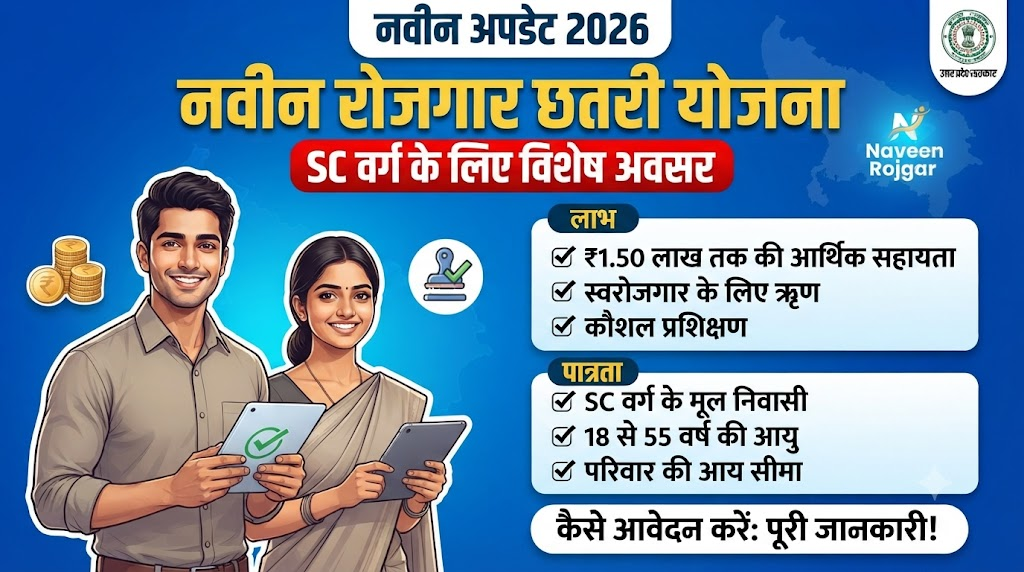
The Naveen Rojgar Chatri Yojana is a landmark initiative launched by the Government of Uttar Pradesh, spearheaded by Chief Minister Yogi Adityanath. Introduced on July 18, 2020, this program was specifically designed to provide a “protective umbrella” (the literal meaning of Chatri) to the Scheduled Caste (SC) communities across the state.
In the wake of the COVID-19 pandemic, which caused widespread job losses and economic distress among laborers and rural workers, the scheme emerged as a beacon of hope, aiming to foster self-reliance. By providing financial assistance, the government seeks to transform job seekers into job creators, ultimately contributing to the socio-economic upliftment of the state’s most vulnerable populations.
Chhattisgarh Misal Bandobast Record Online 2026 : Search by Name & Village
Overview of the Scheme
The following table outlines the foundational aspects of the Naveen Rojgar Chatri Yojana to help applicants understand the scheme at a glance.
| Feature | Details |
| Scheme Name | Naveen Rojgar Chatri Yojana |
| Launched By | Government of Uttar Pradesh |
| Primary Beneficiary | Scheduled Caste (SC) individuals |
| Objective | To provide financial aid for self-employment |
| Financial Support | Up to ₹25,000 (varies based on project) |
| Target Audience | Unemployed youth and displaced laborers |
| Mode of Application | Online via Employment Portal / Local Employment Office |
| Status | Active and Ongoing |
Objectives of the Program
The primary objective of the Naveen Rojgar Chatri Yojana is to foster comprehensive development for the SC community. The government identified that without financial capital, talented individuals from marginalized backgrounds often struggle to initiate small businesses. This scheme aims to bridge that gap by offering seed capital, thereby:
- Encouraging entrepreneurship at the grassroots level.
- Reducing dependency on migrant labor for income.
- Providing sustainable livelihoods to rural households.
- Empowering SC individuals to run small-scale ventures like grocery shops, laundry services, or technical cafes.
- Ensuring that the economic benefits reach the most remote districts of Uttar Pradesh.
Eligibility Criteria
To ensure that the scheme reaches the intended demographic, strict eligibility guidelines have been established. Applicants must meet the following requirements:
- Residential Status: Must be a permanent resident of Uttar Pradesh.
- Caste Category: The applicant must belong to the Scheduled Caste (SC) community.
- Age Limit: Individuals aged between 18 and 40 years are eligible to apply.
- Employment Status: The applicant must be unemployed. Those currently employed in government or private sectors are generally ineligible.
- Educational Qualification: A minimum of 10th-grade (High School) completion is typically required.
- Financial Standing: The applicant must not be a loan defaulter of any government or financial institution.
Financial Benefits and Assistance
The scheme provides a crucial financial push to help beneficiaries set up their own enterprises. The government provides financial aid of up to ₹25,000 for various small-scale businesses. This aid is primarily intended to cover the initial investment costs, such as:
- Purchasing raw materials for small-scale manufacturing.
- Setting up retail infrastructure (e.g., counters, signage, or small storage).
- Buying essential equipment for service-based work (e.g., washing machines for laundry, computers for cyber cafes).
- Rental deposits for small commercial spaces.
- The overall aim is to remove the “entry barrier” for individuals who have the skill but lack the capital to start their journey.
Recommended Business Ideas
The scheme is highly versatile, allowing beneficiaries to apply for diverse sectors of the economy. Some of the most successful ventures supported under this scheme include:
- Retail Businesses: Small grocery or Kirana stores.
- Service Sector: Laundry and dry cleaning units.
- Digital Services: Cyber cafes and computer training centers.
- Small-Scale Trade: Tent houses for event management.
- Agri-allied Services: Small-scale animal husbandry or dairy support.
- Manufacturing: Handicraft workshops or small-scale textile units.
Required Documents for Application
Preparation is key to a smooth application process. Applicants should keep the following documents scanned and ready:
- Aadhaar Card: As the primary identity and residence proof.
- PAN Card: For financial transactions and bank linkage.
- Caste Certificate: A valid certificate issued by the UP government to verify SC status.
- Educational Certificates: 10th-grade mark sheet or equivalent.
- Bank Details: A passbook or cancelled cheque for the DBT (Direct Benefit Transfer) process.
- Income Certificate: To verify the economic background of the family.
- Self-Declaration Form: A formal declaration regarding the applicant’s unemployment status.
Application Process: Step-by-Step
The government has digitized the process to ensure transparency and ease of access for the youth.
- Portal Visit: Log on to the official Uttar Pradesh Employment Portal or the designated state government scheme website.
- Registration: Click on the “New Account” or “Sign Up” button to create a user ID.
- Form Filling: Carefully fill in personal details, educational qualifications, and bank information.
- Document Upload: Upload the required documents in the prescribed format (usually PDF or JPEG).
- Submission: Review the details and submit the application.
- Verification: The local employment office will review the application.
- Approval: Upon successful verification, the financial assistance is transferred directly to the beneficiary’s bank account.
Role of the Employment Office
The local District Employment Offices play a pivotal role in the implementation of the Naveen Rojgar Chatri Yojana. Their responsibilities include:
- Public Awareness: Organizing camps in rural areas to inform SC families about the scheme.
- Verification: Conducting field visits or document checks to ensure the authenticity of the applicants.
- Guidance: Helping illiterate or digitally unskilled applicants complete the online registration.
- Dispute Resolution: Addressing grievances related to payment delays or document rejection.
Impact on Urban and Rural Economy
Since its launch, the scheme has had a cascading effect on the state’s economy. By empowering thousands of families:
- Reduced Migration: More people are finding stable income sources within their own districts.
- Entrepreneurial Growth: Local markets are seeing a surge in micro-enterprises.
- Social Equity: There is a notable reduction in financial dependency, leading to higher self-esteem within the SC community.
- Skill Utilization: Individuals are finally using their latent skills, whether in technical work or retail, to earn a dignified living.
Monitoring and Sustainability
The government does not just provide money; it intends for these businesses to last. Measures taken to ensure sustainability include:
- Training Support: In some districts, beneficiaries are provided with basic business management training.
- Periodic Audits: Follow-up checks are conducted to ensure that the funds are utilized for the business rather than personal consumption.
- Growth Tracking: The government monitors the success of the ventures to determine if further help (like access to bank loans) is required.
Challenges and Solutions
While the scheme has been highly successful, some challenges exist:
- Digital Gap: Limited internet access in remote villages. Solution: Local Common Service Centres (CSCs) are assisting with registrations.
- Awareness: Many eligible individuals still do not know how to apply. Solution: Use of social media and radio to spread the word.
- Documentation Errors: Simple mistakes in bank details can lead to failed transactions. Solution: Dedicated help desks at employment offices.
Difference Between Other Schemes
It is important not to confuse this scheme with others:
- Naveen Rojgar Chatri Yojana: Specifically for SC families, focuses on small self-employment.
- Pandit Deendayal Upadhyay Swarojgar Yojana: Focuses on broader entrepreneurship support with larger loan components.
- Berojgari Bhatta: A scheme that provides a monthly stipend to unemployed youth until they find a job, whereas the Chatri Yojana is for permanent business setup.
Important Links and Notifications
Applicants are advised to rely only on official portals for all information.
- Official Employment Portal (Uttar Pradesh): https://sewayojan.up.nic.in/
- Yuva Sathi Portal: https://www.yuvasathi.in/
- Guidelines PDF: Visit the “Schemes” section on the Seva Yojan portal to download the latest project notification PDF.
- Note: Always verify the authenticity of any “agent” claiming to facilitate the loan; the government process is free of cost.
Frequently Asked Questions (FAQs)
1. Who is eligible for the Naveen Rojgar Chatri Yojana?
Only permanent residents of Uttar Pradesh belonging to the Scheduled Caste (SC) category, aged 18-40, are eligible.
2. Is there a physical form I need to fill out?
You can apply online via the UP Employment Portal, but you may visit your local employment office for guidance.
3. How much financial aid will I receive?
The scheme provides financial assistance of up to ₹25,000 for setting up small businesses.
4. Can I get a loan instead of a grant?
The scheme primarily focuses on financial assistance/grants, but the government often encourages banks to support beneficiaries with additional loans.
5. What if I am already working in a part-time job?
The scheme is intended for the unemployed. Candidates with full-time or stable jobs are generally not eligible.
6. Are there any hidden charges for applying?
No, the application process is completely free. Beware of anyone asking for money to “approve” your application.
7. Can I apply for any type of business?
The business must be legal and viable. Examples include retail stores, services, and small workshops.
8. How will I know if my application is approved?
You can track your application status by logging into the official Seva Yojan portal.
9. Do I need an income certificate?
Yes, an income certificate is required to verify your economic background and eligibility for the assistance.
10. Where can I find the official application link?
You can visit the official UP Seva Yojan portal for the latest registration links and notifications.