
The Mahatma Gandhi National Rural Employment Guarantee Act (MGNREGA) stands as one of the largest social security initiatives globally, securing the right to work for millions of rural households. By guaranteeing at least 100 days of wage employment in a financial year to every rural family willing to do unskilled manual work, it serves as a powerful economic safety net. However, the success of this program relies heavily on the transparency of its local execution.
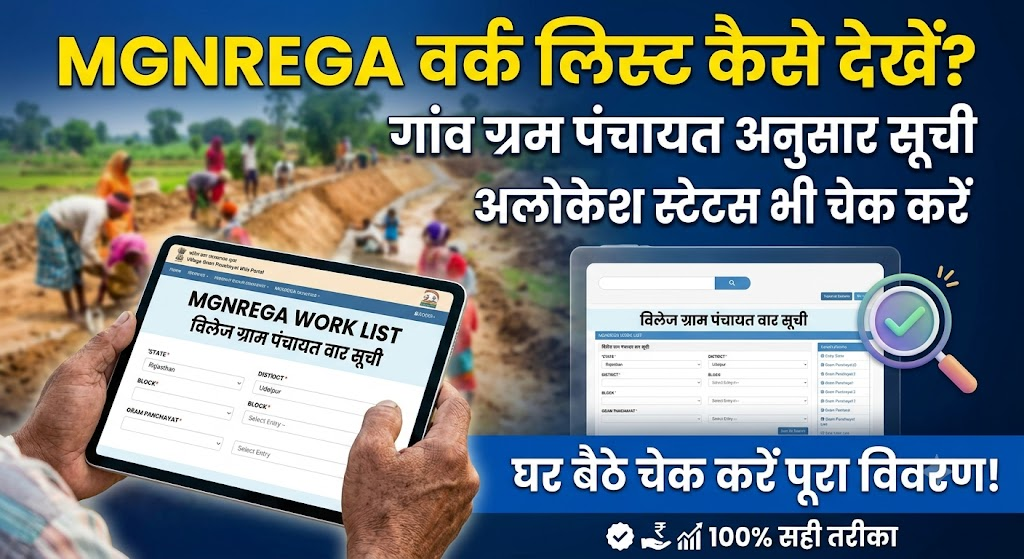
The MGNREGA Work List is a comprehensive public catalog that details every sanctioned, ongoing, and completed project within a specific local jurisdiction. Keeping track of this work list helps rural workers know exactly which community projects are open for employment. It gives grassroots citizens the power to claim their rightful employment allocations while keeping local administrations accountable for asset creation and resource deployment.
Quick Scheme Overview and Highlights
To give portal visitors a clear snapshot of how the employment guarantee and project monitoring frameworks function, the core structural indicators are outlined below:
| Key Feature | Scheme & Portal Specifics |
| Scheme Name | Mahatma Gandhi National Rural Employment Guarantee Act (MGNREGA) |
| Nodal Ministry | Ministry of Rural Development (MoRD), Government of India |
| Primary Digital Hub | Official NREGA Portal (nrega.nic.in) |
| Core Guarantee | Minimum 100 Days of guaranteed unskilled manual wage labor per year |
| Tracking Metrics Available | Approved Work Category, Consolidated Wage Lists, Muster Rolls, and Job Cards |
| Payment Method | Direct Benefit Transfer (DBT) via Aadhaar Based Payment System (ABPS) |
| Application Scope | All rural districts across 36 States and Union Territories |
| Information Target | Gram Panchayat wise project allocations and active worker wage schedules |
Primary Objectives of Publishing the Work List Online
The open publication of village-wise project ledgers satisfies critical pillars of decentralized governance:
- Eradicating Corruption: Publishing data online prevents local authorities from creating fake projects or over-allocating funds to non-existent assets.
- Empowering Wage Seekers: Workers can easily see active sites in their immediate neighborhood, making it easier to formally demand work from their Gram Panchayat.
- Strategic Local Development: Rural communities can review ongoing projects to ensure that essential water conservation, road connectivity, and agricultural assets are built evenly.
- Social Audit Readiness: A completely public log makes sure that civil society groups and village panels can audit the physical sites without bureaucratic gatekeeping.
Core Categories of Permissible MGNREGA Works
The Ministry of Rural Development specifies a strict list of permissible community and individual works to build sustainable infrastructure:
- Natural Resource Management (NRM): This category focuses heavily on water conservation, rainwater harvesting, check-dam construction, watershed management, and extensive afforestation.
- Agriculture & Allied Infrastructure: Building compost pits, community cattle sheds, fish drying yards, and carrying out land development activities for small and marginal farmers.
- Common Community Assets: Constructing rural sanitation structures, Anganwadi centers, village markets, and durable all-weather concrete or gravel connectivity roads.
- Livelihood Support Investments: Building personal housing frameworks under PMAY-G and supporting individual asset building like wells or orchards for scheduled castes and tribes.
Step-by-Step Guide to Check NREGA Work List Online
Citizens can pull the complete current project directory for their respective village by using the following digital navigation steps:
- Open a desktop or mobile browser and navigate directly to the primary website at nrega.nic.in.
- Scroll down the landing page and locate the “Quick Access” portal menu or click on the “Reports” tab under the key features block.
- Pass the standard system security captcha and select your specific State from the interactive national map or dropdown listing.
- Select the current Financial Year, followed by choosing your respective District, Block, and local Gram Panchayat from the sequential options.
- Click the “Proceed” icon to reveal the master administrative ledger section.
- Navigate to the dedicated “Work Demand, Allocation & Information” column and select the specific file link titled “List of Works”.
- Filter the resulting screen by selecting options like “All”, “Ongoing”, “Completed”, or “Approved” to display the complete regional project registry on your screen.
Understanding the Structure of an Online NREGA Work Ledger
When a citizen opens the village register, the portal presents highly structured metrics that require systematic reading:
- Unique Work ID Code: An 18-digit administrative identification key stamped on every project to track funding, location, and structural category safely.
- Project Status Flags: Clear markers labeling whether a project is currently active (“Ongoing”), finished (“Completed”), or awaiting funds (“Approved”).
- Estimated Financial Outlay: The exact budgetary limit authorized for materials and wages for that specific development site.
- Muster Roll Tracking: Linked portals showing the physical attendance registers of the workers deployed at that site during specific construction spells.
How to Check the Consolidated NREGA Wage List
The wage list acts as the official financial ledger that approves payment transfers to workers before the funds hit their bank accounts.
- Go to the Gram Panchayat report control deck on the official portal.
- Look for the financial reporting category often marked under “R7 Financial Progress” or worker dashboards.
- Select “Consolidated Report of Payment to Worker” or click on the specific “WageList” option from the search utility tools.
- The portal will reveal the complete list of generated wage sheets, showing unique job card keys, applicant names, precise days worked, and the total amount transferred.
- This tool allows workers to cross-examine whether their daily attendance has turned into processed payments or if their wages are stuck at the processing stage.
Crucial Role of the Aadhaar Based Payment System (ABPS)
To keep transaction tracks safe and eliminate middleman delays, the distribution engine relies heavily on modern biometric identity mappings:
- Aadhaar Seeding Mandate: All active job cards must have their primary worker entries uniquely linked with their verified Aadhaar numbers.
- Bank Mapping Integration: The user’s Aadhaar number must be safely linked to their active savings bank account via the National Payments Corporation of India (NPCI) mapper.
- No Manual Routing: Payments are directed straight to the Aadhaar-linked account, preventing local supervisors or contractors from siphoning off wages.
- Error Correction Tracks: If a transaction fails due to inactive mapping, workers can use the online wage status tool to identify the issue and update their KYC details at their bank.
Process to Request and Secure Allotted Work
Simply holding a job card does not mean work will automatically start; workers must follow the official demand submission channel:
- Form-6 Submission: The applicant must submit a written work request using Form-6 to the Gram Panchayat office or via the integrated Janmanrega app.
- Group Demands: Multiple workers can sign a joint demand application to initiate a specific community project from the permissible work list.
- Dated Receipt Collection: It is highly critical to demand a dated receipt of the application from the local Panchayat Secretary or program assistant.
- The 15-Day Rule: The local administration is legally bound to offer a physical work assignment within 15 days of receiving the request.
Right to Unemployment Allowance and Delayed Compensation
The MGNREGA framework includes powerful legal penalties to protect rural workers from administrative delays or inefficiencies:
- Unemployment Allowance Rule: If the local administration fails to provide a work site within 15 days of receiving a valid application, the worker is legally entitled to a daily cash allowance.
- Allowance Scale: The allowance starts at one-fourth of the standard wage rate for the first 30 days, moving up to half the wage rate for the remaining period.
- Delayed Payment Penalties: Wages must be paid out within 15 days of closing the weekly muster roll sheet.
- Daily Interest Accumulation: For every single day of delay beyond the sixteenth day, workers are entitled to a compensation rate of 0.05% of their unpaid wages, which is automatically added to their final payout.
Key Differences: Individual Works vs. Community Works
Understanding project scopes helps landless laborers and small landowners utilize the scheme resources optimally.
| Comparison Parameter | Individual Category Assets | Common Community Assets |
| Primary Beneficiary | Single family (SC/ST, small/marginal farmers) | The entire rural village community |
| Typical Project Examples | Cattle sheds, farm ponds, land leveling, orchard pits | Check dams, village markets, roads, canal clearing |
| Site Location | Executed directly on private land owned by the beneficiary | Executed on public gram panchayat or government land |
| Labor Sourcing | The landowning family members get priority employment | Any active job card holder in the village can join |
Disqualification Factors and Work Allocation Rejections
A worker’s name or a proposed village project can face rejection under specific regulatory conditions:
- Absence of ABPS Verification: Workers who have not completed their Aadhaar-to-bank mapping will face payment blocks on active muster rolls.
- Non-Permissible Project Submissions: Proposing construction projects that use heavy heavy-duty machinery or require non-local materials will result in immediate rejection.
- Exceeding the 100-Day Household Cap: Once a single household card completes 100 combined days of labor within a financial year, the system automatically stops further work allocations.
- Age Out of Bounds: Any family member registered on the job card who is under 18 years old will be barred from manual labor sites.
Grievance Redressal Mechanisms and Complaint Tracking
If workers face issues with missing project names, unfair job assignments, or unpaid wages, they can use official grievance channels:
- The Local Ombudsman: Every district features a dedicated, independent MGNREGA Ombudsman to handle public complaints and penalize faulty block officials.
- Online CPGRAMS Portal: Citizens can log a formal complaint online via pgportal.gov.in or use the regional NREGA grievance sub-menu.
- Muster Roll Inspections: Workers have the legal right to check the active physical muster roll sheet at the project site to ensure their daily attendance is marked accurately.
- Toll-Free Direct Helpline: Citizens can call the national support desk at 1800-111-555 to report fake projects or delayed wage issues directly.
Important Web Infrastructure and Digital Document Links
Portal visitors can use these direct links to monitor projects, check lists, and view official guidelines:
- Official Central Web Portal: Mahatma Gandhi National NREGA Hub
- Panchayat Level Access Hub: NREGA Direct Gram Panchayat Login Gateway
- Advanced Search Directory: Integrated MIS Report & Work Status Finder
- Official Permissible Works Document: Users can check structural parameters and review the full list of permissible projects by downloading the official Schedule 1 Master Circular Guidelines.
Frequently Asked Questions
How can I check my village NREGA work list for the current year?
You can check it by visiting nrega.nic.in, opening “Reports”, selecting your state, district, block, and panchayat, and clicking on “List of Works”.
What is a unique 18-digit work code in MGNREGA?
It is a unique identification number assigned to every approved project to track its budget, location, progress, and workers.
Can a project be executed using construction machines like JCBs?
No. The scheme strictly bans contractors and heavy machinery for manual tasks to ensure that local rural laborers get employment.
What happens if I do not get a work site within 15 days of applying?
You become legally eligible to receive a daily unemployment allowance from the state government until a work site is assigned.
How much compensation is paid for delayed NREGA wages?
Workers are entitled to a delay compensation of 0.05% of their unpaid weekly wages for every day the payment is delayed past the 15-day limit.
What do color codes like Green and Gray mean on the online job card list?
Green indicates that the job card has a photo uploaded and employment has been used, while Gray means the card is active but no work has been claimed yet this year.
Where can I find the attendance sheet of an ongoing village project?
You can view it online by checking the “Muster Roll” reports under your Gram Panchayat’s daily report tab on the official portal.
Is it possible to add a new project to the permissible work list?
New projects can be proposed during the annual Gram Sabha meeting, where the village planning list is designed and sent to the block for approval.
Can a landless laborer get an individual asset built on public land?
No. Individual assets like cattle sheds can only be built on land privately owned by eligible SC/ST or marginal farming families.
What should I do if my wage payment fails due to an ABPS error?
You need to visit your linked bank branch and ask them to map your Aadhaar number with the NPCI server to enable seamless DBT transfers.