
The Balasaheb Thackeray Smruti Matoshree Gram Panchayat Building Scheme is a flagship initiative by the Maharashtra Government designed to provide independent office buildings to gram panchayats that lack proper infrastructure. Named in memory of Balasaheb Thackeray, the scheme addresses a critical gap in rural governance by ensuring that every gram panchayat has a dedicated space to administer and serve the local population .
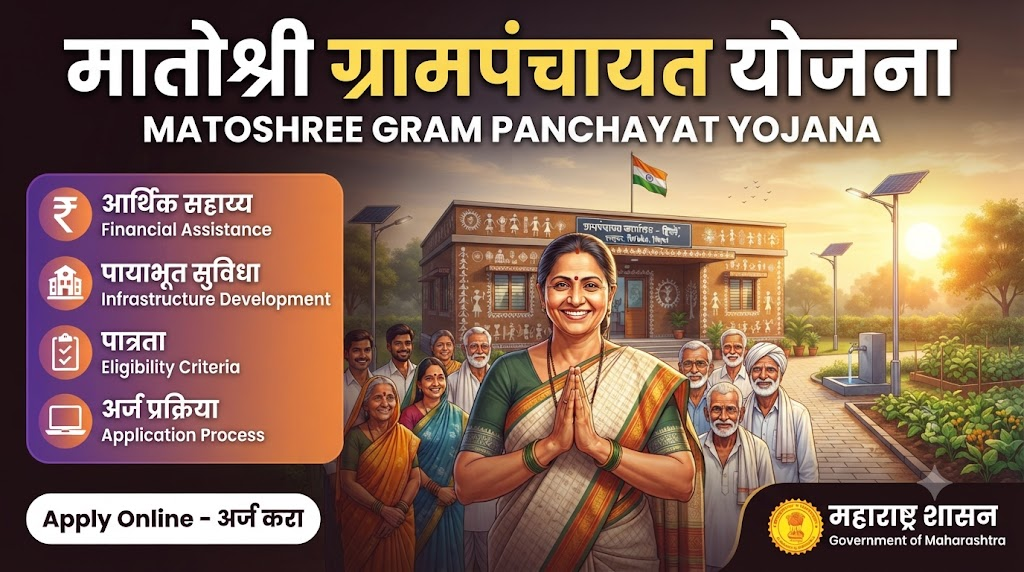
The scheme was initially approved by the Maharashtra Cabinet in January 2018 for a period of four years (2018-19 to 2021-22) . Given its success and the continued need for rural infrastructure, the scheme was extended until 2027-28 by the state cabinet .
The primary objective is to provide financial assistance for constructing office buildings for smaller and financially weaker gram panchayats that do not have their own buildings. The scheme has made a significant impact, with 4,252 gram panchayats identified as beneficiaries. Administrative approval has been granted to 1,748 gram panchayats, with Rs 38.13 crore already spent on construction .
UP Kaushal Vikas Yojana 2026: Complete Guide to Skill Training, Courses & Online Apply
Scheme Overview and Key Statistics
| Particular | Details |
|---|---|
| Scheme Name | Balasaheb Thackeray Smruti Matoshree Gram Panchayat Building Scheme |
| Launch Year | 2018 |
| Implementing Department | Rural Development & Panchayat Raj Department, Maharashtra Government |
| Total Beneficiary Gram Panchayats | 4,252 |
| Administrative Approvals | 1,748 gram panchayats |
| Funds Spent | Rs 38.13 crore (as of 2023) |
| Extension Period | Up to 2027-28 |
| Official Website | rdd.maharashtra.gov.in |
| Application Mode | Through Gram Panchayat Resolution |
| Financial Assistance | Rs 20 lakh / Rs 25 lakh based on population |
Key Benefits Table:
| Population Category | Financial Assistance (Earlier) | Financial Assistance (Revised) | Changes |
|---|---|---|---|
| Less than 2,000 | Rs 15 lakh | Rs 20 lakh | Increase of Rs 5 lakh |
| More than 2,000 | Rs 18 lakh | Rs 25 lakh | Increase of Rs 7 lakh |
Key Takeaway: The Maharashtra Cabinet significantly increased the financial assistance to help gram panchayats construct better-quality buildings, recognizing the importance of robust rural infrastructure .
Objectives of the Scheme
- Infrastructure Development: To provide independent and permanent office buildings to gram panchayats that are currently functioning from rented premises, makeshift structures, or rooms in temples or other public buildings.
- Strengthening Local Governance: To empower gram panchayats by giving them a dedicated space to conduct meetings, store records, and provide essential services to citizens efficiently. This aligns with the broader goal of strengthening local democracy .
- Financial Support: To provide financial assistance to smaller and financially weaker gram panchayats that may not have the resources to construct their own buildings.
- Improving Service Delivery: A dedicated office space allows gram panchayats to improve the delivery of public services like issuing certificates, maintaining land records, and implementing government schemes.
- Transparency and Accountability: Having a proper office enhances the visibility of the panchayat and makes it more accessible to the public, thus improving transparency and accountability.
Eligibility Criteria
The scheme is specifically designed for gram panchayats in Maharashtra that meet certain criteria. These are the key eligibility conditions:
- Lack of Own Building: The primary condition is that the gram panchayat does not have its own independent office building.
- Population Criteria: Based on the 2011 census or current population estimates, gram panchayats are categorized for financial assistance .
- Gram Sabha Resolution: The gram panchayat must pass a resolution in its Gram Sabha meeting expressing its desire to avail the scheme and opting for it .
- Financial Contribution: Earlier, gram panchayats had to contribute 10% of the cost from their funds. This requirement has been completely waived off in the recent extension .
- First Preference for Convergence: The scheme guidelines prioritize using funds from other schemes like the Mahatma Gandhi National Rural Employment Guarantee Act (MGNREGA) first for construction. The Matoshree scheme funds are used to cover the remaining cost .
Special Provisions:
- Gram panchayats with a population between 1,000 and 2,000 were previously required to attempt the Public-Private Partnership (PPP) model twice before seeking funds. This condition was abolished in November 2018, making it easier for them to get government funds .
- The fund sharing ratio has been revised to 85:15 (Government: Gram Panchayat) for smaller panchayats and 80:20 for larger ones .
Financial Assistance Details
The financial assistance provided under the scheme has been revised to ensure that gram panchayats can build functional and robust office buildings.
Revised Financial Assistance (2023 Extension)
| Population | Government Share | Gram Panchayat Share | Total Building Value |
|---|---|---|---|
| Less than 2,000 | Rs 17 lakh (85%) | Rs 3 lakh (15%) | Rs 20 lakh |
| More than 2,000 | Rs 20 lakh (80%) | Rs 5 lakh (20%) | Rs 25 lakh |
Important Changes:
- Increased Funds: Funds were increased from Rs 15 lakh (for smaller panchayats) and Rs 18 lakh (for larger ones) .
- Waiver of 10% Contribution: The earlier condition of a mandatory 10% contribution from the gram panchayat’s own funds has been cancelled .
Additional Funds:
If the construction cost exceeds the sanctioned amount, the additional funds can be sourced from:
- Other schemes of the state and central government.
- Finance Commission funds.
- District Village Development Fund.
- MP and MLA funds .
How the Scheme Works
The implementation of the scheme follows a structured process to ensure transparency and timely completion of buildings.
Step 1: Gram Sabha Resolution
- The gram panchayat passes a resolution in its Gram Sabha meeting, expressing its need for a new office building and its willingness to participate in the scheme .
- The resolution also indicates the availability of land for construction.
Step 2: Proposal Preparation
- The gram panchayat, with the help of the Block Development Officer (BDO), prepares a proposal that includes a detailed estimate of the construction cost, design, and plan.
- The plan must be in line with the standards prescribed by the Public Works Department (PWD).
Step 3: Submission and Technical Sanction
- The proposal is submitted to the Zilla Parishad for administrative and technical approval.
- The Chief Executive Officer (CEO) of the Zilla Parishad gives the final administrative approval .
Step 4: Fund Release
- Once approved, the government releases funds to the gram panchayat in installments based on the progress of the work.
- The 15% or 20% contribution from the gram panchayat’s own funds must be available before the release of the final installment.
Step 5: Construction and Monitoring
- The gram panchayat undertakes the construction, ensuring adherence to the sanctioned plan and quality standards.
- The work is monitored by the Block Development Officer and the Zilla Parishad.
Application Process
The application process is decentralized and entirely through the gram panchayat.
How to Apply:
- Initiate a Gram Sabha Meeting: The Sarpanch or Gram Sevak convenes a Gram Sabha meeting.
- Pass a Resolution: The Gram Sabha passes a formal resolution to apply for the scheme. The resolution must clearly state the requirement for a building, the availability of land, and the willingness to contribute the gram panchayat’s share of funds.
- Prepare and Submit Proposal: The gram panchayat, in coordination with the Block Development Office, prepares a detailed proposal with cost estimates and building plans.
- Approval: The proposal is submitted to the Zilla Parishad through the Block Development Officer for approval.
- Fund Release: Upon approval, the funds are released to the gram panchayat’s account.
Required Documents:
- Gram Sabha Resolution.
- Land ownership documents.
- Detailed estimate and plan.
- Technical approval from the relevant authority.
Progress and Achievements
The scheme has made a significant impact on rural infrastructure in Maharashtra.
- Target Beneficiaries: The scheme was designed to benefit 4,252 gram panchayats across the state that lacked their own office buildings .
- Administrative Approvals: As of the 2023 extension, the government has given administrative approval to 1,748 gram panchayats for construction under the scheme .
- Funds Utilized: To date, Rs 38.13 crore has been spent on these constructions .
- Successful Implementation: The scheme has been particularly successful in districts like Satara, where a gram panchayat that lacked a building for 46 years finally got its own office through the scheme. Bhavaniwadi Gram Panchayat, established in 1975, was operating from a small room in a temple until the Matoshree Yojana provided the funds for a dedicated building .
Important Links and Official Resources
| Resource | Link/Description |
|---|---|
| Official Website | rdd.maharashtra.gov.in (Rural Development and Panchayat Raj Department, Maharashtra) |
| Satara District Order | Official order dated 23 July 2025 regarding approvals in Satara District |
| Government Resolution (GR) | Search for GR No. ग्रापंई २०१८/प्र.क्र. ५३/ बांधकाम-४ dated 2 November 2018 |
Frequently Asked Questions (FAQs)
What is the Balasaheb Thackeray Smruti Matoshree Gram Panchayat Building Scheme?
It is a scheme launched by the Maharashtra Government to provide financial assistance to gram panchayats that do not have their own office buildings, enabling them to construct independent and permanent structures .
Who is eligible for the scheme?
Any gram panchayat in Maharashtra that does not have its own office building and has passed a Gram Sabha resolution to that effect is eligible. Preference is given to smaller and financially weaker panchayats .
How much financial assistance is provided under the scheme?
Gram panchayats with a population of less than 2,000 receive Rs 20 lakh, while those with a population of more than 2,000 receive Rs 25 lakh for the construction of their office building .
What is the contribution required from the gram panchayat?
Under the revised scheme, gram panchayats are required to contribute a small percentage of the cost (15% for smaller panchayats and 20% for larger ones). The condition of a mandatory 10% contribution has been waived .
How long is the scheme valid?
The scheme, which was initially valid for four years (2018-2022), has been extended and will now be in effect until the year 2027-28 .
How can a gram panchayat apply for the scheme?
The application process starts with a resolution in the Gram Sabha meeting. The gram panchayat then prepares a proposal and submits it to the Block Development Officer for approval through the Zilla Parishad .
What has been the progress of the scheme?
The scheme has benefited 4,252 gram panchayats. Administrative approval has been granted to 1,748 gram panchayats, and Rs 38.13 crore has been spent on the constructions so far .
Can funds from other sources be used for the building?
Yes, if the construction cost exceeds the sanctioned amount, the gram panchayat can use funds from other schemes like the Finance Commission funds, MLA/MP funds, or district village development funds .
Is there a similar scheme for farm roads?
Yes, the Maharashtra Government has also launched the Matoshree Gram Samriddhi Panand Road Yojana. This separate scheme aims to construct durable roads to farms, providing free materials like soil, stones, and murum to farmers .